
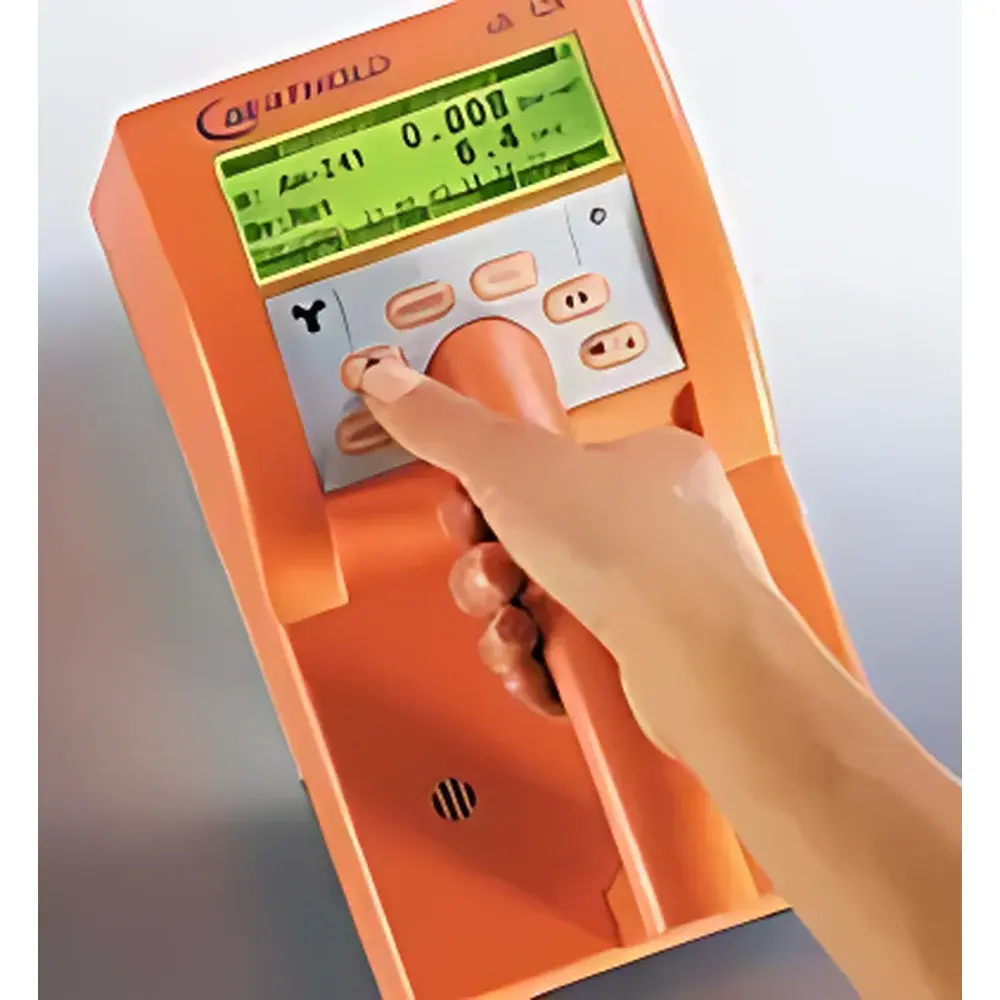
LB124 Portable Alpha/Beta Surface Contamination Monitor by Berthold
| Brand | Berthold |
|---|---|
| Origin | Germany |
| Model | LB124 |
| Instrument Type | Dose Rate / Contamination Meter |
| Detector | Large-Area ZnS(Ag) Scintillator |
| Sensitive Area | 171 cm² |
| Detection Efficiency | α: 22% (²⁴¹Am), β: 11% (¹⁴C), 49% (¹³⁷Cs) |
| Background | α: 0.1 cps, β: 10 cps |
| Display Units | cps and Bq/cm² |
| Calibration Factors | Pre-loaded for >50 radionuclides |
| Weight | 1.3 kg (including batteries) |
| Operating Modes | Simple / Standard / Professional |
| Compliance | Designed for ISO 7503-1, IEC 60846-2, and ANSI N42.17B |
Overview
The LB124 Portable Alpha/Beta Surface Contamination Monitor is an engineered solution for quantitative assessment of removable radioactive contamination on surfaces in nuclear facilities, radiopharmaceutical laboratories, decommissioning sites, and waste management operations. Based on scintillation detection principles, the instrument utilizes a large-area zinc sulfide doped with silver (ZnS(Ag)) detector — a well-established technology optimized for high-efficiency alpha particle detection and robust beta sensitivity across a broad energy range (≥150 keV for β⁻). Its geometry-corrected reflector design ensures uniform angular response over the full 171 cm² active area, minimizing edge effects and supporting reproducible measurements per ISO 7503-1 (Radiation protection — Measurement of surface contamination — Part 1: Techniques for measurement of surface contamination). The device operates as a calibrated dose rate and activity density meter, delivering real-time readings in counts per second (cps) and derived surface activity concentration (Bq/cm²), traceable to national standards via factory-applied nuclide-specific calibration factors.
Key Features
- Human-centered ergonomic housing enabling stable one-handed operation during extended field surveys or glove-box inspections.
- Backlit high-contrast LCD display with dual-unit readout (cps and Bq/cm²), configurable for ambient lighting conditions including low-light or shielded environments.
- Three-tier operational firmware architecture: Simple mode for rapid pass/fail screening; Standard mode for routine survey logging; Professional mode supporting manual nuclide selection, background subtraction, and time-resolved count accumulation.
- Pre-calibrated response factors for over 50 radionuclides—including ²⁴¹Am, ¹⁴C, ¹³⁷Cs, ⁹⁰Sr/⁹⁰Y, ³H (via indirect beta correlation), and common medical isotopes—enabling direct conversion from measured count rate to regulatory-relevant activity density without external calculation.
- Ruggedized IP54-rated enclosure compliant with industrial handling requirements; battery-powered (rechargeable Li-ion) for continuous operation up to 12 hours under typical survey duty cycles.
Sample Compatibility & Compliance
The LB124 is designed for non-destructive, in-situ measurement of fixed and removable alpha/beta emitters on planar or gently curved surfaces—including stainless steel, concrete, plastic, glass, and painted substrates. It meets the performance criteria specified in IEC 60846-2 (Radiation protection instrumentation — Ambient and/or directional dose equivalent (rate) meters and/or monitors for beta, X and gamma radiation) and aligns with ANSI N42.17B (Performance Criteria for Hand-Held Instruments for the Detection and Identification of Radionuclides). Its calibration methodology supports compliance with nuclear regulatory frameworks requiring documented metrological traceability, including EURATOM Basic Safety Standards Directive 2013/59 and U.S. NRC Regulatory Guide 4.15. The instrument is routinely deployed in GLP-aligned environments where audit-ready records of contamination status are required prior to equipment release or facility transition.
Software & Data Management
Data export is supported via USB interface to Berthold’s proprietary LB-Soft suite, which enables post-processing of measurement logs, generation of contamination maps, and automated report drafting compliant with ISO/IEC 17025 documentation requirements. All measurement sessions include embedded metadata: timestamp, operator ID, location tag (manually entered), selected nuclide, background reference value, and mode configuration. Audit trails preserve parameter changes and calibration history in accordance with FDA 21 CFR Part 11 principles for electronic records and signatures. No cloud connectivity is implemented—data remains under local control to meet ITAR and nuclear security policy constraints.
Applications
- Routine contamination monitoring of workbenches, tools, PPE, and floor surfaces in nuclear medicine departments and radiopharmacy production suites.
- Final status verification during decommissioning projects per IAEA RS-G-1.7 guidelines, including characterization of legacy contamination in reactor auxiliary buildings.
- Waste drum assay and segregation support in low- and intermediate-level waste processing facilities.
- Emergency response screening following suspected spill events or transport incidents involving unsealed sources.
- Periodic QA/QC checks of decontamination efficacy following chemical or mechanical cleaning procedures.
FAQ
What is the minimum detectable activity (MDA) for ²⁴¹Am using the LB124?
The MDA depends on counting time, background stability, and surface geometry. Under standard 10-second measurement with typical background (0.1 cps α), the instrument achieves an MDA of approximately 0.04 Bq/cm² for ²⁴¹Am at 95% confidence (Currie equation).
Can the LB124 distinguish between alpha and beta emissions in mixed fields?
No. It employs pulse-height insensitive ZnS(Ag) detection and relies on physical filtering (e.g., removable Mylar shield) and nuclide-specific calibration to infer contribution. Spectral separation requires alpha/beta discriminating detectors such as phoswich or pulse-shape analysis systems.
Is the LB124 suitable for measuring tritium (³H) surface contamination?
Tritium beta particles fall below the practical detection threshold of ZnS(Ag) due to low energy (Emax = 18.6 keV). The LB124 is not recommended for ³H; liquid scintillation counting or specialized gas-proportional detectors are required.
How often does the instrument require recalibration?
Annual calibration is recommended per ISO/IEC 17025 and manufacturer guidance. Field verification with check sources (e.g., ²⁴¹Am disc) should be performed before each shift or survey campaign.
Does the LB124 comply with EU RoHS and REACH directives?
Yes. All materials and manufacturing processes conform to Directive 2011/65/EU (RoHS2) and Regulation (EC) No 1907/2006 (REACH), with full declaration of SVHC substances available upon request.
Related Products







