
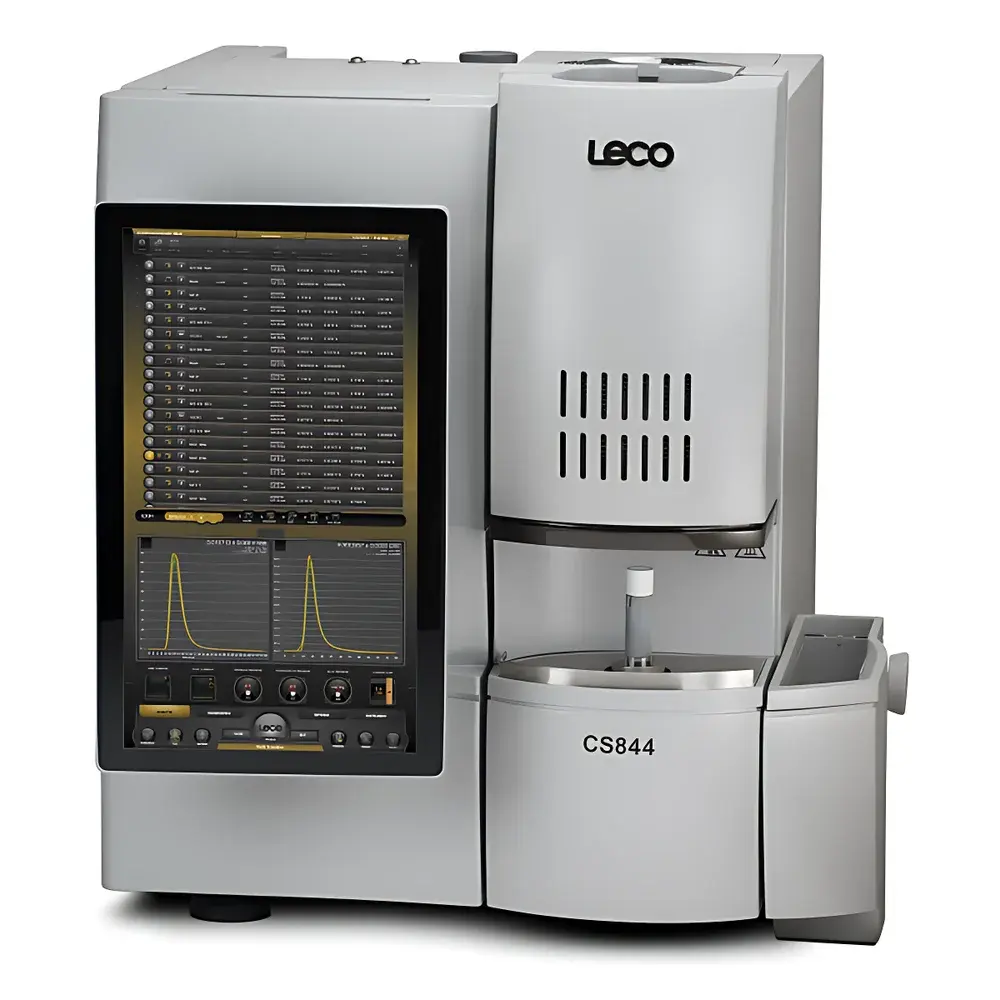
LECO CS844 Carbon and Sulfur Analyzer
| Brand | LECO |
|---|---|
| Origin | USA |
| Manufacturer Type | Original Equipment Manufacturer (OEM) |
| Product Category | Imported Instrument |
| Model | CS844 |
| Measurement Principle | Infrared Absorption |
| Heating System | High-Frequency Induction Furnace |
| Carbon/Sulfur Range | 0.6 ppm – 6 wt% |
| Analysis Time | < 50 seconds |
Overview
The LECO CS844 Carbon and Sulfur Analyzer is a high-precision, combustion-based elemental analyzer engineered for quantitative determination of total carbon and total sulfur in ferrous and non-ferrous metals, ores, alloys, ceramics, and other inorganic solid materials. Utilizing high-frequency induction combustion followed by dual-channel infrared absorption detection, the CS844 delivers trace-level sensitivity and macro-range accuracy in a single analytical cycle. The instrument operates on the principle that sample combustion in an oxygen-rich atmosphere quantitatively converts carbon to CO₂ and sulfur to SO₂; these gases are then swept through temperature-stabilized, multi-pass infrared cells where absorbance at characteristic wavelengths (4.26 µm for CO₂, 7.35 µm for SO₂) is measured against calibrated reference signals. This methodology conforms to widely accepted standards including ASTM E1019, ISO 15350, and JIS G 1211, ensuring regulatory acceptability in metallurgical QA/QC, foundry process control, and third-party certification laboratories.
Key Features
- Six-axis adjustable, industrial-grade capacitive touchscreen interface with glove-compatible operation and anti-glare coating for consistent visibility under laboratory lighting conditions.
- Tool-free, fully automated dual-brush furnace head cleaning system reduces scheduled maintenance downtime by up to 70% versus prior-generation models.
- Thermally isolated, dual-range infrared detection cells featuring constant-temperature oven control (±0.1 °C), long-life IR emitters, and drift-compensated analog-to-digital circuitry—enabling stable baseline performance over extended operational periods.
- High-efficiency solid-state high-frequency induction furnace (2.5 MHz) with programmable power ramping, integrated combustion tube auto-loading/unloading, and optional pre-heated dust filtration to enhance sulfur recovery and minimize matrix interference.
- Integrated high-speed vacuum particulate extraction system evacuates ash and combustion residue directly to an external cyclonic collector—eliminating internal filter clogging and preventing cross-contamination between runs.
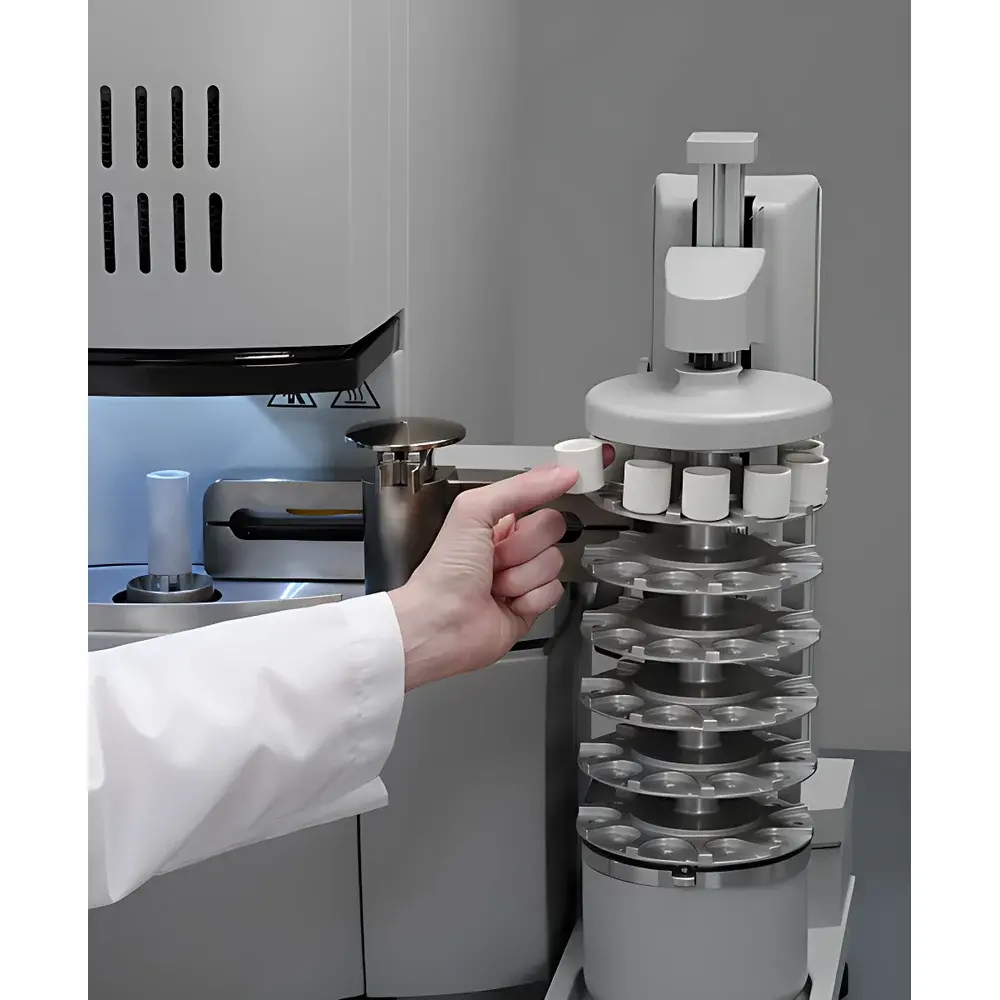
- Modular automation support: configurable 10-position or 60-position autosamplers with gravimetric integration capability; optional remote diagnostics via secure TLS-encrypted connection for predictive service alerts and firmware updates.
Sample Compatibility & Compliance
The CS844 accommodates solid samples ranging from 0.1 g to 1.0 g (standard), including cast iron, stainless steel, titanium alloys, slag, limestone, graphite electrodes, and refractory ceramics. Sample cup types include ceramic, graphite, and metal crucibles—each selected based on matrix reactivity and required combustion temperature. All hardware and software components comply with IEC 61000-6-3 (EMC), UL 61010-1 (safety), and RoHS 2011/65/EU directives. Data integrity features—including electronic signatures, audit trails, and user-access tiering—support compliance with FDA 21 CFR Part 11, ISO/IEC 17025:2017, and GLP/GMP documentation requirements when configured with Cornerstone™ software’s full validation package.
Software & Data Management
Cornerstone™ Software v5.x serves as the unified control, calibration, and reporting platform for the CS844. Its modular architecture separates functions into four navigable workspaces: Analyze, Diagnose, Configure, and Instrument. Real-time environmental monitoring (ambient temperature, pressure, humidity) is embedded within the combustion simulation dashboard, enabling automatic compensation for gas density variations. Batch grouping logic allows users to assign replicate analyses, reference materials, and blanks within a single sequence—automatically calculating mean values, standard deviations (RSD%), and confidence intervals per ASTM E29. Reporting supports export to CSV, XML, PDF/A-1a, and LIMS-compatible ASTM E1382 formats. Full digital troubleshooting guides—including animated maintenance walkthroughs, annotated component schematics, and error-code lookup—are accessible without external documentation.
Applications
The CS844 is routinely deployed in primary metal production (e.g., blast furnace hot metal monitoring), secondary refining (EAF/LF slag analysis), quality assurance of finished products (ASTM A751 tensile bar certification), and geological survey labs performing whole-rock geochemical profiling. Its low detection limits (0.6 ppm C/S) and wide dynamic range (0.6 ppm–6 wt%) make it suitable for both ultra-low-carbon steels (4 wt% S). The instrument also supports method development for emerging applications such as additive manufacturing powder feedstock qualification and spent catalyst characterization in petrochemical refining.
FAQ
What combustion atmosphere is used during analysis?
High-purity oxygen (≥99.995%) delivered at regulated pressure (0.2–0.4 MPa); optional helium dilution available for reactive matrices.
Is the CS844 compatible with existing LECO calibration standards?
Yes—supports all legacy LECO Certified Reference Materials (CRMs) traceable to NIST SRMs, including IRMM, BAM, and BCS series.
Can Cornerstone software be validated for regulated environments?
Yes—comprehensive IQ/OQ/PQ protocols, change control logs, and electronic signature workflows are included in the GxP Validation Package (optional license).
What maintenance intervals are recommended for the infrared cells?
No routine optical cleaning required; cell lifetime exceeds 10 years under normal operating conditions due to hermetic sealing and thermal stabilization.
Does the CS844 require external cooling water or compressed air?
No—fully air-cooled design with passive heat dissipation; only electrical supply (230 V ±10%, 50/60 Hz, 30 A) and oxygen gas are required.




