
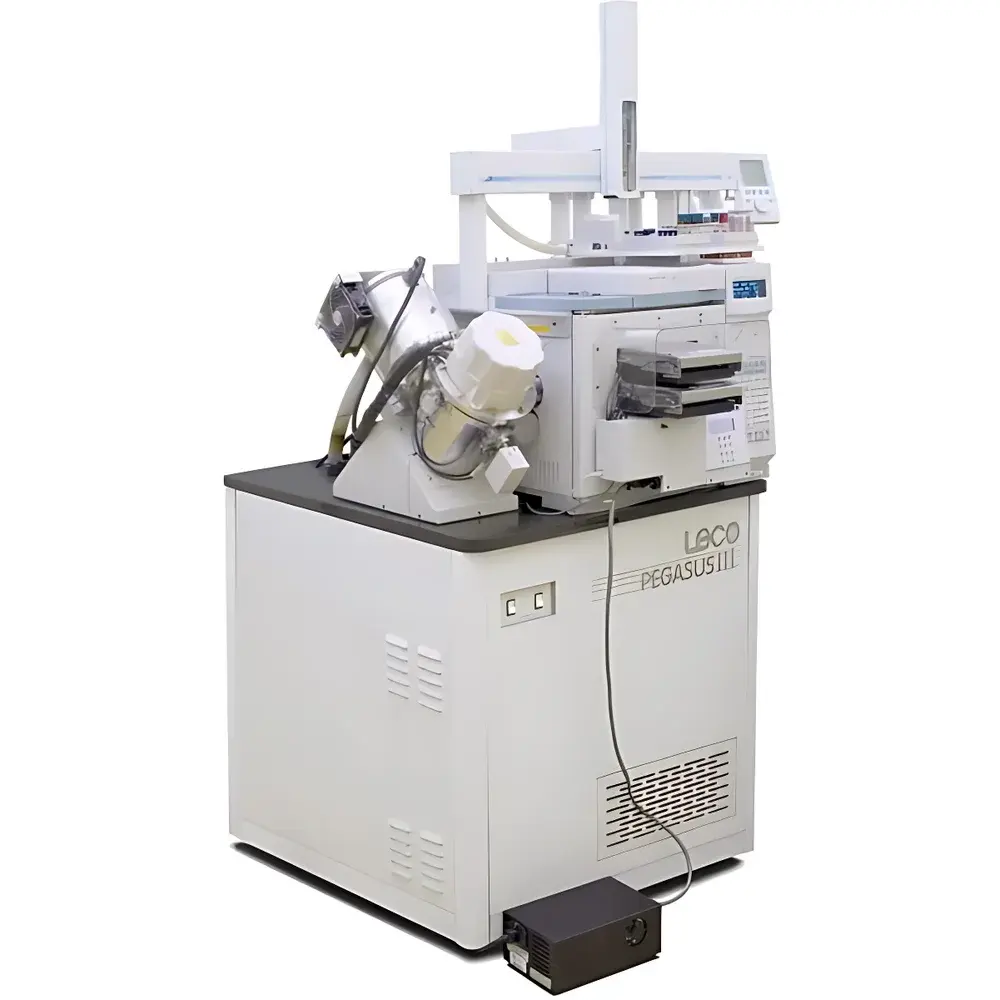
LECO Pegasus GC×GC-TOFMS
| Brand | LECO |
|---|---|
| Origin | USA |
| Manufacturer Type | Manufacturer |
| Origin Category | Imported |
| Model | Pegasus |
| Instrument Type | Time-of-Flight Mass Spectrometer (TOFMS) |
| Autosampler | CTC LEAP CombiPAL (Auto Headspace / Liquid / SPME) |
| Oven Temperature Control | LTM A68 with Range 0–400 °C and Ramp Rate ±1800 °C/min |
| Data Acquisition Speed | Up to 500 full-spectrum scans per second |
| Software | ChromaTOF v5.x or later |
| Regulatory Compliance | Designed for GLP/GMP environments |
Overview
The LECO Pegasus GC×GC-TOFMS is a high-speed comprehensive two-dimensional gas chromatography coupled with time-of-flight mass spectrometry system engineered for ultra-rapid, high-fidelity chemical characterization of complex volatile and semi-volatile mixtures. Unlike conventional quadrupole or triple-quadrupole GC-MS platforms operating in selected ion monitoring (SIM) or tandem MS (MS/MS) modes, the Pegasus acquires full-mass spectral data at up to 500 spectra per second across a mass range of m/z 1–1000, enabling true untargeted analysis without prior knowledge of analytes. Its core architecture integrates cryogen-free modulated GC×GC separation—providing enhanced peak capacity and orthogonality—with a high-dynamic-range TOF mass analyzer delivering sub-microsecond transient response, isotopic fidelity, and mass accuracy better than 5 ppm RMS. This combination allows complete chromatographic resolution of co-eluting compounds separated by as little as 0.01 seconds in retention time—critical for applications involving petrochemicals, botanical volatiles, food aromas, environmental contaminants, and forensic toxicology.
Key Features
- Ultra-fast GC×GC separation with LTM A68 oven module: temperature programmable from 0 °C to 400 °C, with heating/cooling rates up to ±1800 °C/min—enabling sub-minute total run times while maintaining thermal stability and reproducibility.
- High-speed TOF mass detection: real-time acquisition of full-spectrum data at 500 Hz, preserving peak shape integrity even under ultrafast chromatographic conditions (e.g., EPA Method 8260B completed in ≤2 min with re-injection within 5 min).
- Electron Ionization (EI) source with extended lifetime and no routine cleaning requirement—designed for continuous operation over multi-day sequences with minimal maintenance intervention.
- True Signal Deconvolution™ algorithm: automatically resolves overlapping peaks in both chromatographic and mass dimensions, extracting clean, library-matchable spectra from co-eluting components with retention time differences as low as 10 ms.
- Automated Peak Find functionality: detects all chromatographic features—including sub-baseline signals—based on user-defined signal-to-noise thresholds and retention index windows.
- Matrix Management workflow: enables high-throughput non-targeted screening in samples with extreme dynamic range (e.g., trace contaminants in highly concentrated matrices), supporting differential abundance analysis across sample cohorts.
Sample Compatibility & Compliance
The Pegasus GC×GC-TOFMS accommodates diverse sampling interfaces including liquid injection, headspace analysis, solid-phase microextraction (SPME), and thermal desorption—fully automated via the CTC LEAP CombiPAL platform. It is routinely deployed in regulated laboratories performing analyses aligned with ASTM D7213 (petroleum hydrocarbons), USP (method validation), and EPA Methods 8260B, 8270E, and 1613. System validation documentation supports IQ/OQ/PQ protocols, and ChromaTOF software includes configurable audit trails, electronic signatures, and user-access controls compliant with FDA 21 CFR Part 11 and EU Annex 11 requirements. All hardware modules meet CE, UL, and CSA safety standards for laboratory instrumentation.
Software & Data Management
ChromaTOF software provides end-to-end control of the GC, modulator, TOFMS, and autosampler—integrated natively with Agilent 6890N GC and 7683 autosamplers or third-party CTC CombiPAL systems. It supports batch processing of >100,000 resolved peaks per dataset, with fully customizable report templates exportable to Excel, CSV, mzML, and ANDI-NetCDF formats. Peak tables are copy-paste ready into spreadsheet applications. The software implements automated calibration verification, blank subtraction, internal standard tracking, retention index alignment, and MS tuning diagnostics—all logged with timestamped metadata for full traceability. Raw data files are stored in vendor-neutral HDF5 format to ensure long-term archival integrity.
Applications
This platform is validated for comprehensive compositional profiling across multiple domains: petroleum fingerprinting and biomarker analysis; metabolomic profiling of plant essential oils and tobacco volatiles; authenticity testing of wines and spirits; impurity identification in pharmaceutical intermediates; residual solvent quantitation per ICH Q3C guidelines; and screening of semi-volatile organic compounds (SVOCs) in indoor air, soil, and water matrices. Its ability to deliver both qualitative identification and semi-quantitative abundance data—without method development for each compound—makes it especially valuable in exploratory research, forensic casework, and quality-by-design (QbD) initiatives where unknown component characterization is essential.
FAQ
What distinguishes the Pegasus GC×GC-TOFMS from conventional GC-MS systems?
It combines comprehensive two-dimensional separation with full-spectrum, high-speed TOF detection—delivering untargeted analysis capability, superior peak capacity (>10,000 peaks per run), and quantitative reproducibility across wide concentration ranges.
Is the system compatible with existing Agilent GC hardware?
Yes—ChromaTOF natively controls Agilent 6890N GCs and 7683 autosamplers; optional interface modules support integration with newer Agilent Intuvo or 8890 platforms.
Does ChromaTOF support compliance with FDA 21 CFR Part 11?
Yes—the software includes role-based access control, electronic signatures, and immutable audit trails for all acquisition, processing, and reporting actions.
Can the system perform quantitative analysis without external standards?
While absolute quantification requires calibration standards, ChromaTOF enables robust relative quantification (e.g., fold-change analysis) and semi-quantitative screening using response factor libraries and internal standard normalization.
What maintenance intervals are recommended for the EI source?
The EI source is designed for >6 months of continuous operation without cleaning under typical environmental or food matrix loads; source replacement is typically required only after 12–18 months of heavy use.
Related Products







