
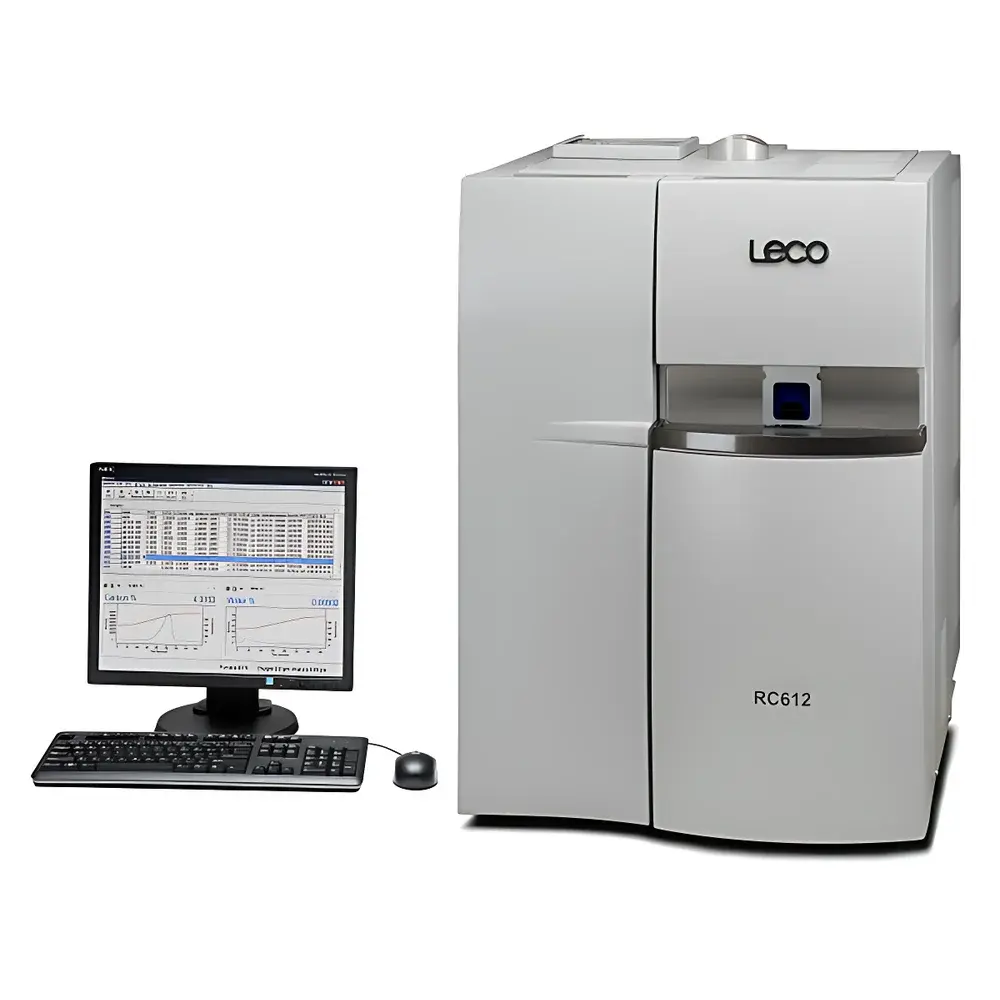
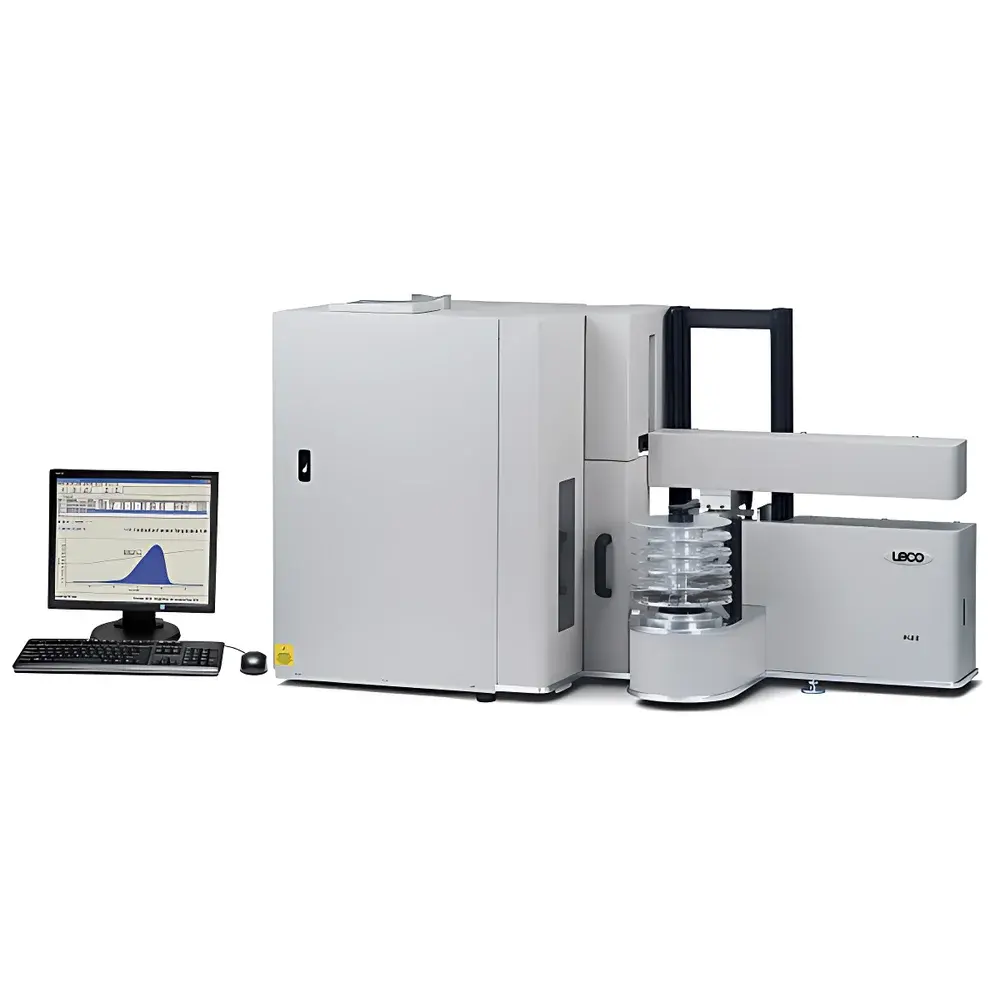
LECO RC-612 Multi-Phase Carbon and Moisture Analyzer
| Brand | LECO |
|---|---|
| Origin | USA |
| Manufacturer | LECO Corporation |
| Type | Imported Instrument |
| Model | RC-612 |
| Heating Method | Infrared |
| Compliance | AWS A4.3 / ANSI/AWS A4.3, ASTM E1019 (carbon), ASTM E203 (moisture), ISO 11722, ISO 11723 |
| Optional Accessories | 50-position Autosampler, SmartLine® Remote Diagnostics, Analytical Balance Integration |
Overview
The LECO RC-612 Multi-Phase Carbon and Moisture Analyzer is a dual-detection combustion-based analytical system engineered for simultaneous quantitative determination of total carbon (TC), elemental carbon forms (e.g., surface carbon, free carbon, organic carbon, inorganic carbon), and moisture content in solid heterogeneous materials. Unlike conventional infrared moisture analyzers that rely solely on thermal gravimetric principles, the RC-612 integrates high-temperature combustion (up to 1350 °C) with infrared detection (NDIR) and electrochemical cell technologies to resolve carbon speciation while concurrently quantifying water via loss-on-drying (LOD) under controlled inert and oxidative atmospheres. Its core architecture follows ASTM E1019 for total carbon analysis and ASTM E203 for Karl Fischer–compatible moisture validation—making it uniquely qualified for applications where carbon phase distribution directly impacts material performance, such as in welding consumables, metallurgical powders, catalysts, battery electrode materials, and geological samples.
Key Features
- Integrated dual-channel detection: NDIR cells for CO₂ (carbon quantification) and H₂O (moisture) coupled with precision thermogravimetric monitoring
- Large-diameter quartz combustion tube (Ø 25 mm × 300 mm) enabling robust handling of diverse sample geometries—including powders, rods, tubes, and irregularly shaped solids—without pre-grinding or pelletization
- Modular furnace design with segmented temperature zoning (preheat, combustion, post-combustion) to optimize thermal decomposition profiles for carbon phase differentiation
- Embedded diagnostic firmware supporting real-time fault logging, sensor calibration tracking, and predictive maintenance alerts—reducing mean time to repair (MTTR)
- Quick-release tube end block assembly fabricated from high-purity alumina ceramic, allowing tool-free combustion tube replacement in under 90 seconds
- Compliance-ready software architecture supporting 21 CFR Part 11 audit trails, electronic signatures, and GLP/GMP-aligned data integrity protocols
Sample Compatibility & Compliance
The RC-612 accommodates sample masses ranging from 0.01 g to 2.0 g across matrices including ferrous and non-ferrous metals, refractory oxides, carbon composites, polymers, ceramics, and mineral concentrates. It meets the mandatory moisture testing requirements defined in AWS A4.3 (Standard Method for Determining Diffusible Hydrogen in Weld Metal), ensuring trace-level water quantification (<10 ppm) in coated electrodes and flux-cored wires. For carbon analysis, it adheres to ISO 11722 (determination of total carbon in iron and steel) and ISO 11723 (carbon in titanium alloys), with method validation documentation available per ISO/IEC 17025. All combustion gas pathways are constructed from electropolished stainless steel and passivated quartz to prevent catalytic memory effects or cross-contamination between organic/inorganic carbon fractions.
Software & Data Management
Operating on Windows-based Thermo-Calc™ software, the RC-612 provides configurable method templates for sequential or parallel carbon/moisture analysis, with user-defined ramp rates, hold times, and atmosphere switching logic (He/N₂/O₂). Data output includes full chromatographic peak integration, mass loss derivatives (DTG), cumulative %H₂O and %C curves, and speciated carbon reports (surface C, organic C, carbonate C, carbide C). Raw data files are stored in vendor-neutral .csv and .xml formats; metadata fields include operator ID, instrument serial number, calibration certificate IDs, and environmental sensor logs (temperature/humidity). SmartLine® remote diagnostics enable secure, encrypted technician access for firmware updates and spectral baseline verification—fully compliant with ITAR-controlled export regulations.
Applications
- Quality control of welding electrodes and filler metals per AWS A4.3 moisture specifications
- Carbon speciation in lithium-ion battery anode materials (graphitic vs. amorphous carbon quantification)
- Moisture and residual carbon profiling in sintered metal injection molding (MIM) feedstocks
- Decomposition behavior analysis of calcium carbonate, dolomite, and hydrated silicates in cementitious systems
- Trace water detection in high-purity graphite crucibles used in semiconductor crystal growth
- Research into carbon sequestration mechanisms in biochar and activated carbon sorbents
FAQ
Does the RC-612 require carrier gas cylinders?
Yes—it operates with ultra-high-purity helium (99.999%) as the primary carrier gas and oxygen (99.995%) for combustion enhancement. Optional gas generator integration is supported.
Can the instrument distinguish between adsorbed water and structural hydroxyl groups?
Yes—through programmed temperature ramping combined with derivative thermogravimetric analysis (DTG), enabling deconvolution of physisorbed H₂O (≤150 °C), interlayer water (150–400 °C), and dehydroxylation events (>400 °C).
Is method validation support provided for regulatory submissions?
LECO supplies IQ/OQ/PQ protocol templates, system suitability test procedures, and raw data audit packages aligned with FDA, EMA, and PMDA expectations for analytical instrument qualification.
What maintenance intervals are recommended for routine operation?
Quartz tube inspection every 200 runs; NDIR cell zero calibration weekly; combustion catalyst replacement every 1,000 analyses or per manufacturer’s sulfur tolerance assessment.
How does the RC-612 handle halogen-containing samples?
A dedicated halogen scrubber module (optional) removes Cl/F/Br compounds upstream of the detectors to prevent corrosion and signal drift—validated per ASTM D7359 for halogen interference mitigation.
Related Products




