
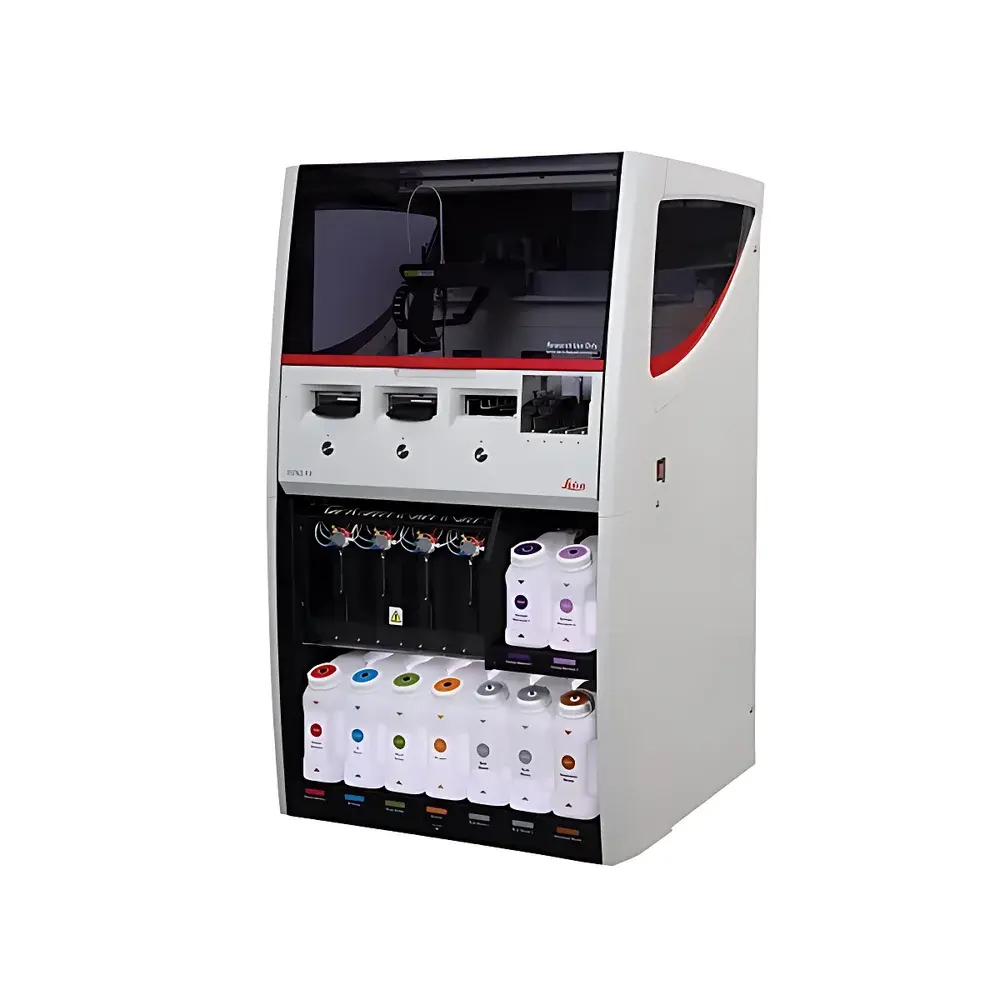
Leica BOND RX Fully Automated IHC and ISH Staining System
| Brand | Leica |
|---|---|
| Origin | Australia |
| Manufacturer Type | Authorized Distributor |
| Origin Category | Imported |
| Model | BOND RX |
| Price Range | USD 260,000 – 390,000 (approx.) |
| Automation Level | Fully Automated |
| Technology Versatility | Supports Multiple Assay Types |
| Staining Method | Reagent Dispensing (Drop-Dispense) |
| Max Slides per Run | 30 |
| Max Reagent Cartridges | 36 |
| Dimensions (W × D × H) | 790 × 1378 × 806 mm |
| Application Scope | Immunohistochemistry (IHC), Fluorescence In Situ Hybridization (FISH), Chromogenic In Situ Hybridization (CISH), RNA In Situ Hybridization (ISH), Locked Nucleic Acid (LNA)-based ISH, Tyramide Signal Amplification (TSA), Hematoxylin & Eosin (H&E), Immunofluorescence (IF), Circulating Tumor Cell (CTC) staining |
Overview
The Leica BOND RX is a fully automated, high-throughput stainer engineered for precision, reproducibility, and regulatory compliance in diagnostic pathology and translational research laboratories. It employs a proprietary drop-dispense reagent delivery system—distinct from traditional immersion or flow-through architectures—to minimize tissue stress, preserve antigenicity, and ensure uniform reagent coverage across heterogeneous tissue sections. The platform integrates tightly with Leica’s Novocastra portfolio of validated primary antibodies, detection kits, and nucleic acid probes, enabling standardized execution of immunohistochemistry (IHC), in situ hybridization (ISH), fluorescence in situ hybridization (FISH), chromogenic ISH (CISH), LNA-enhanced ISH, tyramide signal amplification (TSA), immunofluorescence (IF), and routine H&E staining—all within a single instrument. Its modular architecture supports GLP- and CAP-compliant workflows, with built-in audit trails, user access controls, and electronic record integrity aligned with FDA 21 CFR Part 11 requirements.
Key Features
- Fully automated operation with pre-programmed, vendor-validated protocols for >200 IHC and ISH assays—including USP/CLIA-relevant biomarkers such as ER, PR, HER2, PD-L1, ALK, and BRAV600E.
- BOND CoverSlip™ technology: Patented slide-covering mechanism that maintains consistent humidity and temperature during incubation, reducing edge effects, section detachment, and epitope degradation.
- Three independent slide racks (up to 30 slides total) enable concurrent processing of multiple protocols—e.g., parallel IHC and FISH runs—without cross-contamination or manual intervention.
- 36-position reagent carousel accommodates primary antibodies, polymer detection systems, chromogens, counterstains, probe cocktails, and amplification reagents; all stored at ambient or refrigerated conditions (4–8°C optional).
- 50% faster cycle time versus prior-generation BOND platforms, achieving full IHC staining in ≤3 hours and complex multi-step ISH protocols in <6 hours.
- Scalable network configuration: Up to five BOND RX units can be centrally managed via Leica Biosystems’ BOND Link software, enabling synchronized scheduling, remote monitoring, and consolidated QC reporting.
Sample Compatibility & Compliance
The BOND RX accepts standard 1–4 µm formalin-fixed paraffin-embedded (FFPE) tissue sections on charged or APES-coated glass slides. It supports both conventional dewaxing/rehydration and antigen retrieval methods—including heat-induced epitope retrieval (HIER) using EDTA, citrate, or Tris-EDTA buffers—and enzymatic retrieval (e.g., proteinase K) for RNA ISH. All protocols are developed and verified per ISO 15189 and CLSI EP23-A guidelines. The system meets CE-IVD marking requirements and is validated for use in laboratories accredited under CAP, COLA, and UK NEQAS standards. Full traceability is maintained through barcode-scanned slide tracking, reagent lot logging, and timestamped run records.
Software & Data Management
BOND Link v5.x provides intuitive, role-based workflow management with drag-and-drop protocol editing, real-time instrument status dashboards, and integrated quality control dashboards. Software features include electronic signature capture, automated calibration logs, version-controlled protocol libraries, and export of structured data (CSV, PDF, XML) compatible with LIS/HIS integration via HL7 or ASTM E1384 interfaces. Audit trail functionality records all user actions, parameter changes, and error events with immutable timestamps—supporting 21 CFR Part 11 compliance when deployed with appropriate IT infrastructure and SOPs.
Applications
The BOND RX serves as a core platform in academic pathology departments, clinical reference labs, biopharma biomarker development groups, and CROs performing companion diagnostic assay validation. It enables robust multiplexing strategies—e.g., sequential IHC/FISH on serial sections—and supports emerging applications including spatial transcriptomics sample prep, circulating tumor cell (CTC) enrichment and characterization, and digital pathology pipeline integration via whole-slide imaging compatibility. Its consistency in staining intensity, background suppression, and subcellular localization fidelity makes it suitable for quantitative image analysis (QIA) training and AI model benchmarking.
FAQ
Does the BOND RX support dual-epitope or sequential staining protocols?
Yes—its programmable incubation timing, precise reagent dispensing, and integrated wash modules allow for multi-step, multi-target assays including sequential IHC and ISH on the same slide.
Can third-party antibodies or probes be used on the BOND RX?
While Leica Novocastra reagents are fully validated and supported, the platform permits custom protocol development for third-party reagents; however, performance qualification and ongoing QC must be performed per laboratory SOPs.
Is remote diagnostics or service support available?
Leica Biosystems offers BOND Connect—a secure, encrypted remote connectivity option enabling proactive diagnostics, firmware updates, and technical support without on-site intervention.
What maintenance intervals are recommended?
Daily cleaning of fluidics and slide handling components is required; monthly calibration of dispensing accuracy and temperature sensors is advised; annual preventive maintenance by certified field service engineers ensures long-term reproducibility.
How does the BOND RX handle low-abundance RNA targets in ISH?
Through optimized probe hybridization kinetics, stringent post-hybridization stringency washes, and integrated TSA amplification modules—enabling detection sensitivity down to single-copy RNA molecules in FFPE tissue.





