
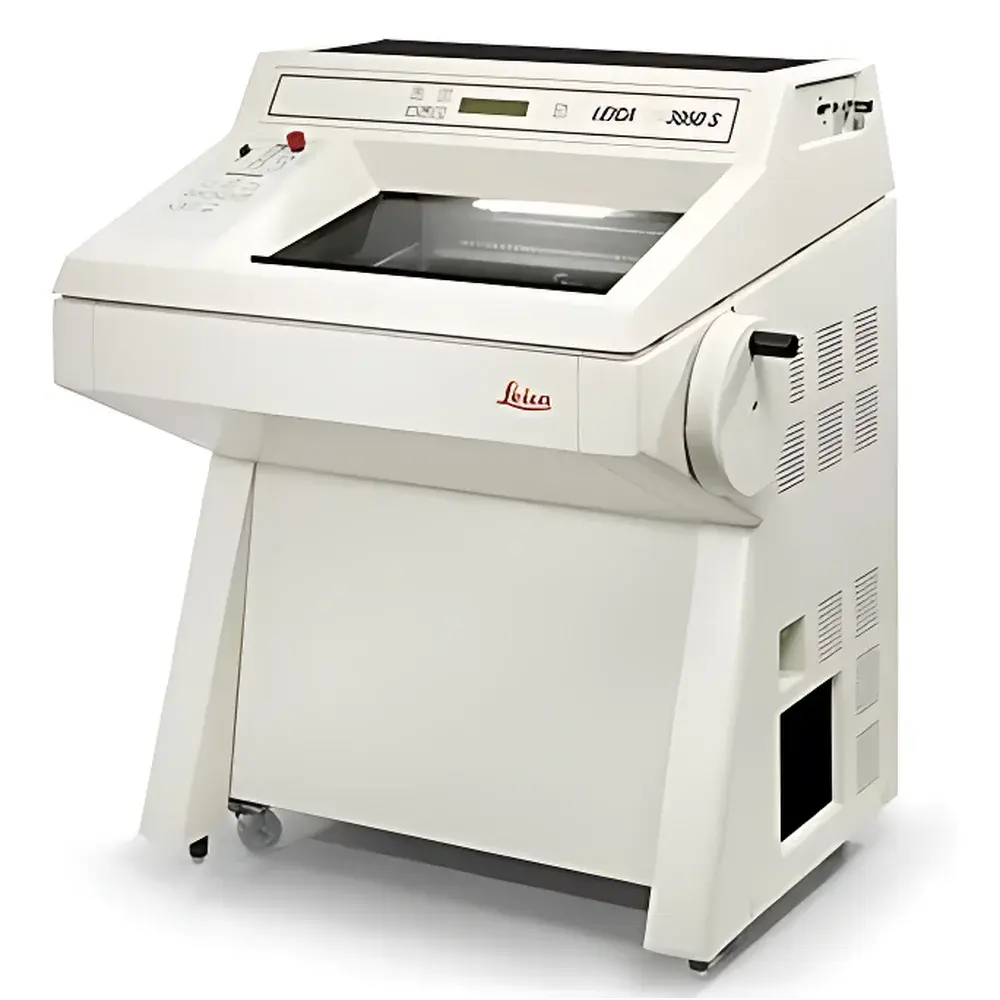
Leica CM3050 S Cryostat Microtome
| Brand | Leica |
|---|---|
| Origin | Germany |
| Model | CM3050 S |
| Cutting Temperature Range | –35 °C to –15 °C (adjustable) |
| Section Thickness Range | 0.5 µm to 100 µm |
Overview
The Leica CM3050 S Cryostat Microtome is a precision-engineered, research-grade cryostat system designed for reproducible, high-fidelity sectioning of fresh-frozen biological specimens under controlled low-temperature conditions. Operating on the principle of cryo-microtomy—where tissue samples are rapidly frozen and maintained at sub-zero temperatures (–35 °C to –15 °C) to preserve ultrastructural integrity—the CM3050 S enables consistent sectioning of delicate, lipid-rich, or hydration-sensitive tissues without antigen masking or morphological distortion. Its thermally stable chamber architecture, coupled with an integrated anti-static cooling system and precise thermal gradient control, minimizes ice crystal formation and ensures optimal sample hardness across heterogeneous tissue types. Developed specifically for neuroscience, oncology, pharmacology, and translational pathology laboratories, the instrument supports rigorous experimental workflows requiring histological fidelity at the subcellular level—including immunofluorescence, in situ hybridization (ISH), and laser capture microdissection (LCM)-compatible preparation.
Key Features
- Precision step motor-driven advancement mechanism delivering exceptional thickness reproducibility (±0.1 µm typical deviation over 100 consecutive sections) across the full 0.5–100 µm range.
- Motorized sectioning module (optional) enabling programmable, hands-free cutting cycles with synchronized blade advance and specimen retraction—reducing operator variability and fatigue during extended sessions.
- Fine-positioning sample holder with dual-axis micrometer adjustment (X/Y) and angular tilt compensation, allowing real-time alignment of anatomical landmarks—critical for serial section reconstruction in mouse brain mapping or human cortical layer analysis.
- Programmable countdown trimming mode: users define initial block face removal depth and step interval; the system executes rapid, uniform surface trimming prior to diagnostic sectioning—significantly accelerating workflow throughput.
- Dedicated retraction function with cumulative thickness counter and reset button, facilitating accurate tracking of total section volume removed—essential for quantitative stereology and volumetric tissue sampling protocols.
- Integrated safety interlocks compliant with EN 61000-1-2 (EMC immunity) and IEC 61000-6-2 (industrial environment emissions), including blade guard sensors, door position monitoring, and emergency stop circuitry aligned with ISO 13857 safety distance requirements.
Sample Compatibility & Compliance
The CM3050 S accommodates standard OCT-embedded specimens up to 30 mm × 40 mm × 25 mm (W × L × H), as well as specialized holders for rodent brains, spinal cords, and biopsy cores. It supports both disposable stainless-steel and reusable tungsten-carbide blades, with optional cryo-adhesive tapes for fragile sections. All operational parameters—including chamber temperature, knife angle, section speed, and anti-roll plate settings—are documented in audit-ready logs meeting GLP and GMP documentation standards. The system’s firmware architecture supports 21 CFR Part 11-compliant user access controls when paired with Leica’s LAS X software suite, enabling electronic signatures, change history tracking, and role-based permissions for regulated environments.
Software & Data Management
While the CM3050 S operates as a standalone hardware platform, its motorized functions integrate seamlessly with Leica’s LAS X Core software via USB or Ethernet interface. This integration enables remote parameter configuration, protocol storage (e.g., “Mouse Hippocampus – 12 µm IF-ready”), and export of timestamped session metadata—including ambient/coolant temperatures, section count, and motor load diagnostics—to CSV or LIF formats. Audit trails are retained for ≥12 months by default and support automated backup to network-attached storage (NAS) or LIMS endpoints. Optional firmware updates maintain compatibility with evolving ISO/IEC 17025 calibration reporting frameworks.
Applications
- High-resolution neuroanatomical mapping requiring serial 5–10 µm sections from perfusion-fixed, flash-frozen murine or primate brains.
- Pharmaceutical preclinical studies involving time-course analysis of drug distribution in frozen tumor xenografts using MALDI imaging mass spectrometry.
- Clinical research biobanking where rapid freezing and sectioning preserve RNA integrity for downstream spatial transcriptomics (e.g., 10x Visium).
- Quality control of cell therapy products, including cryosectioning of 3D organoids for viability and differentiation marker assessment.
- Teaching laboratories performing comparative histopathology with standardized sectioning protocols across multiple user cohorts.
FAQ
What is the minimum achievable section thickness, and how is consistency ensured?
The CM3050 S achieves nominal thicknesses down to 0.5 µm using its closed-loop step motor and hardened specimen advance mechanism. Consistency is maintained via real-time thermal stabilization of the chuck assembly and automatic compensation for blade wear-induced drift.
Is the system compatible with third-party staining platforms?
Yes—standardized slide dimensions (76 × 26 mm) and flat-bottomed cassette interfaces ensure interoperability with automated stainers from Ventana, Dako, and Leica Biosystems.
Can the instrument be validated for ISO 13485 medical device manufacturing environments?
When deployed with documented IQ/OQ protocols and integrated into a validated software environment (e.g., LAS X with Part 11 extension), the CM3050 S meets key metrological and traceability requirements for Class IIa/III device histology support.
Does the system support nitrogen-cooled operation?
No—the CM3050 S relies exclusively on compressor-based refrigeration with redundant condensate management; it is not configured for liquid nitrogen or LN₂-assisted cooling.
What maintenance intervals are recommended for optimal performance?
Daily chamber defrosting, weekly blade alignment verification, and quarterly calibration of the temperature sensor and thickness encoder are specified in the service manual (Ref. CM3050-S-MAN-EN Rev. 4.2).
Related Products



