
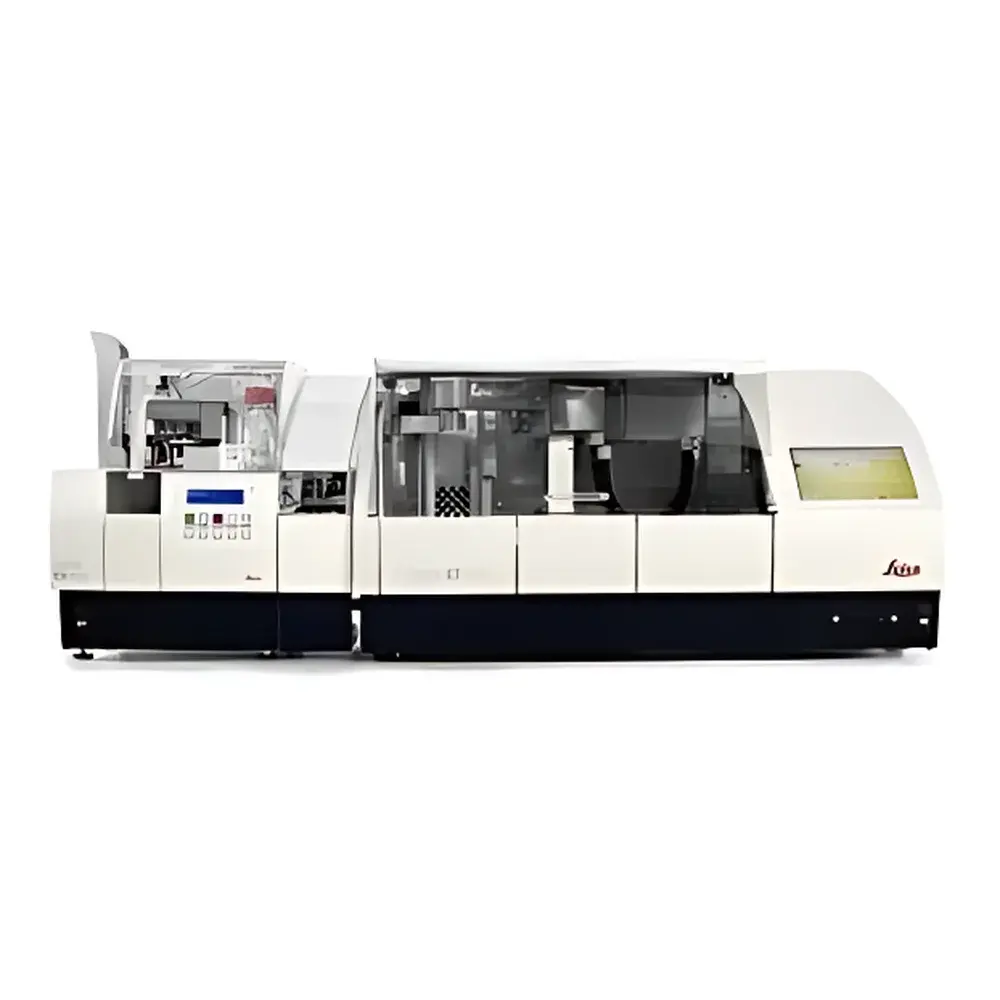
Leica CV5030 Automated Coverslipper
| Brand | Leica |
|---|---|
| Origin | Germany |
| Model | CV5030 |
| Automation Level | Fully Automatic |
| Instrument Type | Rotary |
| Compatibility | Designed for integration with Leica ST5020 Stainer and Leica TS5025 Transport Station |
| Loading Capacity | 3 microscope slide racks |
| Enclosure | Transparent viewing lid |
Overview
The Leica CV5030 Automated Coverslipper is a precision-engineered rotary coverslipping system designed for high-throughput histopathology laboratories requiring reproducible, contamination-minimized mounting of glass coverslips onto stained tissue sections. Operating on a robust carousel-based architecture, the CV5030 executes automated adhesive application (typically resin-based or aqueous mounting media), precise coverslip placement, and controlled pressure application—eliminating manual handling variability and reducing operator exposure to hazardous solvents. As the final module in Leica’s integrated staining-to-mounting workflow, it interfaces seamlessly with the Leica ST5020 Multifunctional Stainer and Leica TS5025 Transport Station, enabling end-to-end unattended processing from dewaxing through hematoxylin–eosin (H&E) or special stain protocols to final coverslipping. This integration supports GLP-compliant documentation trails when paired with Leica Application Suite (LAS) software and satisfies core operational requirements for ISO 15189-accredited pathology labs.
Key Features
- Fully automatic rotary operation with synchronized carousel indexing for consistent cycle timing and minimal mechanical wear.
- Integrated transport interface compliant with Leica TS5025 bidirectional communication protocol—enables real-time status feedback and error-handling coordination across the staining–transport–coverslipping chain.
- Three-rack loading capacity (standard 25-slide racks), supporting batch processing without mid-run intervention and improving instrument utilization during peak throughput periods.
- Optically transparent polycarbonate enclosure allowing continuous visual verification of coverslip alignment, adhesive dispensing, and rack movement—critical for troubleshooting and adherence to internal QA checklists.
- Programmable mounting media dispensing parameters (volume, dwell time, nozzle height) calibrated per media viscosity class, supporting both xylene-based resins (e.g., DPX, Permount) and water-soluble alternatives (e.g., Glycergel, AquaMount).
- Self-diagnostics and maintenance alerts logged via embedded firmware, including adhesive reservoir level monitoring, vacuum line integrity checks, and stepper motor position validation.
Sample Compatibility & Compliance
The CV5030 accommodates standard 1″ × 3″ (25 × 75 mm) glass microscope slides with thicknesses ranging from 0.9 to 1.2 mm, including frosted-end, barcoded, and pre-etched variants. It maintains compatibility with common histological mounting media certified for long-term archival stability under ASTM E2014 and ISO 10993-5 biocompatibility guidelines. The system conforms to IEC 61000-6-2 (immunity) and IEC 61000-6-3 (emissions) electromagnetic compatibility standards. When operated within Leica’s validated ecosystem—including ST5020, TS5025, and LAS software—the full workflow meets traceability requirements aligned with FDA 21 CFR Part 11 for electronic records and signatures, supporting audit readiness for CAP inspections and CLIA-certified laboratory operations.
Software & Data Management
Controlled exclusively through Leica Application Suite (LAS) v4.13 or later, the CV5030 supports method-driven operation with user-defined protocols stored in encrypted project files. Each run generates a timestamped audit log containing rack ID, start/stop times, media lot number (manually entered or barcode-scanned), environmental sensor readings (ambient temperature/humidity), and any system warnings. Logs export in CSV or PDF format for integration into LIMS platforms via HL7 or ASTM E1384 interfaces. Optional LAS Connect enables remote monitoring, predictive maintenance scheduling, and firmware update deployment—all without compromising network segmentation requirements for HIPAA- or GDPR-sensitive environments.
Applications
- Routine H&E and special stain mounting in diagnostic surgical pathology workflows.
- High-volume immunohistochemistry (IHC) slide processing where consistent coverslip adhesion prevents antigen retrieval artifacts during downstream analysis.
- Research histology requiring archival-grade mounting for digital pathology scanning (e.g., Aperio AT2, Zeiss Mirax) and long-term storage at −20 °C.
- Cytology preparations (e.g., Pap smears, liquid-based cytology slides) where uniform coverslip tension minimizes cell distortion.
- Quality assurance programs involving inter-laboratory slide exchange, where standardized mounting reduces interpretation variance among pathologists.
FAQ
Is the CV5030 compatible with non-Leica stainers?
No—the CV5030 requires hardware-level synchronization with Leica TS5025 and ST5020 systems; third-party stainers lack the proprietary electrical and mechanical handshake required for safe, validated transport.
Can the CV5030 apply mounting media to only selected slides within a rack?
No—it operates at the rack level; all slides in an active rack receive identical media application parameters. Selective mounting requires manual intervention or upstream slide sorting prior to loading.
What maintenance intervals are recommended for optimal performance?
Daily wipe-down of optical sensors and adhesive nozzles; monthly calibration of dispensing volume and pressure actuators using Leica-certified test kits; annual full-system validation by Leica Field Service Engineers.
Does the system support barcode scanning for rack-level traceability?
Yes—integrated 2D barcode reader (optional accessory) captures rack IDs and links them directly to LAS audit logs, satisfying ISO 15189 clause 5.8.2 on sample identification integrity.
How is adhesive waste managed during cleaning cycles?
The CV5030 includes a dedicated solvent recovery tray and programmable purge sequences that direct excess resin into sealed, disposable containment vessels compliant with local hazardous waste disposal regulations.





