
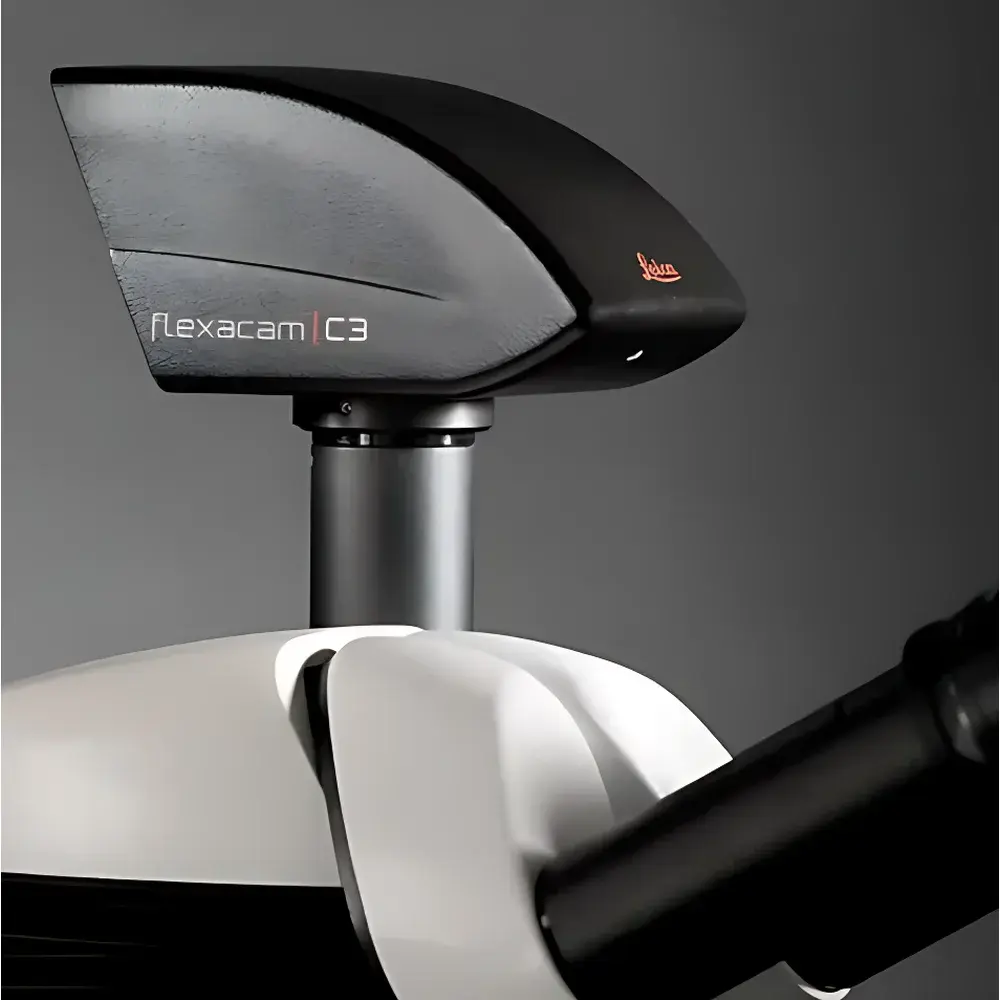
Leica Flexacam C3 12-Megapixel Standalone Microscopy Camera
| Brand | Leica |
|---|---|
| Country of Origin | Germany |
| Model | Flexacam C3 |
| Sensor Resolution | 12 MP CMOS |
| Frame Rate | up to 60 fps (live view), 30 fps (Full HD video) |
| Output Interfaces | HDMI, Gigabit Ethernet, USB-C (host), USB-A (peripheral) |
| Dynamic Range | High |
| Color Accuracy | Calibrated for scientific imaging |
| Operating Mode | Computer-free standalone or PC-connected |
| Storage Options | Local network (SMB), USB flash drive, email attachment |
| On-Screen Display (OSD) | Integrated menu system for exposure, white balance, contrast, annotation, measurement, and overlay functions |
| Software Tools | Real-time measurement, region-of-interest annotation, image overlay (reference/comparison), timestamped metadata embedding |
| Compliance | Designed for GLP/GMP-aligned workflows |
Overview
The Leica Flexacam C3 is a purpose-engineered 12-megapixel standalone microscopy camera designed to transform conventional optical microscopes into self-contained digital imaging workstations. Unlike traditional microscope cameras requiring host PC integration, the Flexacam C3 operates autonomously via direct HDMI output to monitors or through Gigabit Ethernet for networked deployment—eliminating dependency on external computing hardware while preserving full imaging fidelity. At its core lies a high-sensitivity CMOS sensor optimized for low-noise, high-dynamic-range acquisition under variable illumination conditions typical in routine and research-grade microscopy. Its real-time signal processing pipeline ensures minimal latency between sample observation and on-screen visualization—critical for dynamic specimen assessment in life sciences, pathology, and industrial quality assurance. The device adheres to fundamental principles of quantitative optical imaging: consistent color reproduction calibrated against standard illuminants (D65), geometric stability across magnification changes, and pixel-level linearity essential for downstream morphometric analysis.
Key Features
- True standalone operation: No PC required for live viewing, annotation, measurement, or export—enables rapid deployment in cleanrooms, production floors, or teaching labs.
- 12-megapixel CMOS sensor with native 4K-capable output resolution (3840 × 2160) and Full HD video recording at 30 fps; supports real-time preview at up to 60 fps for motion-critical applications.
- Integrated On-Screen Display (OSD) interface: Intuitive menu navigation for exposure control, white balance adjustment, gamma correction, and digital zoom—accessible directly via USB mouse or front-panel buttons.
- On-device analytical tools: Pixel-accurate linear and area measurements with customizable units (µm, mm, inch); multi-point annotation with text overlays and arrow markers; side-by-side or alpha-blended image overlay for comparative analysis against reference standards or prior acquisitions.
- Flexible connectivity architecture: HDMI for immediate monitor output; Gigabit Ethernet for seamless integration into institutional LANs (SMB/CIFS file sharing, DHCP support); USB-C for optional PC tethering; USB-A for peripheral expansion (keyboard, Wi-Fi dongle, or barcode scanner).
- Embedded metadata tagging: Automatic timestamping, objective magnification detection (when paired with Leica DM series microscopes), and user-defined project identifiers embedded within exported JPEG/TIFF files—supporting traceability requirements in regulated environments.
Sample Compatibility & Compliance
The Flexacam C3 is compatible with all Leica DM-series upright and inverted microscopes equipped with C-mount or F-mount adapters, and functions reliably with third-party optical systems using standard mechanical interfaces. It maintains optical fidelity across transmitted light (brightfield, phase contrast, DIC), reflected light (epi-fluorescence with appropriate filter cubes), and polarized light modalities. While not certified as an IVD device, its design supports documentation practices aligned with ISO 13485 quality management systems and FDA 21 CFR Part 11 principles when used in conjunction with validated network storage protocols and controlled user access policies. Image exports include EXIF-compliant metadata fields suitable for inclusion in GLP-compliant laboratory notebooks or electronic lab records (ELN).
Software & Data Management
No proprietary desktop software installation is required for basic operation. All configuration and image handling occur within the embedded firmware environment. For advanced integration, the Flexacam C3 exposes RESTful API endpoints over HTTP/HTTPS for remote control and automated image retrieval—enabling scripting via Python, LabVIEW, or enterprise LIMS platforms. Export formats include lossless TIFF (16-bit grayscale or RGB), compressed JPEG (user-adjustable quality), and MP4-encoded Full HD video with H.264 compression. Files may be saved locally to USB mass-storage devices, streamed to SMB/CIFS shares on Windows/Linux servers, or dispatched via SMTP-configured email gateways with configurable subject lines and recipient lists—facilitating audit-ready data handover without manual file transfer steps.
Applications
- Materials science: Grain boundary analysis, coating thickness evaluation, and defect mapping in metallurgical and semiconductor samples.
- Quality control laboratories: Rapid visual verification of component dimensions, solder joint integrity, and surface finish consistency per ASTM E1558 or ISO 9001 inspection protocols.
- Life sciences education: Real-time group observation during histology or microbiology practical sessions—reducing eyepiece fatigue and enabling inclusive classroom participation.
- Clinical pathology: Preliminary slide triage and teleconsultation-ready image capture where HIPAA-compliant network routing can be enforced at infrastructure level.
- Forensic documentation: Chain-of-custody compliant imaging of trace evidence with embedded timestamps, operator ID, and instrument calibration status.
FAQ
Does the Flexacam C3 require a computer to operate?
No—it functions fully independently when connected to an HDMI display or networked via Ethernet. A PC is only needed for optional advanced automation or custom integration scenarios.
Can I calibrate the camera for quantitative measurements?
Yes—calibration is performed using a stage micrometer and stored per-objective in non-volatile memory. Measurement results include scale metadata for reproducibility across instruments.
Is raw sensor data accessible?
The camera outputs processed 12-bit or 16-bit linear data in TIFF format. Raw Bayer data is not exposed to preserve color fidelity and noise characteristics optimized in firmware.
How is firmware updated?
Updates are delivered as signed binary packages via USB flash drive or HTTPS download through the built-in web interface, with checksum validation and rollback capability.
What cybersecurity measures are implemented?
The device supports TLS 1.2+ for web interface access, configurable password policies, disabled default credentials, and optional MAC address filtering on Ethernet interfaces—meeting baseline NIST SP 800-53 controls for laboratory edge devices.





