
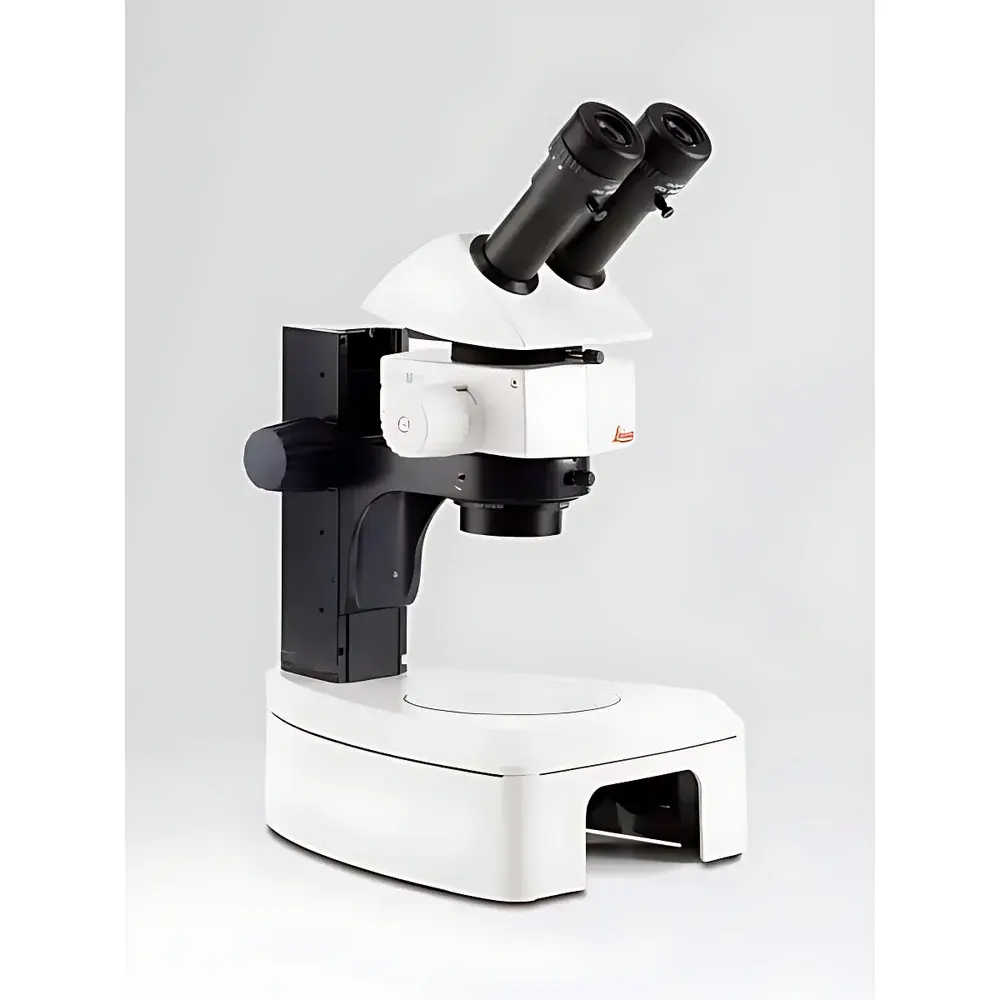
Leica M50 Stereo Microscope
| Brand | Leica |
|---|---|
| Origin | Germany |
| Model | M50 |
| Zoom Ratio | 6.3:1 |
| Standard Magnification Range | 6.3×–40× (with 1× objective) |
| Objective | Achromatic 1× (WD = 89.6 mm) |
| Resolution | up to 450 lp/mm |
| Focusing System | Coaxial coarse/fine focus with integrated cable routing |
| Eyepiece Field Number | 23 mm |
| ESD Protection | <2 s discharge time |
| Mounting Interface | 76 mm standard dovetail |
| Illumination Options | Reflected, transmitted, oblique, and ring light compatible |
| Modular Compatibility | Interchangeable objectives, eyepieces, stands, stages, and digital imaging modules |
Overview
The Leica M50 Stereo Microscope is a high-performance, modular stereomicroscope engineered for precision visual inspection, quality control, and routine laboratory documentation in industrial, academic, and R&D environments. Based on the proven Greenough optical design, it delivers true stereoscopic vision with natural depth perception and minimal distortion across its 6.3:1 zoom range. The system employs an achromatic optical path optimized for color fidelity and contrast, achieving a maximum resolution of 450 line pairs per millimeter—enabling reliable visualization of fine surface topography, microstructural features, solder joints, PCB traces, biological specimens, and material defects. Its compact main body features a short optical path length that maximizes light throughput while maintaining an extended working distance of 89.6 mm at 1× magnification—critical for manipulating samples, integrating tools, or mounting auxiliary devices such as micromanipulators or laser ablation systems.
Key Features
- 6.3:1 continuous zoom optics with five fixed magnification steps—ensuring repeatable, parfocal alignment across the entire magnification range without refocusing.
- Achromatic 1× objective with 89.6 mm working distance and 23 mm field number—providing wide-field observation while preserving ergonomic access and tool clearance.
- ESD-safe construction with conductive housing and grounding path; electrostatic discharge dissipates in under 2 seconds—meeting IEC 61340-5-1 requirements for electrostatic protected areas (EPAs) in electronics assembly and semiconductor handling.
- Integrated cable management within the focusing column—reducing clutter and improving workstation hygiene and safety compliance.
- 76 mm standard dovetail interface—enabling seamless mechanical integration with Leica’s portfolio of motorized stages, transmitted light bases (e.g., TL4000), and third-party automation platforms.
- Modular optical train—supporting interchangeable eyepieces (10×, 15×, 20×), auxiliary lenses (0.5×, 1.5×, 2×), and digital imaging adapters (C-mount, F-mount, Leica DFC series).
Sample Compatibility & Compliance
The Leica M50 accommodates a broad spectrum of sample types—from large printed circuit boards and mechanical assemblies to delicate botanical sections and small animal dissections—without requiring sample sectioning or coating. Its large depth of field (>30 mm at low magnification) and wide field of view ensure contextual awareness during detailed inspection. The microscope complies with ISO 10934-1 (optical microscopy terminology), DIN EN 61000-6-3 (EMC emission standards), and RoHS 2011/65/EU. When configured with certified digital cameras and audit-trail-enabled software (e.g., Leica Application Suite X), the system supports GLP and GMP workflows—including FDA 21 CFR Part 11-compliant electronic records when paired with appropriate validation protocols.
Software & Data Management
The M50 integrates natively with Leica Application Suite X (LAS X), a platform designed for regulated environments. LAS X provides calibrated measurement tools (length, angle, area, particle count), multi-focus extended depth of field (EDF) image synthesis, annotation layers, and structured reporting templates. All image metadata—including magnification, objective ID, illumination settings, and timestamp—are embedded in TIFF or JPEG files. For traceability, LAS X supports user-defined roles, electronic signatures, and audit trails compliant with ISO/IEC 17025 and ISO 9001 documentation requirements. Optional Leica DM6000-compatible remote control modules enable centralized fleet management in multi-station laboratories.
Applications
- Electronics manufacturing: SMT inspection, solder joint evaluation, counterfeit component identification, and failure analysis under variable lighting (ring light, coaxial, or polarized).
- Materials science: Fracture surface analysis, coating thickness assessment, grain structure documentation, and corrosion evaluation.
- Life sciences: Dissection of model organisms, embryonic staging, microinjection setup, and histological slide screening.
- Forensics: Toolmark comparison, fiber analysis, and document examination with oblique illumination.
- Quality assurance labs: Incoming inspection of machined parts, plastic injection-molded components, and medical device packaging integrity verification.
FAQ
What is the maximum resolution achievable with the Leica M50?
The optical system resolves up to 450 line pairs per millimeter under optimal Köhler illumination and with a 1× achromatic objective.
Can the M50 be used for photomicrography?
Yes—it supports C-mount and F-mount camera adapters, and is fully compatible with Leica DFC series digital cameras and LAS X software for quantitative image capture.
Is the M50 suitable for cleanroom environments?
Its ESD-safe design, absence of volatile organic compounds in housing materials, and optional stainless-steel stage accessories make it suitable for ISO Class 5–7 cleanrooms.
Does the M50 support motorized focusing or stage control?
While the base model features manual coaxial focus, it accepts Leica’s optional motorized Z-drive and programmable XY stages via the 76 mm dovetail interface and LAS X control layer.
How does the M50 compare to the Leica M60 or M80 in terms of optical performance?
The M50 shares the same Greenough optical architecture and parfocal zoom mechanism but offers a more compact form factor and optimized cost-to-performance ratio for routine QC applications, whereas the M60/M80 provide higher NA objectives and enhanced fluorescence compatibility.





