
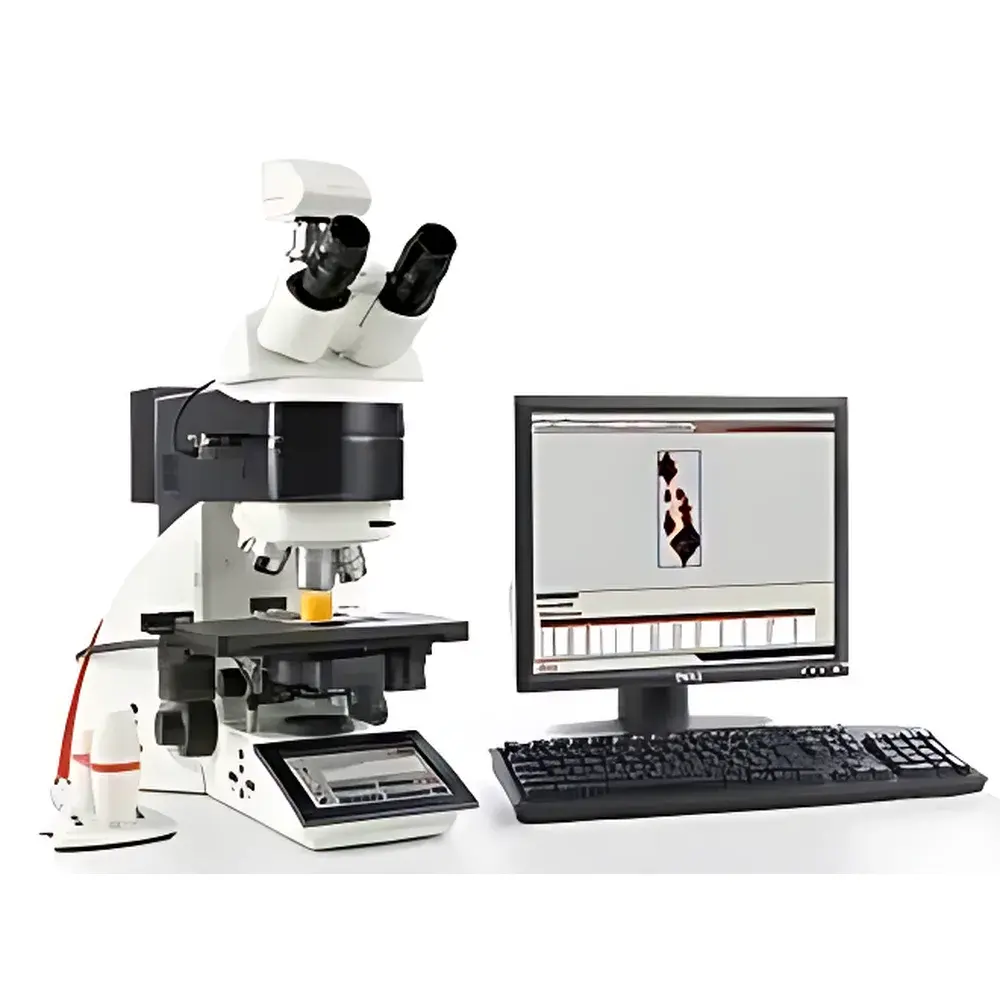
Leica Steel Expert 2.0 Metallurgical Image Analysis Software
| Brand | Leica |
|---|---|
| Origin | Germany |
| Manufacturer Type | Authorized Distributor |
| Origin Category | Imported |
| Model | Steel Expert 2.0 |
| Price Range | USD 68,000 – 136,000 (based on configuration) |
| Microscope Type | Upright |
| Total Magnification | 1000× |
| Eyepiece | 10× |
| Objective | 100× |
| Compliance Standards | ASTM E45-11, ISO 4967:2013, EN 10247:2013 (Draft), DIN 50602 |
| Software Architecture | Modular, Standalone or Integrated with Leica DM Series Microscopes |
| Deployment | Windows-based, FDA 21 CFR Part 11–ready audit trail optional |
| Batch Processing | Yes |
| Multi-Standard Parallel Reporting | Yes |
Overview
Leica Steel Expert 2.0 is a purpose-built metallurgical image analysis software platform engineered for quantitative evaluation of non-metallic inclusions in steel and ferrous alloys. It operates in conjunction with upright metallurgical microscopes—including Leica DM2700 M, DM4000 M LED, DMI3000 M, DM6000 M, and DMI5000 M—to deliver standardized, repeatable, and auditable inclusion assessments. The software implements optical microscopy-based morphological classification and sizing algorithms aligned with internationally recognized metallographic standards. Its core function is to automate the identification, categorization, and statistical quantification of sulfide, oxide, silicate, and carbonitride inclusions—critical determinants of steel’s formability, fatigue life, and corrosion resistance. Designed for laboratories operating under GLP, GMP, or ISO/IEC 17025 frameworks, Steel Expert 2.0 supports traceable workflows from image acquisition through final report generation.
Key Features
- Multi-standard compliance engine supporting parallel evaluation per ASTM E45-11 (Method A & B), ISO 4967:2013, EN 10247:2013 (including Draft Amendment 1), and DIN 50602—with real-time side-by-side result comparison across standards.
- Automated inclusion detection using adaptive thresholding, shape filtering, and contrast-enhanced segmentation—optimized for brightfield and differential interference contrast (DIC) imaging at magnifications up to 1000×.
- Modular licensing architecture: users select only required standard packages (e.g., ASTM-only, ISO+EN bundle, or regional variants), minimizing licensing overhead and enabling phased deployment.
- Batch image processing capability for high-throughput labs—supports unattended analysis of hundreds of fields-of-view with configurable pass/fail criteria and auto-generated summary statistics.
- Calibration-integrated measurement pipeline: maintains pixel-to-micron mapping integrity across objective changes (10×, 20×, 50×, 100×), ensuring metrological traceability per ISO 17025 clause 6.5.2.
- Configurable reporting engine generating PDF/CSV outputs with embedded metadata (operator ID, timestamp, microscope configuration, calibration certificate reference).
Sample Compatibility & Compliance
Steel Expert 2.0 is validated for polished, etched, and unetched metallographic specimens prepared per ASTM E3, ISO 16077, and EN ISO 14489. It accommodates both as-polished surfaces (for oxide/sulfide assessment) and nital-etched sections (for carbide distribution analysis). The software’s classification logic adheres strictly to the morphological definitions and size thresholds defined in each referenced standard—for example, distinguishing Type A (sulfides) from Type B (alumina) in ASTM E45 based on aspect ratio, gray level homogeneity, and particle boundary sharpness. All analytical workflows are compatible with regulatory requirements for audit readiness: optional FDA 21 CFR Part 11-compliant electronic signatures, full audit trail logging (user actions, parameter changes, report exports), and secure role-based access control (RBAC) can be enabled via Leica Application Suite X (LAS X) integration.
Software & Data Management
Deployed on Windows 10/11 (64-bit) platforms, Steel Expert 2.0 uses a client-server architecture for enterprise-scale deployment, supporting centralized database storage (Microsoft SQL Server) and automated backup scheduling. Raw images are stored in TIFF or Leica’s proprietary LIF format with embedded EXIF metadata—including objective magnification, illumination intensity, camera gain, and stage coordinates. Processed data—including inclusion counts per field, area fraction, maximum length, and shape descriptors (circularity, convexity)—are exported to relational databases or LIMS via ODBC drivers. Version-controlled method templates ensure inter-laboratory reproducibility; each template embeds standard-specific acceptance criteria, image acquisition parameters, and reporting layouts. Integration with Leica’s LAS X platform enables seamless transition from live imaging to automated analysis without manual file transfer.
Applications
- Quality assurance in primary steel production (BOF, EAF, ladle refining) for incoming raw material verification and process deviation detection.
- Failure analysis laboratories conducting root cause investigations of fatigue fractures, hydrogen-induced cracking, or premature component wear.
- R&D departments developing ultra-clean steels for aerospace bearings, medical implants, or high-strength automotive components—leveraging sub-micron resolution capabilities to quantify inclusions <1 µm in equivalent circular diameter.
- Third-party certification bodies performing accredited testing per ISO/IEC 17025, requiring documented uncertainty budgets and inter-operator repeatability studies.
- Supplier qualification programs where inclusion rating consistency across global manufacturing sites must be statistically validated.
FAQ
Does Steel Expert 2.0 require a Leica microscope to operate?
No—it supports third-party upright metallurgical microscopes provided they output calibrated digital images with embedded scale information (e.g., via USB3 or GigE cameras with Leica-certified drivers). However, full hardware automation (motorized stage, turret, illumination) is only guaranteed with Leica DM-series systems.
Can it analyze inclusions in stainless steels or tool steels?
Yes. The classification algorithm has been validated on austenitic, ferritic, martensitic, and precipitation-hardening grades, including high-alloy steels containing Nb, V, or Ti microalloying elements that form complex oxycarbides.
Is cloud-based deployment supported?
Not natively. Steel Expert 2.0 is an on-premise application due to data sovereignty and cybersecurity requirements common in metallurgical QA environments. Remote access may be implemented via approved virtual desktop infrastructure (VDI) solutions compliant with ISO 27001.
How often are standard updates released?
Leica releases annual minor updates incorporating editorial revisions to referenced standards (e.g., ASTM E45-23, ISO 4967:2022) and biannual major versions introducing new classification models—typically validated against round-robin interlaboratory studies coordinated by EURAMET and NIST.
What training and support options are available?
Leica offers certified instructor-led workshops (2-day onsite or virtual), ISO 17025-aligned validation documentation kits, and 24/7 technical support with SLA-governed response times for critical production issues.





