
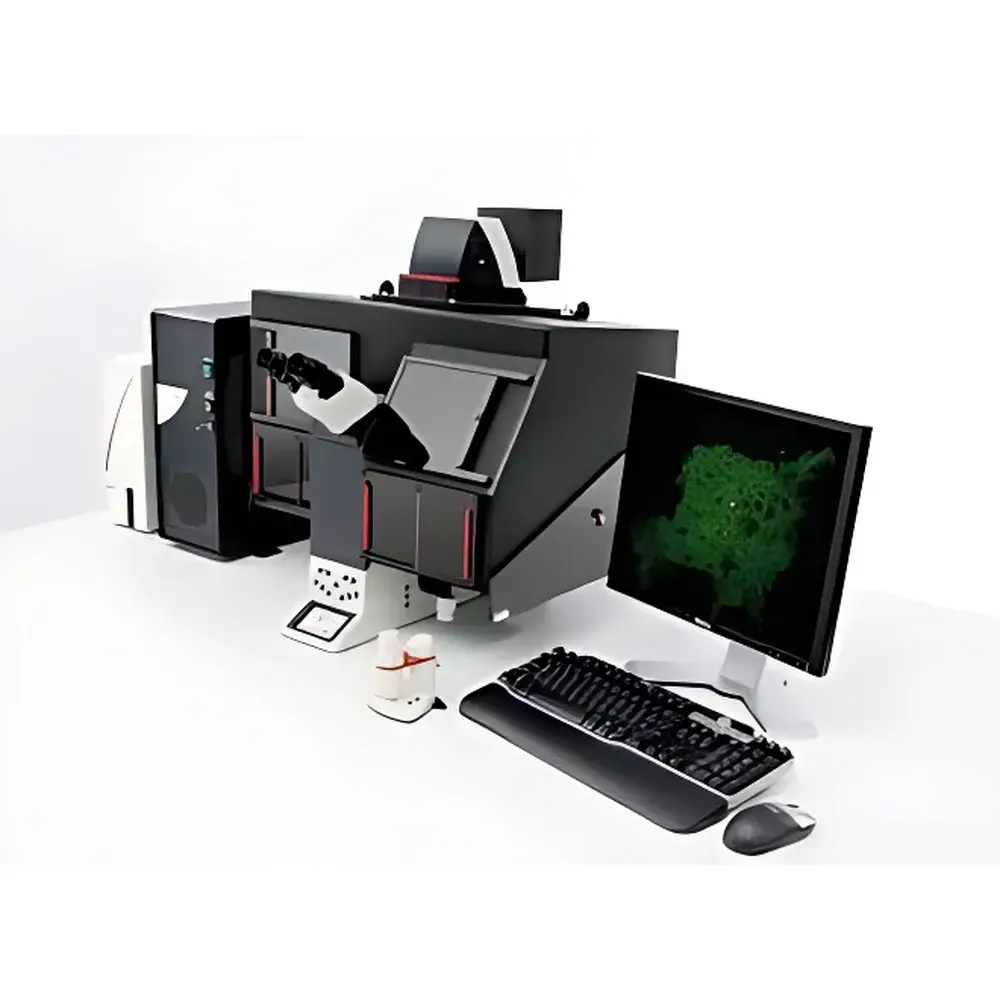
Leica AM TIRF MC Total Internal Reflection Fluorescence Microdissection System
| Brand | Leica |
|---|---|
| Origin | Germany |
| Model | Leica AM TIRF MC |
| Laser Wavelengths | 405 nm, 488 nm, 561 nm, 635 nm |
| Laser Type | Solid-state diode lasers |
| Beam Control | Acousto-Optic Tunable Filter (AOTF) |
| TIRF Depth Calibration | Fully automated, real-time stabilization |
| Imaging Speed | Synchronized high-speed acquisition for live-cell dynamics |
| Software Platform | Leica AF7000 Fluorescence Management Suite |
| Integration | Fully compatible with Leica advanced fluorescence workstations (e.g., DM6000/DM6 B, DMI6000/DMI6 B) |
Overview
The Leica AM TIRF MC is a purpose-engineered total internal reflection fluorescence (TIRF) microdissection system designed for high-precision spatial control and quantitative optical sectioning at the plasma membrane–cytoplasm interface. Built upon Leica Microsystems’ proprietary TIRF optics architecture, the system exploits the evanescent wave phenomenon—generated when laser light undergoes total internal reflection at the glass–coverslip–specimen interface—to achieve axial resolution of ≤100 nm. This enables selective excitation of fluorophores within a sub-150 nm optical slice adjacent to the coverslip surface, effectively eliminating out-of-focus background while preserving signal-to-noise ratio in live-cell and single-molecule applications. The AM TIRF MC integrates seamlessly into Leica’s modular inverted fluorescence microscopy platforms (e.g., DMI6 B, DM6 B), functioning both as a standalone TIRF imaging module and as a precision laser microdissection interface for targeted subcellular ablation or isolation under real-time fluorescence guidance.
Key Features
- Four solid-state diode lasers (405 nm, 488 nm, 561 nm, 635 nm) with individually tunable intensity via acousto-optic tunable filter (AOTF), enabling rapid wavelength switching (<5 ms) without mechanical repositioning
- Automated, software-driven TIRF angle calibration that dynamically maintains optimal evanescent field penetration depth across all wavelengths—critical for multi-color co-localization and FRET experiments
- Motorized TIRF objective turret and precision piezo-driven stage for nanometer-scale beam positioning and repeatable region-of-interest targeting
- Real-time synchronization between laser illumination, camera exposure, and stage movement—ensuring temporal fidelity in time-lapse and kymograph-based analyses
- Integrated dynamic scanner for adaptive adjustment of the evanescent field orientation and depth, compensating for refractive index variations across heterogeneous samples (e.g., cell monolayers on patterned substrates)
- Hardware-level alignment stability certified per ISO 10110-7, supporting GLP-compliant long-term reproducibility in longitudinal studies
Sample Compatibility & Compliance
The Leica AM TIRF MC supports standard 24 × 60 mm and 22 × 22 mm coverslips (No. 1.5H), compatible with live-cell chambers (e.g., Ibidi µ-Slides, Lab-Tek chambers) and fixed tissue sections up to 10 µm thickness. It meets IEC 61000-6-3 (EMC emission) and IEC 61000-6-2 (immunity) standards for laboratory instrumentation. For regulated environments, the system supports audit-trail-enabled operation when paired with Leica LAS X software configured for 21 CFR Part 11 compliance (electronic signatures, user access tiers, immutable acquisition logs). All optical components are traceably calibrated against NIST-traceable photometric standards, and system validation protocols align with ISO/IEC 17025 requirements for measurement uncertainty reporting.
Software & Data Management
Controlled exclusively through the Leica AF7000 Fluorescence Management Suite—now extended with TIRF-specific modules—the system delivers unified hardware orchestration: automatic AOTF calibration, iterative TIRF angle optimization, drift-compensated multi-position time-lapse, and synchronized multi-channel FRET ratio mapping. Raw data are saved in open-format TIFF stacks with embedded metadata (EXIF + OME-XML), ensuring compatibility with Fiji/ImageJ, Imaris, and MATLAB-based analysis pipelines. The software includes built-in tools for quantitative evanescent field decay modeling, lateral drift correction using fiducial markers, and export of calibrated intensity profiles for publication-grade figure generation. Data integrity is enforced via SHA-256 hash logging and optional integration with enterprise LIMS systems via RESTful API.
Applications
- Single-molecule tracking and dwell-time analysis at the plasma membrane (e.g., receptor clustering, clathrin-coated pit dynamics)
- High-fidelity FRET-based conformational assays in live cells, including Ca²⁺-dependent protein interactions and GPCR activation kinetics
- Targeted laser microdissection of membrane nanodomains for downstream proteomic or transcriptomic profiling
- Quantitative vesicle trafficking analysis (exocytosis/endocytosis burst kinetics, docking site occupancy)
- Correlative TIRF–electron microscopy (CLEM) workflows, leveraging precise coordinate mapping between fluorescence ROIs and EM grids
- Long-term (>24 h) timelapse imaging of adherent cell migration with sub-diffraction spatial registration
FAQ
What is the minimum achievable evanescent field penetration depth, and how is it maintained across wavelengths?
The system achieves a calibrated penetration depth range of 60–180 nm, automatically adjusted per wavelength using real-time feedback from the TIRF alignment sensor. No manual recalibration is required during multi-color acquisition.
Can the AM TIRF MC be retrofitted onto existing Leica inverted microscopes?
Yes—compatibility is confirmed for DMI6000/DMI6 B and DM6000/DM6 B series with TIRF-capable objectives (e.g., HCX PL APO 63×/1.47 NA oil). Retrofit requires factory-certified optical alignment and firmware update.
Does the system support quantitative colocalization analysis with statistical confidence metrics?
Yes—AF7000 includes Manders’ overlap coefficient, Pearson’s correlation, and object-based coincidence analysis with bootstrapped p-value estimation (n ≥ 500 ROI replicates).
How is phototoxicity minimized during extended live-cell imaging?
AOTF-based intensity modulation, combined with adaptive exposure gating and LED-based focus maintenance, reduces cumulative photon dose by up to 70% versus conventional shuttered TIRF systems.
Is third-party software integration supported for custom analysis pipelines?
Yes—native Python and MATLAB APIs provide low-level access to raw frame buffers, hardware state variables, and calibrated intensity values, fully documented in the Leica SDK Developer Guide.




