
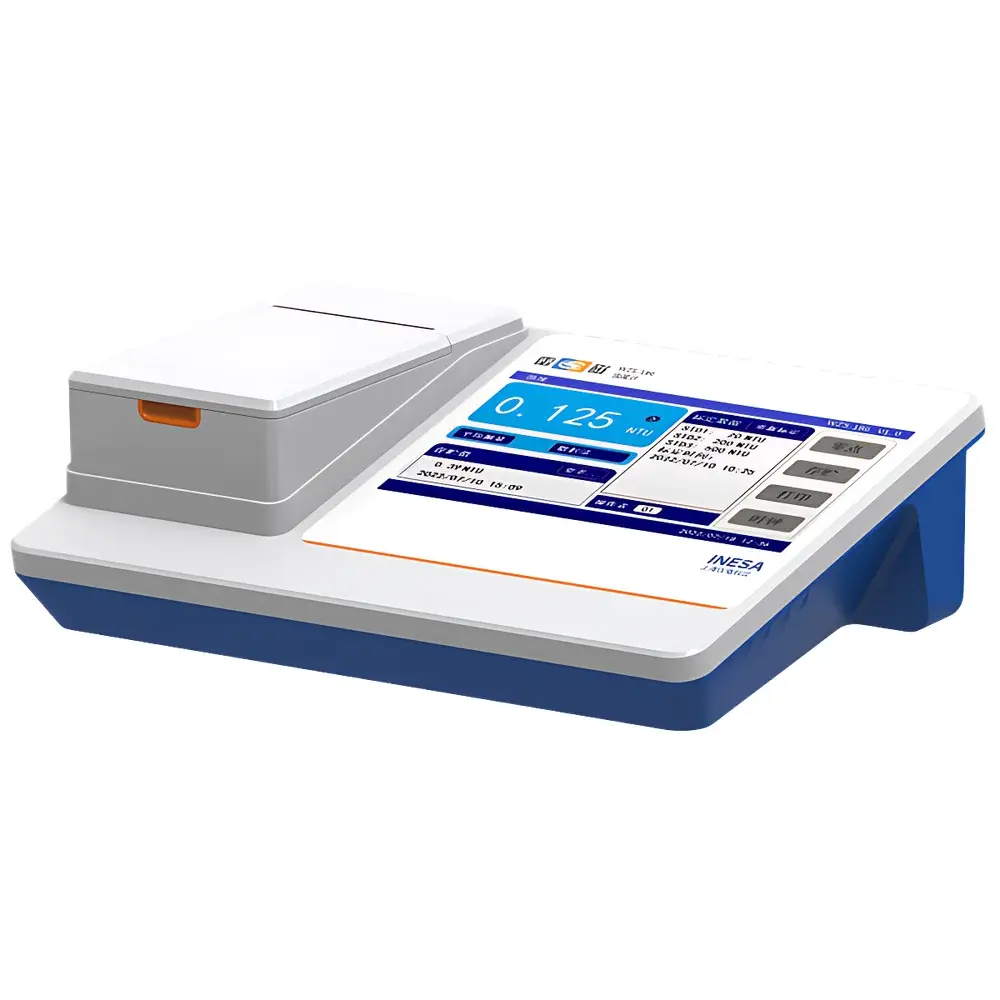
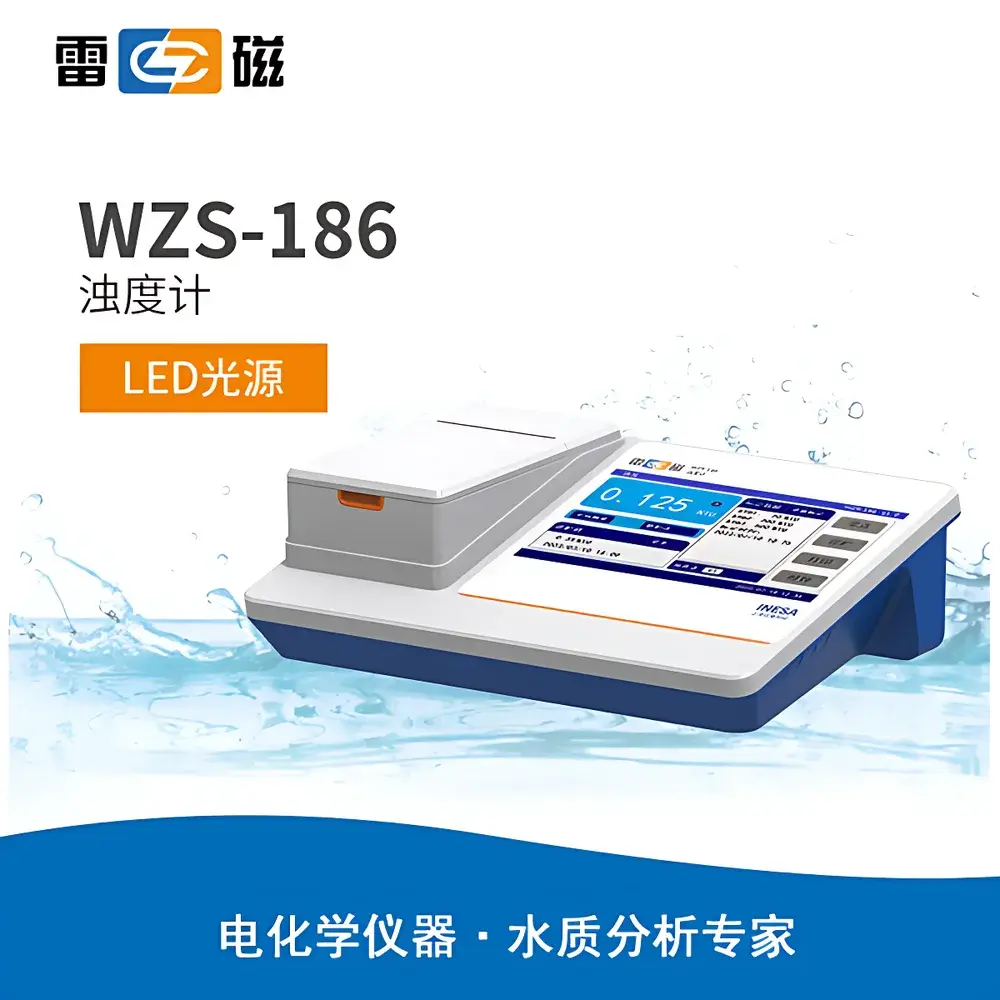
Leichi WZS-186 Benchtop Turbidimeter
| Brand | Leichi |
|---|---|
| Origin | Shanghai, China |
| Manufacturer Type | Direct Manufacturer |
| Origin Category | Domestic (China) |
| Model | WZS-186 |
| Price Range | USD 700–1,400 |
| Form Factor | Benchtop / Laboratory |
| Measurement Range | 0.000–2000 NTU |
| Resolution | 0.001 NTU |
| Operating Temperature | 5–35 °C |
| Accuracy | ±6% |
| Light Source | Infrared LED |
| Compliance | ISO 7027, HJ 1075-2019 |
| Protection Rating | IP54 |
| Display | 7-inch color TFT touchscreen |
| Measurement Principles | Nephelometric (90° scatter) and Ratio Scatter-Transmission |
| Units | NTU, FNU, EBC |
| Calibration Options | Single-point or multi-point (20/200/500/1000/2000 NTU), zero adjustment, factory reset |
| Data Management | Onboard storage, USB export, RS-232 printer interface |
| Software Interface | PC communication via dedicated software |
| GLP Support | Audit trail, timestamped records, user login (if enabled), data traceability |
Overview
The Leichi WZS-186 Benchtop Turbidimeter is a precision optical instrument engineered for reliable, repeatable turbidity measurement in environmental monitoring, drinking water quality control, wastewater treatment, and pharmaceutical process validation laboratories. It operates on the nephelometric principle—measuring light scattered at 90° from an infrared LED source—as specified in ISO 7027:2016 and the Chinese environmental standard HJ 1075–2019. To enhance robustness across heterogeneous sample matrices, the WZS-186 implements a dual-mode optical architecture: it supports both conventional 90° scatter detection and ratio-based scatter-transmission measurement, enabling compensation for color interference, high-absorbance backgrounds, or particulate settling effects. Its 0.001 NTU resolution and full-scale range of 0.000–2000 NTU accommodate applications spanning ultrapure water verification (e.g., USP , EP 2.2.2) to raw surface water analysis. The instrument’s optical path is sealed and temperature-stabilized within its IP54-rated enclosure, minimizing drift during extended operation under ambient lab conditions (5–35 °C).
Key Features
- 7-inch high-resolution color TFT touchscreen with intuitive icon-driven interface and multilingual menu support (English, Chinese)
- Infrared LED light source (λ ≈ 850 nm) ensures long-term stability, reduced photodegradation of sensitive samples, and immunity to ambient visible-light interference
- Dual optical measurement modes: selectable nephelometric (90° scatter) and ratio scatter-transmission for improved accuracy in colored or highly absorbing suspensions
- Automatic range switching across five decades without manual intervention or recalibration
- Comprehensive calibration suite: includes certified primary standards (20, 200, 500, 1000, and 2000 NTU formazin-equivalent suspensions), zero-point verification vial, and user-definable calibration curves
- Three standardized turbidity units—NTU (nephelometric turbidity units), FNU (formazin nephelometric units per ISO 7027), and EBC (European Brewery Convention)—switchable per measurement session
- Two acquisition modes: Standard (single-shot) and Average (10-sample rolling mean), mitigating short-term fluctuations caused by Brownian motion or particle sedimentation
- Built-in power-failure protection retains calibration settings, user preferences, and last-measured values after unexpected shutdown
Sample Compatibility & Compliance
The WZS-186 accepts standard 25-mm round glass cuvettes (included) and accommodates samples with moderate viscosity, non-aggressive pH (pH 4–10), and suspended solids up to ~2000 NTU without dilution. It complies with ISO 7027:2016 for instrument performance, optical geometry, and detector linearity; meets HJ 1075–2019 requirements for field-deployable and laboratory turbidimeters used in China’s environmental monitoring network. While not intrinsically compliant with FDA 21 CFR Part 11, its GLP-aligned data handling—including timestamped measurements, operator ID tagging (via optional password-enabled user profiles), and immutable audit logs exported via USB—supports alignment with GMP/GLP workflows when integrated into validated laboratory information management systems (LIMS). The device is CE-marked for EMC and safety (EN 61326-1, EN 61010-1).
Software & Data Management
Onboard memory stores up to 2,000 measurement records with full metadata: date/time stamp, unit, mode, calibration status, operator ID (if configured), and raw signal intensity. Data export is supported via USB 2.0 (FAT32-formatted flash drive) in CSV format for post-processing in Excel or statistical software. An RS-232 serial port enables direct connection to dot-matrix or thermal label printers for hard-copy reporting compliant with internal QA documentation protocols. Leichi’s proprietary PC communication software (Windows 10/11 compatible) provides real-time instrument control, batch calibration curve editing, trend visualization, and export to PDF or XML for regulatory submission. All stored data includes cryptographic checksums to prevent tampering; system logs record configuration changes, calibration events, and firmware updates.
Applications
- Drinking water utilities: verification of filtration efficiency, disinfection byproduct precursor monitoring, and compliance with WHO Guidelines and GB 5749–2022
- Wastewater treatment plants: activated sludge characterization, effluent quality assurance prior to discharge, and membrane bioreactor (MBR) fouling assessment
- Pharmaceutical manufacturing: rinse water clarity testing per USP , clean-in-place (CIP) validation, and excipient suspension homogeneity checks
- Food & beverage labs: beer haze quantification (EBC mode), juice cloud stability evaluation, and dairy processing water hygiene monitoring
- Academic research: colloidal stability studies, nanoparticle dispersion analysis, and environmental sediment transport modeling
FAQ
What standards does the WZS-186 comply with for optical design and measurement methodology?
It conforms to ISO 7027:2016 (nephelometric principle, 850 nm IR source, 90° detector geometry) and HJ 1075–2019 (Chinese standard for turbidity meters used in environmental monitoring).
Can the instrument measure samples with strong coloration or high absorbance?
Yes—the ratio scatter-transmission mode compensates for spectral absorption by normalizing scattered signal against transmitted intensity, improving accuracy for yellow/brown natural waters or dyed industrial effluents.
Is the calibration traceable to NIST or other national metrology institutes?
The supplied calibration standards are manufactured to match formazin-equivalent turbidity values certified by accredited Chinese NMIs (e.g., NIM); users may substitute NIST-traceable standards (e.g., StablCal®) using the multi-point calibration function.
Does the WZS-186 support network connectivity or Ethernet data transfer?
No—it lacks built-in Ethernet or Wi-Fi; data exchange is limited to USB mass storage and RS-232 serial interfaces to maintain electromagnetic compatibility and cybersecurity boundaries in regulated labs.
How is data integrity ensured during power interruption or software update?
Critical parameters (calibration coefficients, zero offset, user settings) are stored in non-volatile FRAM memory; measurement records are written atomically to prevent partial corruption, and firmware updates require explicit user confirmation with checksum validation.




