
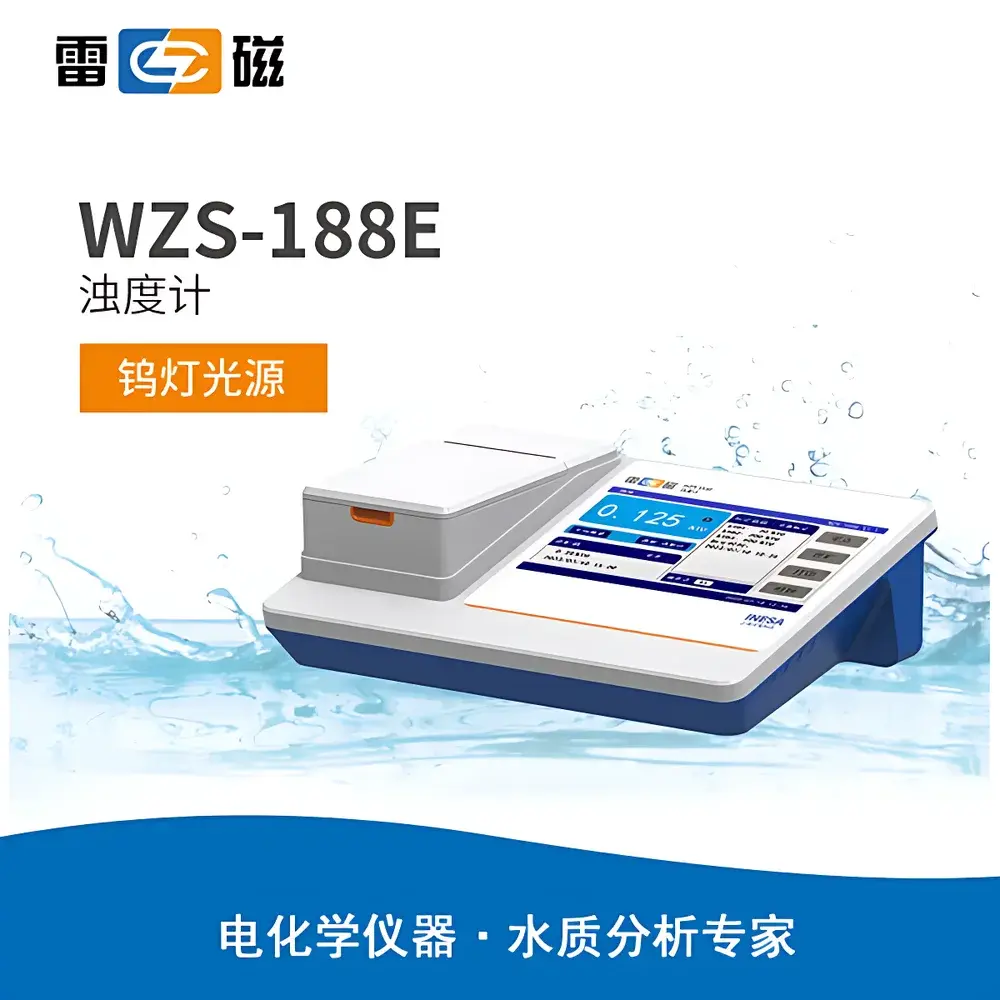
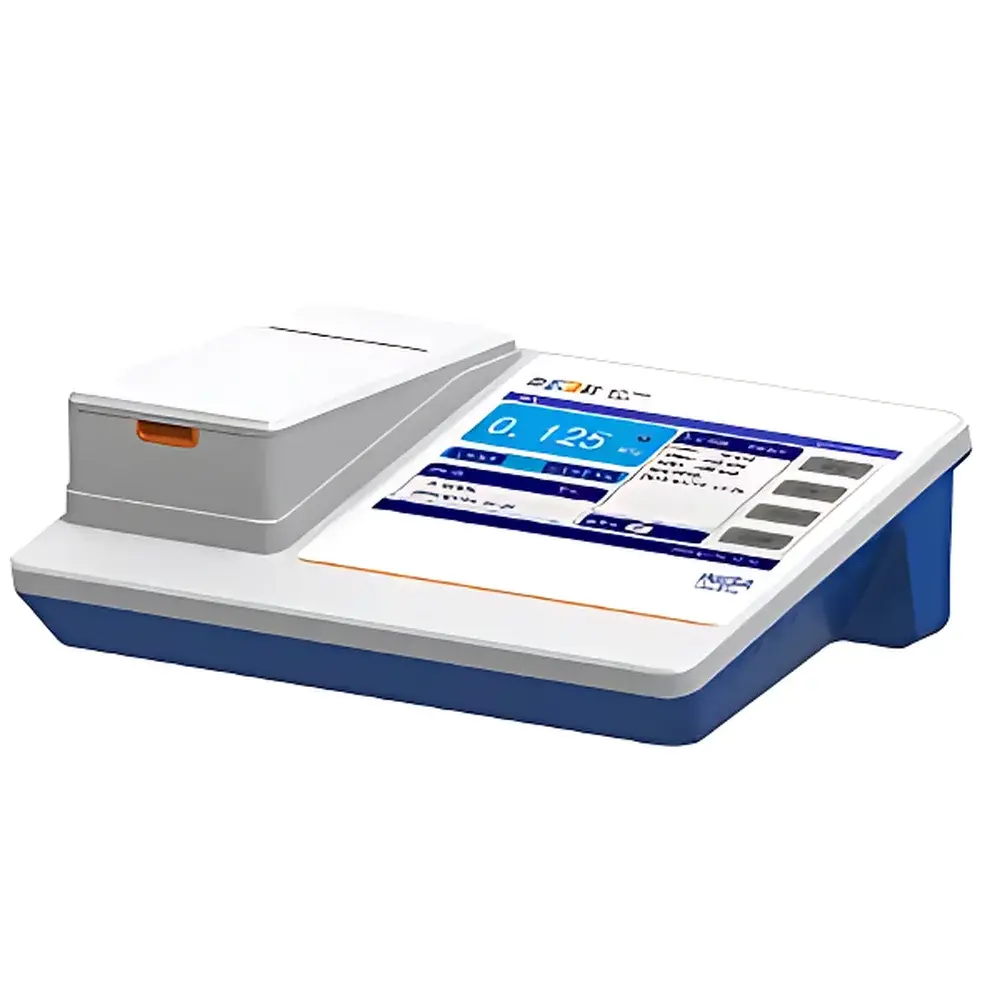
Leichi WZS-188E Benchtop Turbidimeter
| Brand | Leichi |
|---|---|
| Origin | Shanghai, China |
| Model | WZS-188E |
| Instrument Type | Benchtop Laboratory Turbidimeter |
| Measurement Range | (0.000–9.999) NTU, (10.00–99.99) NTU, (100.0–999.9) NTU, (1000–4000) NTU |
| Resolution | 0.001 / 0.01 / 0.1 / 1 NTU |
| Accuracy | ±6% of reading |
| Repeatability | ≤0.5% |
| Zero Drift | ±0.5% FS / 30 min |
| Stability | ±0.5% FS / 30 min |
| Calibration Points | Up to 8 points (2, 20, 50, 200, 500, 1000, 2000, 4000 NTU) |
| Light Source | Tungsten-halogen lamp (400–600 nm), compliant with USEPA Method 180.1 and HJ 1075-2019 |
| Display | 7-inch color touchscreen |
| Protection Rating | IP54 |
| Operating Environment | 5–35 °C, ≤85% RH |
| Power Supply | AC 100–240 V input, DC 24 V / ≥0.7 A output |
| Dimensions & Weight | 189 × 282 × 84 mm, ~1.5 kg |
| Data Storage Capacity | 2000 measurement records |
| Interface | RS-232 for thermal printer, USB for PC communication |
| Compliance | GLP-compliant data logging with audit trail support |
Overview
The Leichi WZS-188E is a high-performance benchtop turbidimeter engineered for precise, traceable, and standards-compliant turbidity measurement in environmental monitoring, drinking water quality control, wastewater treatment, and pharmaceutical process validation laboratories. It operates on the principle of nephelometric detection—measuring the intensity of light scattered at 90° from the incident beam—as specified in USEPA Method 180.1, and supports dual-mode operation including the scatter-transmission ratio method (also known as ratio turbidimetry) to minimize errors caused by color interference, particle absorption, or window fouling. Its tungsten-halogen light source emits broadband visible radiation (400–600 nm), ensuring spectral compatibility with both ISO 7027 and USEPA-defined protocols while enabling robust performance across diverse sample matrices—from low-turbidity potable water to highly concentrated industrial effluents.
Key Features
- Dual optical measurement modes: Nephelometric (90° scatter) and scatter-transmission ratio, selectable via intuitive touchscreen interface
- Auto-ranging capability across four decades: 0.000–9.999 NTU (high-resolution low-range), 10.00–99.99 NTU, 100.0–999.9 NTU, and 1000–4000 NTU (extended range for raw water or slurry applications)
- 7-inch full-color capacitive touchscreen with icon-driven navigation, supporting multi-language UI (English, Chinese, Spanish preloaded)
- Integrated calibration management: zero-point adjustment and up to eight user-defined calibration points (2, 20, 50, 200, 500, 1000, 2000, 4000 NTU) using certified formazin or StablCal® standards
- GLP-compliant data handling: each stored record includes timestamp, operator ID (optional), calibration status, measurement mode, unit, and environmental conditions (temperature, humidity if logged externally)
- IP54-rated enclosure ensures dust resistance and protection against water splashes during routine lab use
- Built-in diagnostics: real-time monitoring of lamp intensity, detector response, and optical path integrity with automated warning flags for maintenance scheduling
Sample Compatibility & Compliance
The WZS-188E accepts standard 25-mm round glass cuvettes (included) and supports interchangeable vial holders for alternative geometries. It is validated for use with formazin-based primary standards and traceable secondary standards compliant with ISO 7027-1:2016 and US EPA 180.1. The instrument meets regulatory requirements for routine water quality testing under China’s HJ 1075-2019 and is suitable for laboratories operating under ISO/IEC 17025, USP , and FDA 21 CFR Part 11 environments when paired with Leichi’s optional secure software package (L-TurboLink v3.2) that enforces electronic signatures, role-based access control, and immutable audit trails. Its ±6% accuracy specification aligns with Class 2 performance criteria defined in ISO 7027 for routine field and laboratory applications.
Software & Data Management
Data export and system integration are enabled via native USB 2.0 and RS-232 interfaces. The included L-TurboLink software provides bidirectional communication with Windows-based PCs, supporting batch export to CSV, Excel-compatible XML, or PDF report templates. All measurements are time-stamped and associated with configurable metadata fields—including sample ID, operator code, location tag, and QC flagging (e.g., “out-of-spec”, “retest required”). Internal memory retains 2000 complete datasets with full traceability; no external storage media are required for routine compliance reporting. Firmware updates are delivered via USB stick with cryptographic signature verification to ensure integrity and version control.
Applications
- Drinking water treatment: raw intake screening, coagulation/flocculation optimization, filter effluent verification per WHO and national regulatory thresholds
- Wastewater discharge monitoring: compliance verification against local effluent limits (e.g., EU Urban Wastewater Directive, US NPDES permits)
- Pharmaceutical manufacturing: clarity testing of parenteral solutions, buffer preparation validation, and cleaning verification per USP and EP 2.2.1
- Environmental field labs: sediment-laden surface water analysis, stormwater runoff characterization, and lake/reservoir trophic state assessment
- Academic research: colloid stability studies, flocculant dosing experiments, and nanoparticle dispersion quantification in suspension systems
FAQ
What turbidity units does the WZS-188E support?
NTU (Nephelometric Turbidity Units), FNU (Formazin Nephelometric Units), and EBC (European Brewery Convention) — automatically converted based on selected calibration standard and measurement mode.
Is the instrument suitable for colored or absorbing samples?
Yes. The scatter-transmission ratio mode compensates for absorbance-related signal attenuation, improving accuracy for yellow or brown water matrices without requiring filtration or dilution.
How is calibration traceability maintained?
Each calibration event is logged with date/time, standard lot number, assigned concentration value, and technician ID; calibration curves are digitally signed and archived alongside raw measurement data.
Can the device be integrated into a LIMS environment?
Yes. ASCII-formatted output via RS-232 or structured CSV export via USB enables direct ingestion into most LIMS platforms using configurable delimiter and header mapping.
Does it meet FDA 21 CFR Part 11 requirements?
When used with L-TurboLink v3.2 and enabled audit-trail settings, the system satisfies electronic record and signature requirements for regulated GxP environments, including role-based permissions and tamper-evident logs.





