
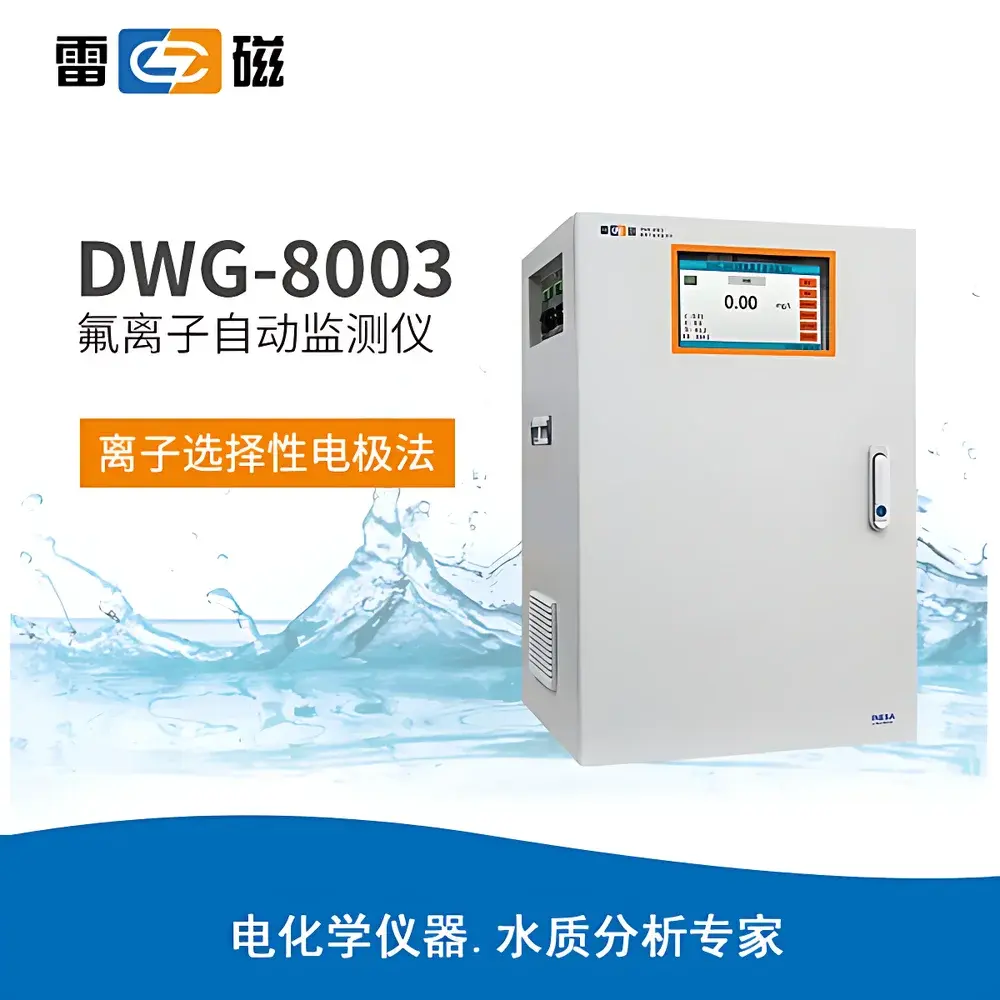
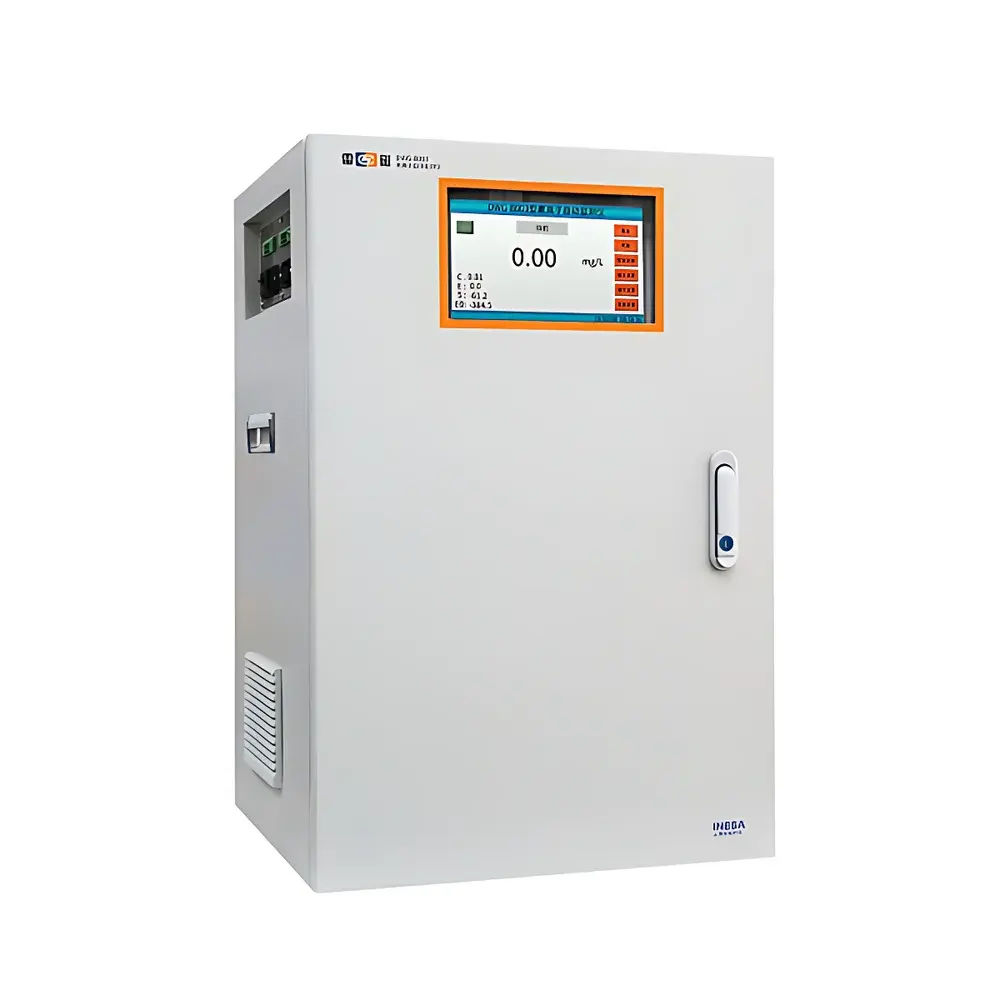
Leici DWG-8003 Fluoride Ion Online Analyzer
| Brand | Leici |
|---|---|
| Origin | Shanghai, China |
| Model | DWG-8003 |
| Type | Online Ion Analyzer |
| Measurement Range | (0.05–1900) mg/L F⁻ |
| Resolution | 0.01 mg/L |
| Accuracy | ±10% of reading |
| Repeatability | ≤3% |
| Stability | ±10% over 4 h |
| 90% Response Time | ≤5 min |
| Output | Isolated 4–20 mA DC (configurable span) |
| Communication | RS-232 or RS-485 (user-selectable) |
| Power Supply | AC 220 V ±10%, 50 Hz |
| Dimensions | 600 × 450 × 160 mm |
| Weight | 50 kg |
Overview
The Leici DWG-8003 Fluoride Ion Online Analyzer is an industrial-grade, continuous-monitoring instrument engineered for reliable, real-time quantification of fluoride ion (F⁻) concentration in aqueous environmental and process streams. It operates on the potentiometric principle using a solid-state or lanthanum fluoride (LaF₃)-based ion-selective electrode (ISE), which generates a Nernstian potential response proportional to the logarithm of free fluoride activity in solution. Designed for unattended operation in demanding field environments—including surface water intakes, drinking water treatment plants, municipal wastewater effluents, and industrial discharge monitoring—the DWG-8003 integrates temperature compensation, automated calibration routines, and robust signal conditioning to maintain measurement integrity across variable matrix conditions. Its architecture complies with fundamental requirements for continuous emission monitoring systems (CEMS) and supports integration into centralized SCADA or LIMS infrastructures via standardized analog and serial protocols.
Key Features
- Ion-selective electrode (ISE) detection system optimized for fluoride-specific response in complex aqueous matrices, minimizing interference from hydroxide, chloride, and sulfate ions under controlled pH conditions (typically pH 5.0–7.0 with TISAB buffer addition)
- Integrated Peltier-based thermostatic control module maintaining sample cell temperature within ±0.5 °C, eliminating thermal drift-induced measurement uncertainty
- 7-inch high-resolution color TFT touchscreen interface with intuitive Chinese-language HMI—fully configurable for multi-user access levels and audit-trail-enabled operation
- Automated calibration sequence supporting up to three-point standardization (e.g., 0.1, 1.0, and 10.0 mg/L F⁻), programmable at user-defined intervals (1–168 h)
- Onboard automatic electrode cleaning cycle using compressed air or low-pressure water jet, triggered per measurement cycle or on scheduled basis to prevent fouling
- Non-volatile internal memory storing ≥100,000 timestamped measurement records and calibration logs with cyclic overwrite protection
- Dual alarm logic: independent high/low concentration thresholds with relay outputs (dry contact) and visual/audio alerts; configurable hysteresis to suppress nuisance tripping
- Power-fail safeguard with supercapacitor-backed RAM retention and graceful restart recovery—no data loss during transient outages
Sample Compatibility & Compliance
The DWG-8003 is validated for use with natural waters (rivers, lakes, reservoirs), clarified and filtered drinking water, secondary-treated wastewater effluents, and pre-treated industrial discharges. Sample turbidity should remain below 5 NTU; suspended solids >10 mg/L require optional inline filtration (e.g., 5-µm cartridge). While not certified to ISO/IEC 17025 for accredited testing, its operational methodology aligns with ASTM D4292 (Standard Test Method for Fluoride Ion in Water by Ion-Selective Electrode) and EPA Method 300.0 (Determination of Anions by Ion Chromatography—supporting ISE as a field-screening alternative). The device meets electromagnetic compatibility (EMC) requirements per GB/T 18268.1–2010 (equivalent to IEC 61326-1) and safety standards per GB 4793.1–2007 (IEC 61010-1).
Software & Data Management
Data acquisition and configuration are managed via embedded firmware supporting Modbus RTU over RS-485 (default) or ASCII protocol over RS-232. The 4–20 mA output is fully scalable (e.g., 0.05–100 mg/L = 4–20 mA) with zero/span adjustment accessible through service mode. All critical events—including calibration initiation, alarm activation, cleaning cycles, and communication timeouts—are logged with UTC timestamps and retained for ≥12 months. Remote diagnostics and firmware updates may be performed via secure serial connection; no cloud dependency or external web server is required. Audit trail functionality records operator ID, action type, timestamp, and pre-/post-value where applicable—supporting GLP-aligned documentation practices.
Applications
- Regulatory compliance monitoring of fluoride discharge limits per local environmental protection bureau directives (e.g., China’s GB 8978–1996 and GB 5749–2022)
- Process control in fluoridation dosing systems at municipal water treatment facilities
- Early-warning detection of fluoride leaching from landfill leachate collection systems or mining runoff
- Quality assurance in semiconductor rinse water loops where sub-mg/L fluoride control is critical
- Long-term trend analysis in watershed management programs assessing anthropogenic fluoride loading
FAQ
What sample pretreatment is required prior to analysis?
Samples must be pH-adjusted to 5.0–7.0 using Total Ionic Strength Adjustment Buffer (TISAB) to minimize hydroxide interference and stabilize activity coefficients. Filtration (≤5 µm) is recommended for turbid or particulate-laden streams.
Can the DWG-8003 measure other anions such as chloride or nitrate?
No. The sensor is specifically configured for fluoride selectivity. Cross-sensitivity to chloride exceeds 10⁻⁴, making it unsuitable for multi-ion analysis without hardware replacement.
Is the instrument compatible with FDA 21 CFR Part 11 requirements?
It supports foundational elements—electronic signatures, audit trails, and role-based access—but lacks digital certificate infrastructure and electronic record validation tools required for full Part 11 compliance in pharmaceutical applications.
How often does the fluoride ISE require replacement?
Typical electrode service life is 12–18 months under continuous operation with regular cleaning and proper storage; performance degradation is indicated by reduced slope (8 min to 90%).
Does the analyzer support automatic TISAB dosing?
No. TISAB addition must be performed externally via peristaltic pump or manual spiking prior to sample introduction; the DWG-8003 does not include reagent dispensing hardware.
Related Products







