
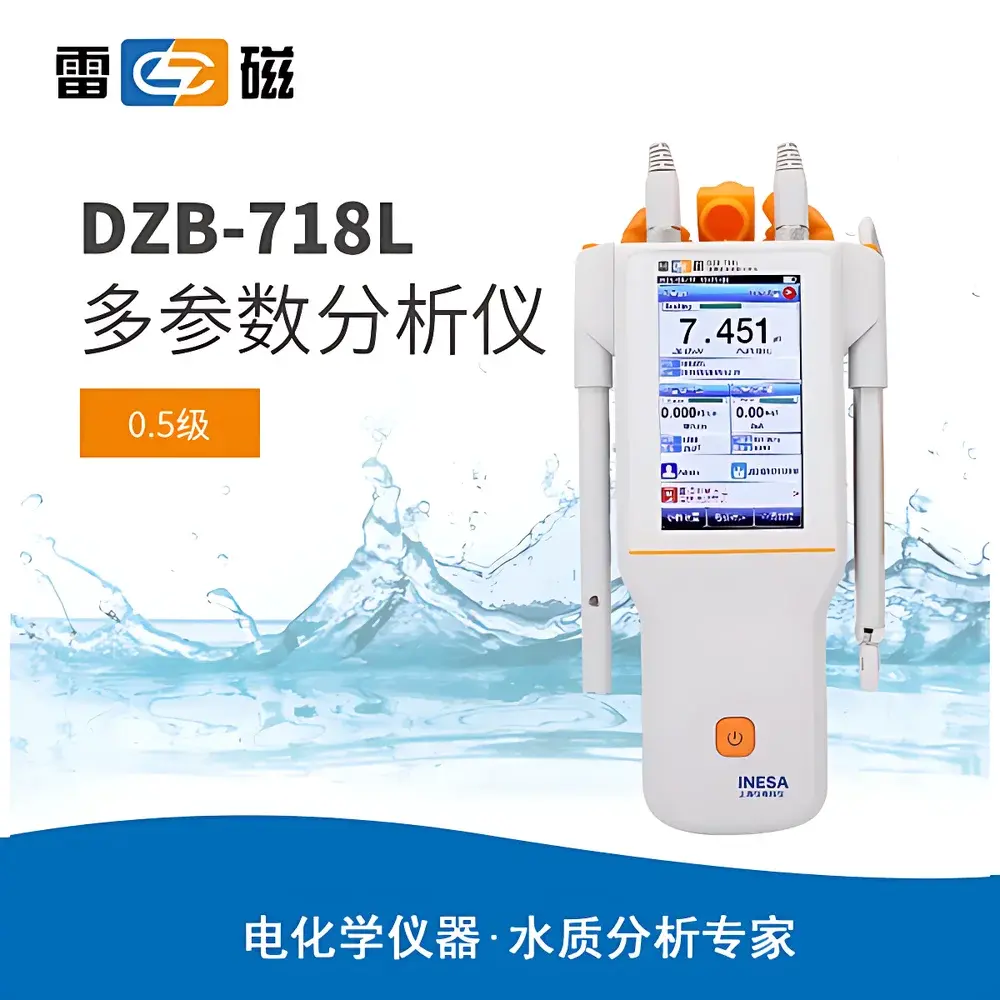
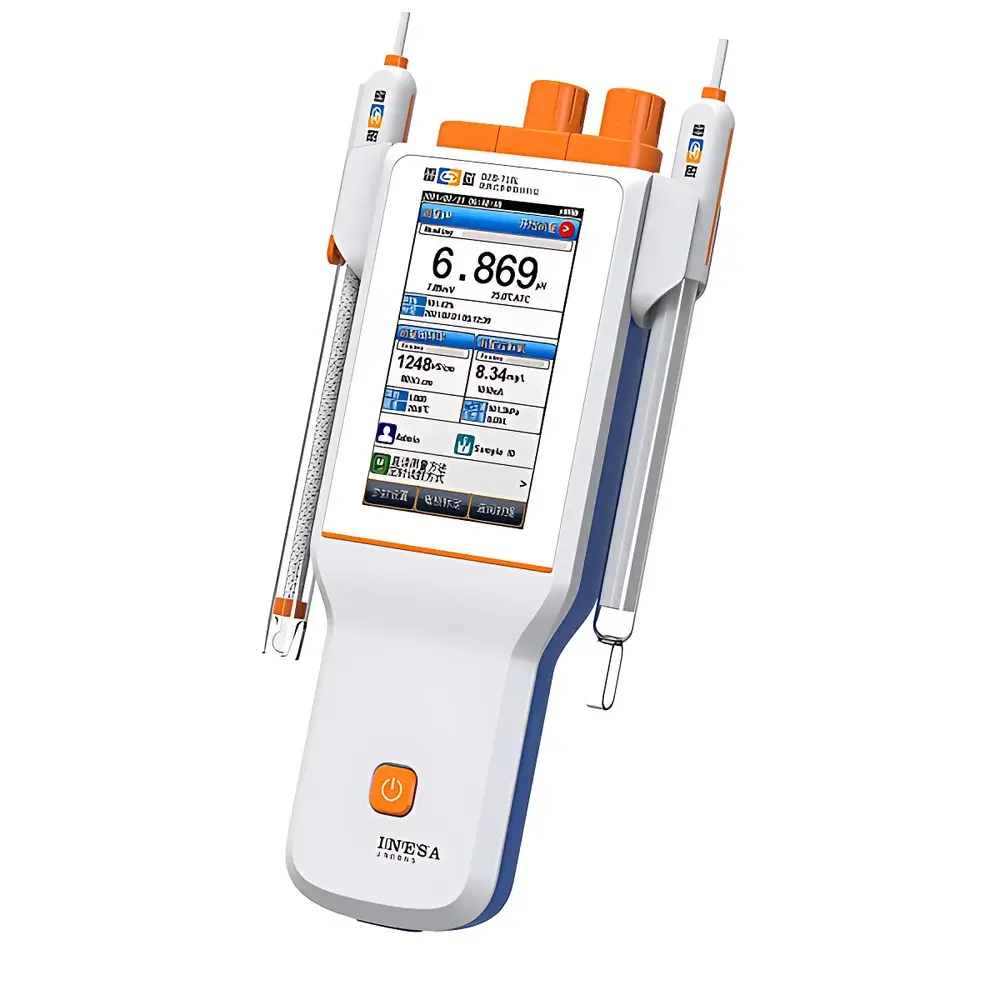
LeiCi DZB-718L Portable Multi-Parameter Water Quality Analyzer
| [Brand | LeiCi |
|---|---|
| Origin | Shanghai, China |
| Model | DZB-718L |
| Instrument Type | Portable/HANDHELD Water Quality Analyzer |
| Measured Parameters | pH, Conductivity, Resistivity, TDS, Salinity, Dissolved Oxygen (DO), Temperature |
| IP Rating | IP65 |
| Display | Color TFT Touchscreen |
| Power | Rechargeable Li-ion Battery |
| Compliance | GLP-compliant Data Management |
| Calibration | Auto-buffer recognition (NIST, GB, DIN, JIS, etc.), 1–8-point pH/pX, 1–5-point conductivity, zero/full-scale DO calibration |
| Connectivity | USB, Bluetooth, USB Flash Drive Support, Barcode Scanner Compatible |
| Storage Capacity | 1000 datasets per parameter group |
| Measurement Accuracy | pH ±0.002, Conductivity ±0.5% FS, DO ±0.10 mg/L (0–50 mg/L), Temp ±0.3 °C (0–60 °C)] |
Overview
The LeiCi DZB-718L Portable Multi-Parameter Water Quality Analyzer is an integrated, field-deployable instrument engineered for high-precision, real-time measurement of critical water quality parameters in environmental monitoring, wastewater treatment, aquaculture, drinking water distribution, and field-based regulatory compliance applications. Built upon a modular electrochemical sensing architecture, the DZB-718L simultaneously acquires data from three independent measurement units—pH/pX, conductivity/resistivity/TDS/salinity, and polarographic dissolved oxygen—each governed by traceable, temperature-compensated transduction principles. Its design adheres to fundamental metrological requirements for field instrumentation: stable electrode potential referencing (Ag/AgCl reference system), four-wire conductivity cell excitation with automatic frequency switching, and Clark-type polarographic DO sensing with membrane diffusion-controlled current response. The analyzer operates within a certified measurement range spanning −2.000 to 20.000 pH, 0.000 μS/cm to 3000 mS/cm conductivity, and 0.00 to 50.00 mg/L dissolved oxygen—enabling reliable characterization across freshwater, brackish, and moderately saline matrices.
Key Features
- High-resolution 4.3-inch color TFT capacitive touchscreen with intuitive icon-driven navigation and dual-language support (English & Chinese)
- IP65-rated enclosure ensuring dust-tightness and protection against low-pressure water jets—suitable for outdoor, humid, or splash-prone environments
- Triple-sensor integration: factory-calibrated tri-combination pH electrode, graphite composite conductivity cell (cell constant 1.0 cm⁻¹), and replaceable polarographic DO probe with Teflon membrane
- Intelligent endpoint detection algorithms supporting auto-read, timed-read, interval-read, and manual acquisition modes
- Comprehensive calibration management: auto-recognition of six international buffer standards (NIST, GB, DIN, USA, MERK, JIS); user-definable custom buffers and standard groups
- GLP-compliant data governance: timestamped records with operator ID, electrode serial numbers, calibration history, and environmental metadata (temperature, atmospheric pressure, salinity)
- Dual power architecture: embedded 3.7 V / 5000 mAh Li-ion battery (≥20 h continuous operation) + universal 5 V DC input for simultaneous charging and measurement
Sample Compatibility & Compliance
The DZB-718L is validated for use with natural waters (rivers, lakes, groundwater), treated effluents, process streams, and potable supplies. Its electrode configurations accommodate turbid, particulate-laden, and low-ionic-strength samples without clogging or drift—enabled by open-junction pH reference design and conductive polymer conductivity cell surface treatment. All measurement protocols align with established methodological frameworks: pH per ASTM D1293 and ISO 10523; conductivity per ASTM D1125 and ISO 7888; dissolved oxygen per ASTM D888 and ISO 5814. The instrument’s firmware implements audit-trail logging compliant with GLP principles, including immutable record creation, user-level access control (administrator/operator/guest tiers), password-protected configuration changes, and tamper-evident export logs—facilitating readiness for regulatory inspection under EPA, EU WFD, or local environmental agency mandates.
Software & Data Management
Data integrity is enforced through a hierarchical storage architecture: up to 1000 measurements per parameter group are retained onboard with full metadata tagging. Export options include CSV via USB-A port, encrypted batch transfer via LeiCi-specific PC software (compatible with Windows 10/11), and direct wireless synchronization to cloud-enabled lab information systems using Bluetooth 4.2 BLE profiles. The embedded file system supports FAT32-formatted USB flash drives for offline archival. All exported datasets contain embedded calibration certificates, electrode health indicators (e.g., asymmetry potential, slope %, membrane response time), and uncertainty annotations derived from instrument specifications and NIST-traceable reference standards. Firmware updates are delivered as signed binary packages to prevent unauthorized modification—maintaining configuration consistency across fleet deployments.
Applications
- Field verification of wastewater discharge compliance against local limits for pH (6–9), conductivity (2 mg/L)
- Rapid assessment of eutrophication risk via concurrent DO saturation %, temperature, and conductivity-derived ionic strength trends
- Aquaculture pond management: daily monitoring of pH diurnal shifts, DO minima at dawn, and salinity stability in hatcheries
- Drinking water safety surveys: spot-checking residual disinfectant impact on redox potential (via mV mode) alongside pH and conductivity
- Educational field labs: student-led water quality profiling with built-in method templates aligned to AP Environmental Science and university-level limnology curricula
- Emergency response: post-flood or spill event screening for acid mine drainage (low pH/high conductivity) or organic loading (low DO/high TDS)
FAQ
What calibration standards are supported for pH measurement?
The DZB-718L auto-recognizes seven predefined buffer groups (NIST, GB, DIN, JIS, USA, MERK, and custom) and allows manual entry of non-standard buffers with user-assigned pH values at specified temperatures.
Can the instrument compensate for atmospheric pressure during DO measurement?
Yes—barometric pressure compensation is fully automated using an integrated digital pressure sensor; units selectable as kPa, mbar, Torr, or atm.
Is the device suitable for seawater analysis?
It supports salinity ranges up to 8.00% and includes manual salinity compensation for DO; however, for full seawater (≈3.5% salinity), use of a dedicated marine-grade DO probe with optimized membrane thickness is recommended.
How is data security maintained during Bluetooth transmission?
All BLE communication uses AES-128 encryption; pairing requires explicit device authorization, and no raw measurement data is broadcast—only authenticated session handshakes and payload-encrypted packets.
Does the analyzer meet FDA 21 CFR Part 11 requirements?
While not formally validated for Part 11 in its out-of-box configuration, the DZB-718L provides foundational controls—including electronic signatures, audit trails, role-based access, and data immutability—that serve as the technical basis for site-specific validation under GxP-regulated environments.
Related Products







