
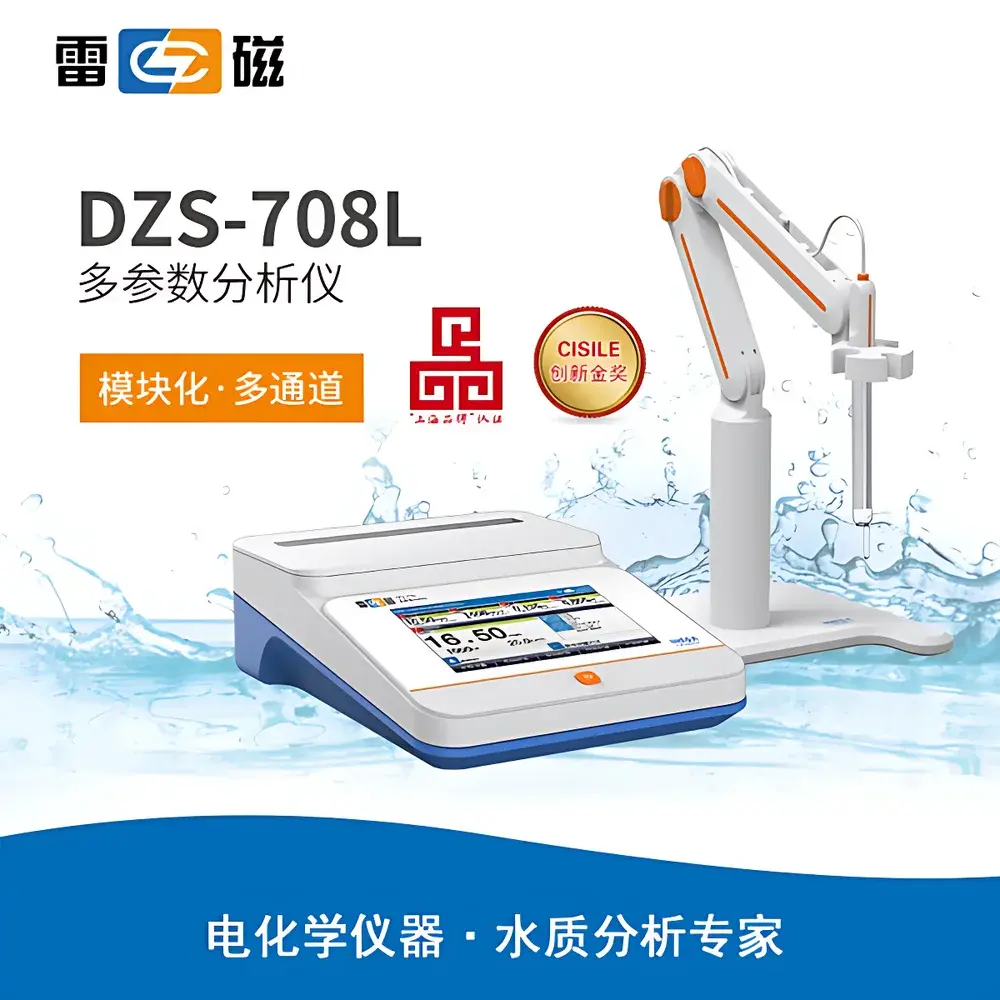
Leici DZS-708L Multi-Parameter Analyzer (Ion Detection Kit)
| Brand | Leici |
|---|---|
| Origin | Shanghai, China |
| Manufacturer Type | Authorized Distributor |
| Regional Classification | Domestic (PRC) |
| Model | Leici DZS-708L Multi-Parameter Analyzer (Ion Detection Kit) |
| Instrument Category | Multi-Ion Analyzer |
| Instrument Type | Benchtop |
| Measurement Range | (1.000 × 10⁻⁹ to 9.999 × 10⁹), selectable units: mol/L, mmol/L, g/L, mg/L, µg/L, ppm, ppb |
| Accuracy | ±0.3% of reading |
| Temperature Range | (−10.0 to 135.0) °C / (14.0 to 275.0) °F |
Overview
The Leici DZS-708L Multi-Parameter Analyzer (Ion Detection Kit) is a modular, benchtop electrochemical platform engineered for high-reproducibility quantitative ion analysis in environmental monitoring, municipal water treatment, industrial process control, and academic research laboratories. It operates on potentiometric measurement principles—specifically, direct potentiometry and standard addition methods—using ion-selective electrodes (ISEs) to determine activity-based concentrations of monovalent and multivalent cations and anions in aqueous matrices. The system integrates pH, ORP, mV, conductivity, dissolved oxygen, and temperature sensing capabilities within a single unified architecture, enabling concurrent multi-parameter profiling without hardware reconfiguration. Its core design adheres to fundamental metrological requirements for trace-level ion quantification, supporting detection limits down to 1.000 × 10⁻⁹ mol/L with four-digit significant resolution across seven concentration units. The instrument’s electronic unit meets Class 0.001 pH/pX specification per GB/T 23767–2009 and ISO 17025-aligned calibration traceability protocols.
Key Features
- 7-inch high-resolution color TFT capacitive touchscreen with intuitive icon-driven navigation and dual-language interface (English/Chinese)
- Four independent measurement channels with automatic module recognition—enabling plug-and-play integration of up to six interchangeable sensor modules: pH, pX (ion-selective), EC-T (two-electrode conductivity), EC-F (four-electrode conductivity), DO-F (fluorescence-based dissolved oxygen), and DO-P (Clark-type polarographic DO)
- IP54-rated enclosure for dust resistance and limited water ingress protection during routine lab use
- Comprehensive electrode diagnostics including pH electrode health assessment, slope/offset validation, and buffer group auto-recognition (GB, DIN, NIST, USA, MERK, JIS)
- Advanced endpoint determination algorithms: auto-read, timed-read, interval-read, and manual-triggered acquisition modes
- Configurable alarm thresholds for calibration status, measurement deviation, and electrode response stability
- Firmware-upgradable architecture supporting method expansion, regulatory compliance updates, and user-defined protocol deployment
Sample Compatibility & Compliance
The DZS-708L supports analysis of liquid samples across diverse matrices—including raw surface water, treated drinking water, wastewater effluents, leachates, soil extracts, and industrial process streams—provided they meet standard ISE compatibility criteria (e.g., low turbidity, absence of interfering complexing agents or redox-active species). It complies with GLP (Good Laboratory Practice) data integrity requirements through built-in audit trails, user-level access control (three-tier permission hierarchy), and immutable timestamped logging of all calibration events, method changes, and measurement records. While not certified for FDA 21 CFR Part 11 out-of-the-box, its GMP-ready operational log structure—including operator ID tagging, electronic signature placeholders, and revision-controlled method storage—facilitates qualification under ISO/IEC 17025 and EPA Method 300.0–300.1 frameworks for regulated ion testing.
Software & Data Management
Data handling conforms to international laboratory informatics standards: 1,000 measurement records per parameter type (pH, ORP, pX, ion concentration), 100 calibration datasets, and 1,000 pH buffer verification logs are retained onboard with full metadata (date/time, operator, electrode ID, temperature, ambient conditions). Export options include USB mass-storage mode (CSV and PDF formats), RS-232 serial printing (configurable templates), and PC synchronization via proprietary Leici Communication Software (Windows-compatible). U盘-based method import/export enables cross-instrument protocol harmonization. Optional barcode scanner integration permits sample ID auto-population, reducing transcription errors in batch workflows.
Applications
- Regulatory compliance testing for nitrate (NO₃⁻), fluoride (F⁻), chloride (Cl⁻), ammonium (NH₄⁺), and heavy metals (Pb²⁺, Cu²⁺, Cd²⁺) in drinking water per WHO Guidelines and China’s GB 5749–2022
- Wastewater discharge monitoring of sodium (Na⁺), potassium (K⁺), calcium (Ca²⁺), and sulfate (SO₄²⁻) in accordance with HJ/T 91–2002
- Soil pore-water extraction analysis for boron (BF₄⁻), cyanide (CN⁻), and iodide (I⁻) in environmental site assessments
- Calibration verification and performance qualification of ISEs used in continuous online analyzers
- Method development for non-standard ions (e.g., perchlorate ClO₄⁻, bromate BrO₃⁻) using custom pX curve modeling and GRAN plot generation
FAQ
Does the DZS-708L support automatic temperature compensation (ATC) during ion concentration measurements?
Yes—it integrates a Pt1000 RTD temperature sensor with real-time ATC across all electrochemical modules, applying Nernstian correction factors based on user-selected ion valence and thermodynamic parameters.
Can the instrument store and recall custom calibration curves for non-predefined ions?
Yes—up to 16 user-defined ion methods can be saved, each with unique slope, intercept, linear range, and unit conversion settings.
Is external power conditioning required for stable operation?
No—the integrated AC/DC adapter (100–240 VAC input, 20 VDC output) includes surge suppression and ripple filtering compliant with IEC 61000-4-5.
What is the maximum allowable sample conductivity when performing pX measurements?
For optimal ISE accuracy, total ionic strength should remain below 0.1 mol/L; higher conductivities require ionic strength adjustment via background electrolyte addition or dilution prior to analysis.
How does the system handle electrode drift during extended batch runs?
The DZS-708L implements dynamic baseline tracking and periodic zero-point verification using reference solution checks, triggering alerts when drift exceeds user-configured thresholds (default: ±2 mV/h).
Related Products







