
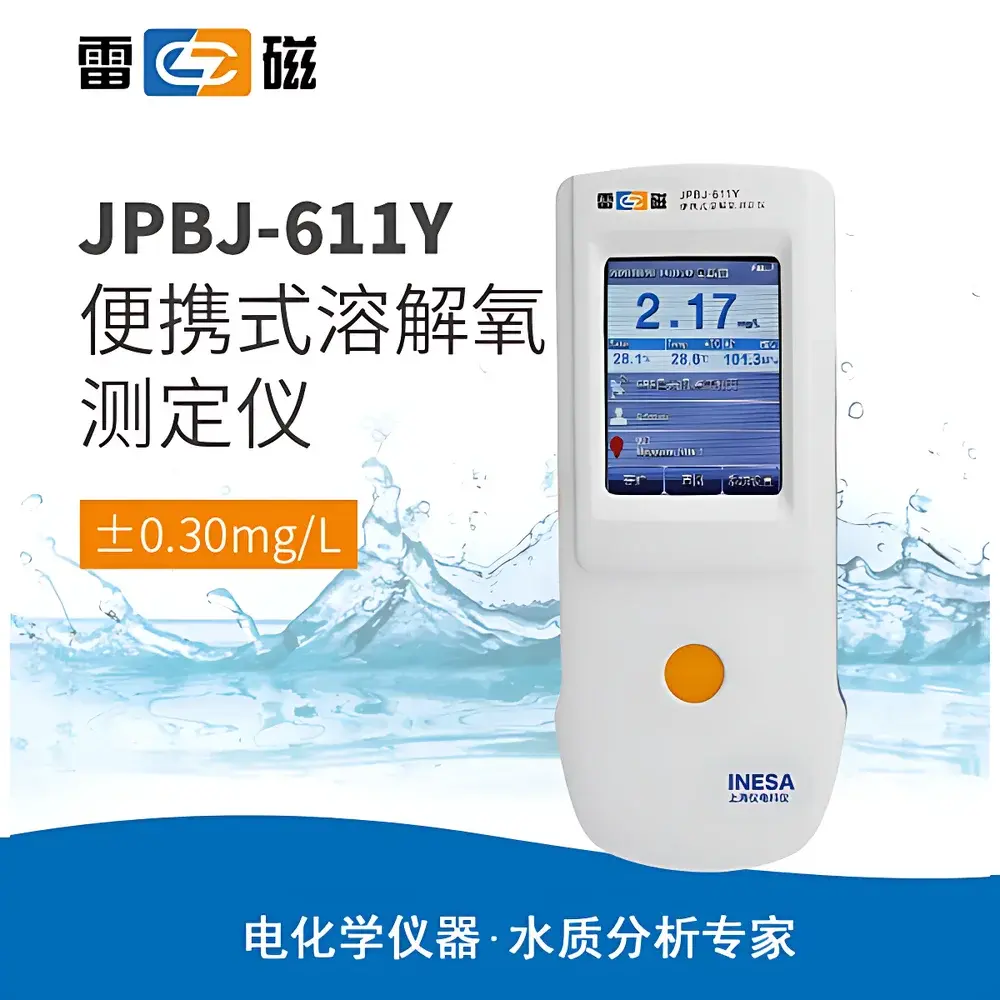
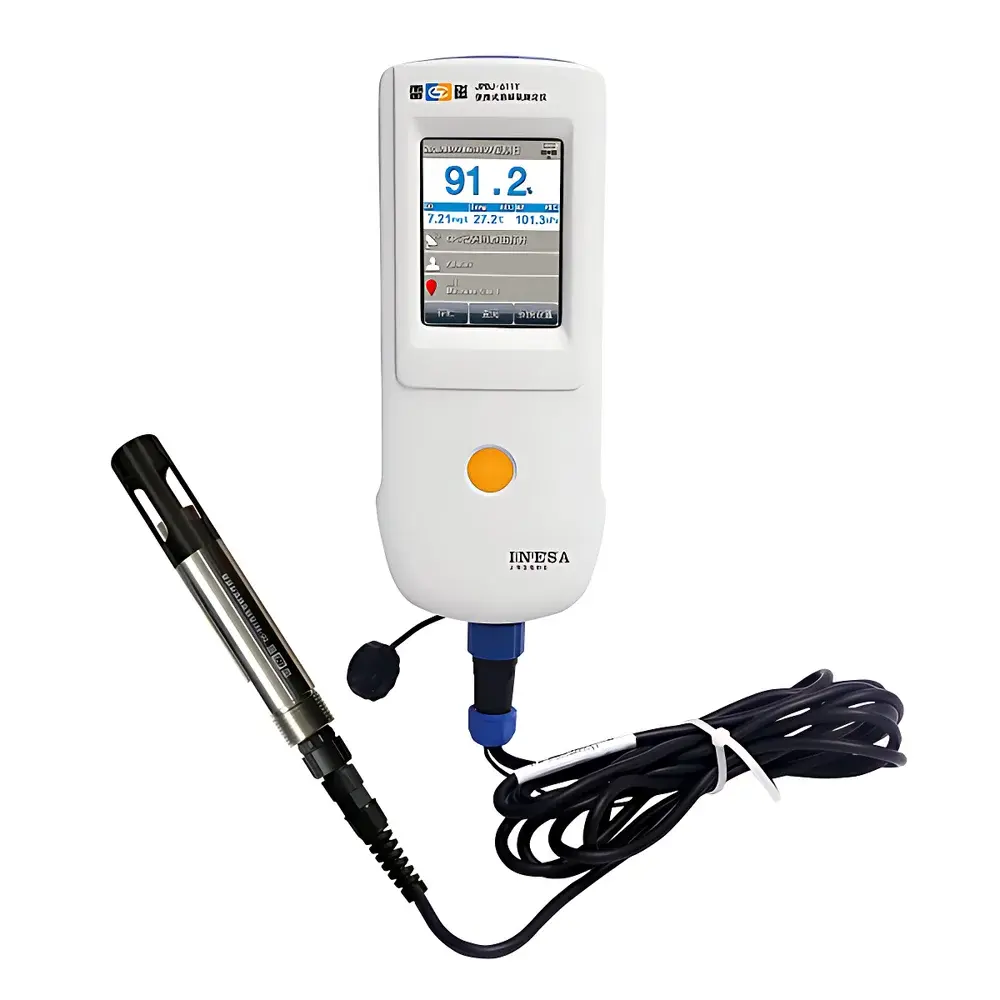
Leici JPBJ-611Y Portable Fluorescence-Based Dissolved Oxygen Meter
| Brand | Leici |
|---|---|
| Origin | Shanghai, China |
| Model | JPBJ-611Y |
| Instrument Type | Portable |
| Measurement Principle | Fluorescence Quenching |
| Measurement Range | (0.00–20.00) mg/L DO |
| Accuracy | ±0.30 mg/L |
| Resolution | 0.01 mg/L (DO), 0.1% (Saturation), 0.1 °C (Temperature) |
| Temperature Range | 0.0–50.0 °C |
| Atmospheric Pressure Compensation | Automatic (50.0–110.0 kPa) |
| Salinity Compensation | Manual (0.0–50.0 g/L) |
| Data Storage Capacity | 1000 records with GPS, timestamp, operator ID, section ID, and calibration metadata |
| Power Supply | Rechargeable Li-ion battery |
| Dimensions | 235 × 90 × 56 mm |
| Weight | ~0.3 kg |
| Standard Electrode | DO-962 fluorescence-based DO sensor |
Overview
The Leici JPBJ-611Y is a field-deployable, fluorescence-quenching based dissolved oxygen (DO) meter engineered for high-reliability in situ water quality assessment. Unlike traditional electrochemical Clark-type sensors—whose performance degrades due to membrane fouling, electrolyte depletion, and flow-dependent response—the JPBJ-611Y employs optical sensing technology grounded in the Stern–Volmer principle: molecular oxygen quenches the fluorescence lifetime of a ruthenium-complex immobilized on the sensor tip. This physical measurement mechanism eliminates polarization time, removes dependence on sample flow rate or stirring, and ensures stable output across variable environmental conditions—including low-turbidity streams, high-salinity estuaries, and organically rich aquaculture ponds. Designed explicitly for regulatory-grade field deployment, the instrument meets core functional requirements for ambient water monitoring under ISO 5814:2012 (Water quality — Determination of dissolved oxygen — Electrochemical probe method) and supports traceable data acquisition workflows aligned with GLP-compliant environmental monitoring programs.
Key Features
- Fluorescence-based DO sensing with no membrane replacement, zero electrolyte refills, and no warm-up or polarization delay—reducing long-term operational cost and maintenance downtime.
- Integrated GPS module enabling georeferenced data logging; each measurement record embeds latitude/longitude, timestamp, operator ID, and user-defined section identifier (up to 30 sections).
- 3.5-inch TFT capacitive touchscreen with high-transmittance optical bonding—optimized for readability under direct sunlight and glove-compatible operation in humid or rainy field conditions.
- Intelligent power management: auto-backlight dimming, programmable auto-shutdown, and low-power sleep mode extend battery life beyond 20 hours per full charge.
- Comprehensive environmental compensation: automatic atmospheric pressure correction (50.0–110.0 kPa), manual salinity input (0.0–50.0 g/L), and full-range temperature compensation (0.0–50.0 °C).
- Robust mechanical design: IP67-rated housing, shock-absorbing rubber overmold, and secure electrode bayonet mount—engineered to withstand repeated submersion, riverbank impacts, and transport in mobile labs.
Sample Compatibility & Compliance
The JPBJ-611Y is validated for direct immersion measurements in natural and anthropogenically impacted waters—including rivers, lakes, wastewater effluents, aquaculture systems, coastal zones, and industrial discharge points. Its fluorescence sensor (DO-962) exhibits minimal interference from hydrogen sulfide, chlorine, carbon monoxide, and heavy metal ions—common interferents in conventional amperometric DO probes. The instrument supports dual-unit reporting (mg/L and % saturation) and complies with fundamental metrological traceability requirements outlined in ISO/IEC 17025:2017 for field instrumentation. While not certified for FDA 21 CFR Part 11 compliance out-of-the-box, its audit-ready data structure—including immutable timestamps, calibration event logs, and operator authentication fields—facilitates integration into GxP-aligned environmental QA/QC protocols when deployed with documented SOPs.
Software & Data Management
All measurements are stored internally (1000 records maximum) with embedded metadata: section ID, GPS coordinates (WGS84), operator code, calibration history (zero/full-point verification dates and values), temperature, pressure, and salinity inputs. Data export is supported via USB-C interface in CSV format—compatible with LIMS platforms, Excel-based trend analysis, and GIS mapping tools (e.g., QGIS, ArcGIS). The instrument supports firmware updates via PC utility software, enabling future enhancements such as expanded calibration algorithms, enhanced GPS accuracy modes, or custom report templates. No cloud connectivity or proprietary cloud accounts are required—ensuring data sovereignty and alignment with institutional IT security policies.
Applications
- River and stream health monitoring: real-time DO profiling across longitudinal transects to identify hypoxic zones and assess reaeration capacity.
- Wastewater treatment plant (WWTP) effluent compliance: rapid verification of discharge DO levels against local regulatory thresholds (e.g., EPA Method 4500-O G).
- Aquaculture site management: routine pond DO surveillance to prevent fish stress during diurnal oxygen swings or algal bloom events.
- Marine and estuarine research: salinity-compensated DO mapping in tidal flats, mangrove ecosystems, and brackish lagoons.
- Emergency response: rapid deployment during chemical spills or thermal discharges where immediate DO depression indicates acute ecological risk.
FAQ
Does the JPBJ-611Y require daily calibration?
No—fluorescence-based DO sensors exhibit excellent long-term stability. Zero-point calibration is recommended before first use and after extended storage; full-scale calibration is advised weekly for critical applications or after exposure to extreme biofouling conditions.
Can the DO-962 sensor be used in seawater?
Yes—provided manual salinity compensation is entered (range: 0.0–50.0 g/L). The sensor’s optical surface resists chloride-induced corrosion better than noble-metal cathodes in electrochemical probes.
Is GPS data logged with every measurement?
Yes—each record includes WGS84 coordinates, altitude (derived from barometric pressure), and UTC timestamp synchronized to internal RTC.
How is data integrity ensured during power loss?
The device implements non-volatile flash memory with write-caching and transactional logging—ensuring no record corruption or partial writes during unexpected shutdown.
What is the expected service life of the DO-962 sensor?
Under typical field use (≤4 hrs/day immersion), the sensor maintains NIST-traceable accuracy for ≥24 months; optical window cleaning and protective cap usage significantly extend functional lifespan.







