
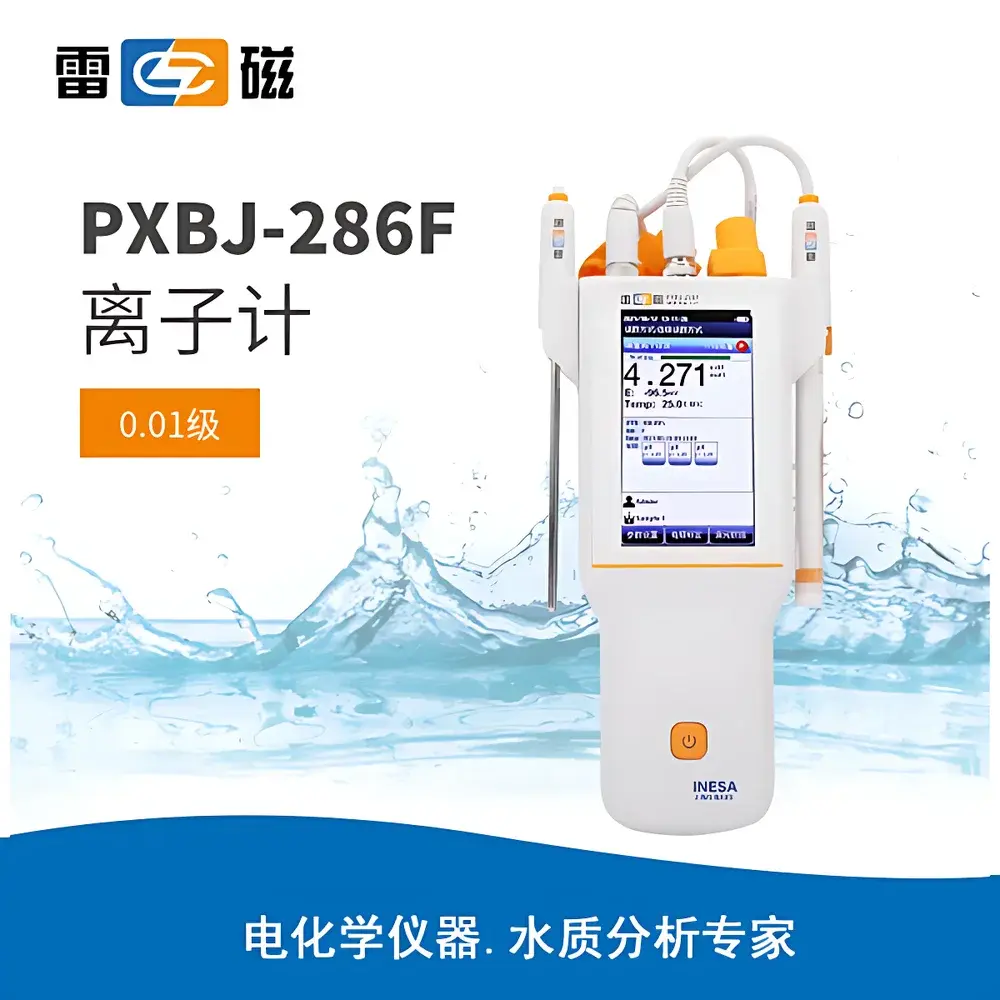
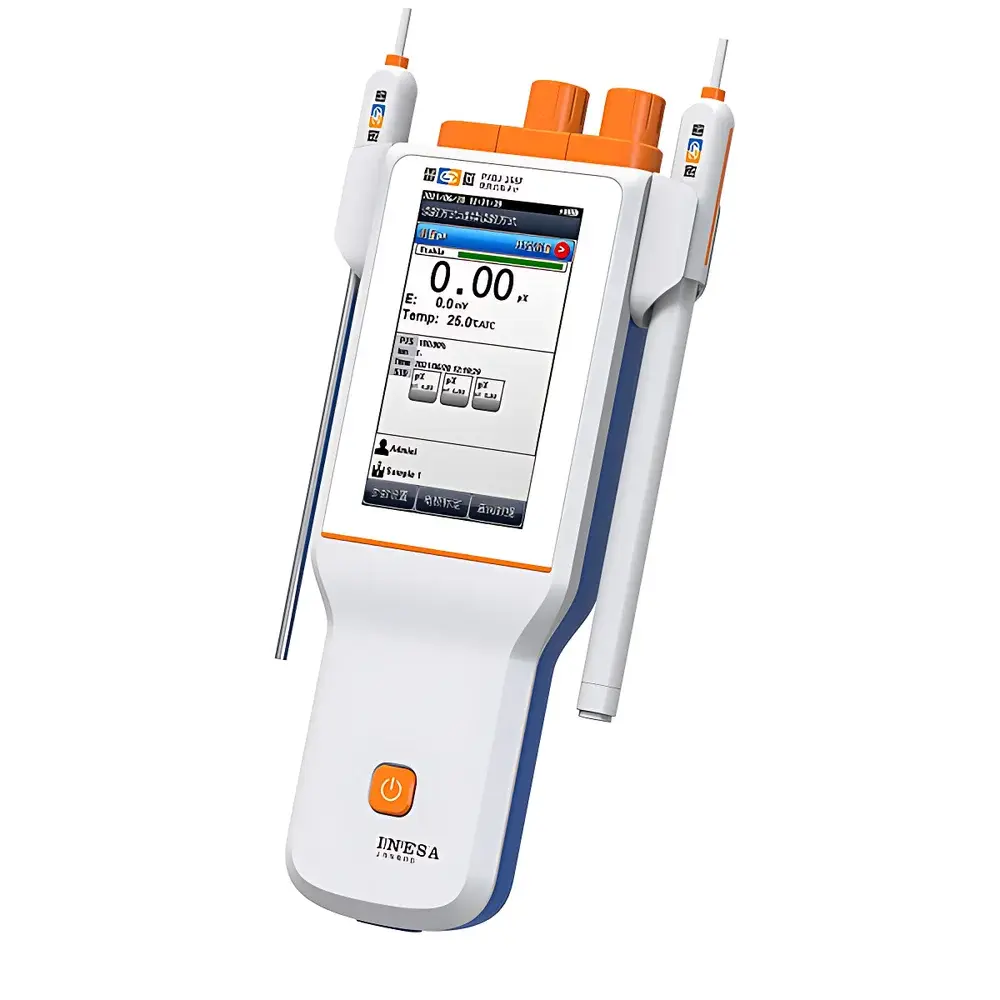
Leici PXBJ-286F Portable Ion Analyzer
| Brand | Leici |
|---|---|
| Origin | Shanghai, China |
| Model | PXBJ-286F |
| Instrument Type | Portable |
| Ion Measurement Range | (−2.00 to 20.00) pX |
| Measurement Accuracy | ±0.01 pX |
| Temperature Range | (−5.0 to 110.0) °C / (23.0 to 230.0) °F |
| pH Range | (−2.00 to 20.00) pH |
| mV Range | (−2000.0 to 2000.0) mV |
| Resolution | 0.01 pX / 0.01 pH / 0.1 mV |
| Temperature Resolution | 0.1 °C / 0.1 °F |
| IP Rating | IP65 |
| Battery | Rechargeable Li-ion |
| Dimensions | 90 × 255 × 40 mm |
| Weight | 0.5 kg |
Overview
The Leici PXBJ-286F Portable Ion Analyzer is a field-deployable electrochemical measurement system engineered for high-precision potentiometric determination of monovalent and multivalent ions in aqueous environmental and industrial samples. Based on the Nernst equation principle, the instrument measures the potential difference between a selective ion electrode (e.g., fluoride, chloride, sodium, potassium, ammonium) and a reference electrode, converting the resulting millivolt signal into concentration units via calibration-derived slope and intercept. Designed for compliance with ISO 17025–accredited laboratories and field-based water quality monitoring programs, the PXBJ-286F supports trace-level ion quantification across five orders of magnitude — from µg/L to mol/L — with built-in temperature compensation and automatic endpoint recognition. Its compact form factor, ruggedized housing, and battery-powered operation enable reliable deployment in wastewater treatment plants, surface water sampling campaigns, groundwater assessment sites, and regulatory inspection workflows where laboratory-grade accuracy must be maintained outside controlled environments.
Key Features
- High-resolution 4.3-inch color TFT touchscreen interface with intuitive icon-driven navigation and dual-language support (English/Chinese)
- Selectable resolution modes: 0.01 pX / 0.1 pX and 0.1 mV / 1 mV for adaptive precision based on application requirements
- Multi-ion capability with preconfigured modes for F⁻, Cl⁻, NO₃⁻, NH₄⁺, K⁺, Na⁺, Ca²⁺, and user-defined ion types
- Automatic electrode recognition and intelligent endpoint detection using dynamic slope analysis and drift thresholding
- Comprehensive calibration flexibility: 1–5 point calibration; auto-recognition of GB, DIN, and NIST pH buffer sets; custom buffer group management
- IP65-rated enclosure ensuring dust-tightness and protection against low-pressure water jets — suitable for outdoor and humid environments
- Integrated temperature compensation with manual or automatic mode; dual-unit display (°C/°F) and ±0.2 °C accuracy
- Onboard data integrity controls including time-stamped measurements, operator ID tagging, and audit-ready event logging
Sample Compatibility & Compliance
The PXBJ-286F is validated for direct measurement of liquid-phase environmental matrices including raw and treated drinking water, surface water, groundwater, effluent streams, and industrial process waters. It accommodates standard combination electrodes and single-ion-selective electrodes (ISEs) with BNC or mini-DIN connectors. The analyzer complies with fundamental metrological requirements outlined in ISO 7870-2 (control charts), ASTM D1293 (pH of water), and ISO 10523 (water quality — determination of pH). While not certified to IEC 61000-6-3 for EMC emissions, its design meets essential electromagnetic compatibility criteria for portable field instrumentation. All stored measurement records adhere to GLP data integrity principles, including immutable timestamps, sequence numbers, and calibration history linkage — enabling full traceability during regulatory audits per EPA Method 300.0 and ISO/IEC 17025 clause 7.7.
Software & Data Management
Data handling is governed by a secure embedded file system supporting up to 1,000 individual measurement records per parameter type (pX, pH, mV, temperature). Each record includes sample ID, electrode serial number, calibration date, ambient temperature, operator code, and raw sensor output. Export is enabled via USB 2.0 interface using Leici’s proprietary PC communication software, which generates CSV- and PDF-formatted reports compliant with FDA 21 CFR Part 11 requirements — including electronic signatures, audit trails, and role-based access control. Optional RS-232 output permits direct connection to thermal printers for real-time hardcopy generation with customizable report templates (e.g., header/footer fields, unit notation, pass/fail flags). Firmware updates are delivered via signed binary packages to ensure cryptographic integrity and prevent unauthorized modification.
Applications
- Field verification of fluoride levels in municipal drinking water per WHO guidelines (1.5 mg/L maximum)
- In-situ monitoring of ammonium nitrogen in wastewater influent and effluent for nitrification/denitrification process control
- Groundwater surveying for chloride intrusion in coastal aquifers
- Calibration and validation of online ion-selective sensors in SCADA-integrated water networks
- Educational laboratory use for teaching potentiometric analysis, Nernstian behavior, and standard addition methodology
- Environmental impact assessments requiring rapid screening of heavy metal cations (e.g., Pb²⁺, Cd²⁺) using appropriate ISEs
FAQ
What ion-selective electrodes are compatible with the PXBJ-286F?
The analyzer accepts all standard BNC-terminated ISEs and combination electrodes meeting IUPAC-recommended impedance specifications (< 10¹² Ω). Fluoride, chloride, nitrate, ammonium, sodium, and potassium electrodes are factory-validated; other ions require user-defined calibration curves.
Does the device support GLP-compliant data export?
Yes — exported files include full metadata (operator ID, calibration certificates, timestamped readings) and can be configured to meet ALCOA+ principles (Attributable, Legible, Contemporaneous, Original, Accurate) when used with Leici’s desktop software.
Can the PXBJ-286F perform Gran plot analysis for weak acid dissociation studies?
Yes — the instrument implements the Gran method for precise equivalence point determination in titration-based ion concentration assays, with automated slope calculation and linear regression fitting.
Is temperature compensation mandatory during pX measurement?
Temperature compensation is optional but strongly recommended; the Nernst slope varies by 0.198 mV/pX per °C at 25 °C, and uncorrected measurements may introduce systematic bias exceeding ±5% in non-isothermal conditions.
How long does the rechargeable battery last under continuous operation?
At typical usage (backlight set to medium, measurement interval every 30 seconds), the integrated 3.7 V / 4000 mAh Li-ion battery provides ≥12 hours of uninterrupted operation, with low-battery warning activated at 15% remaining capacity.







