
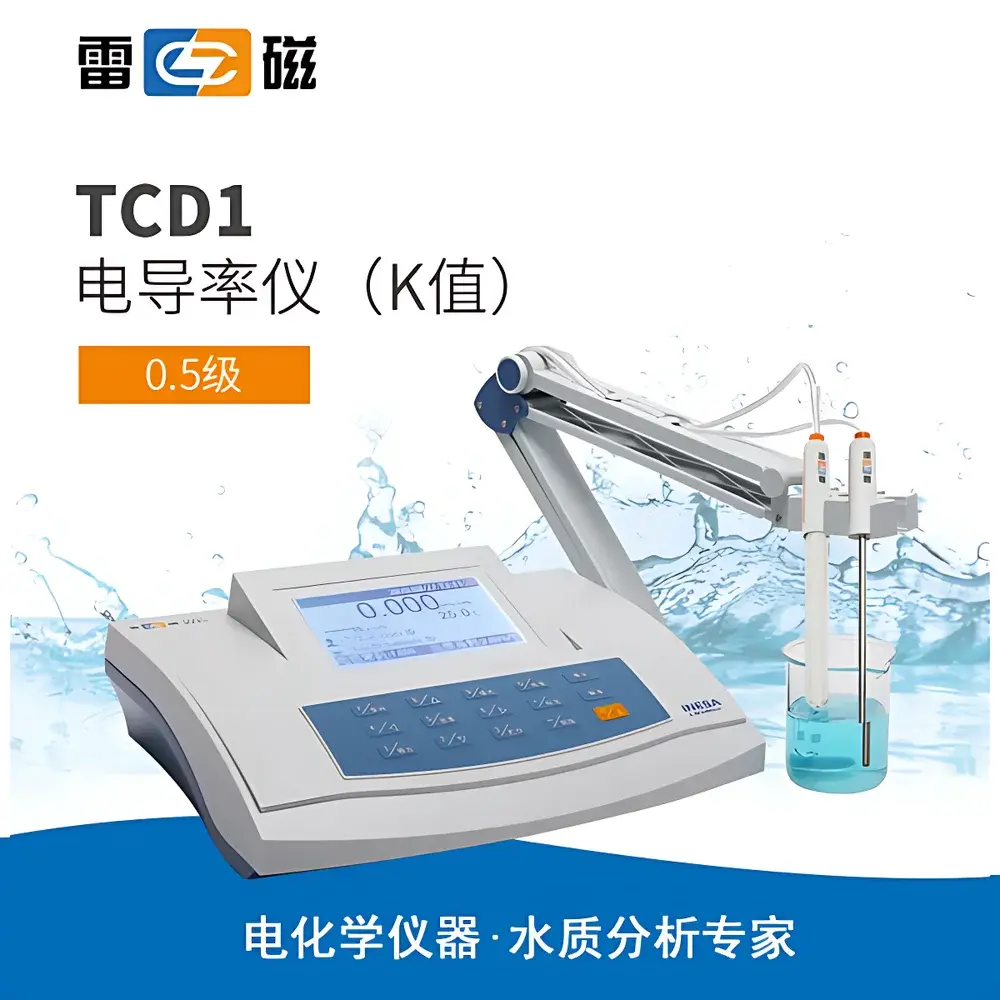
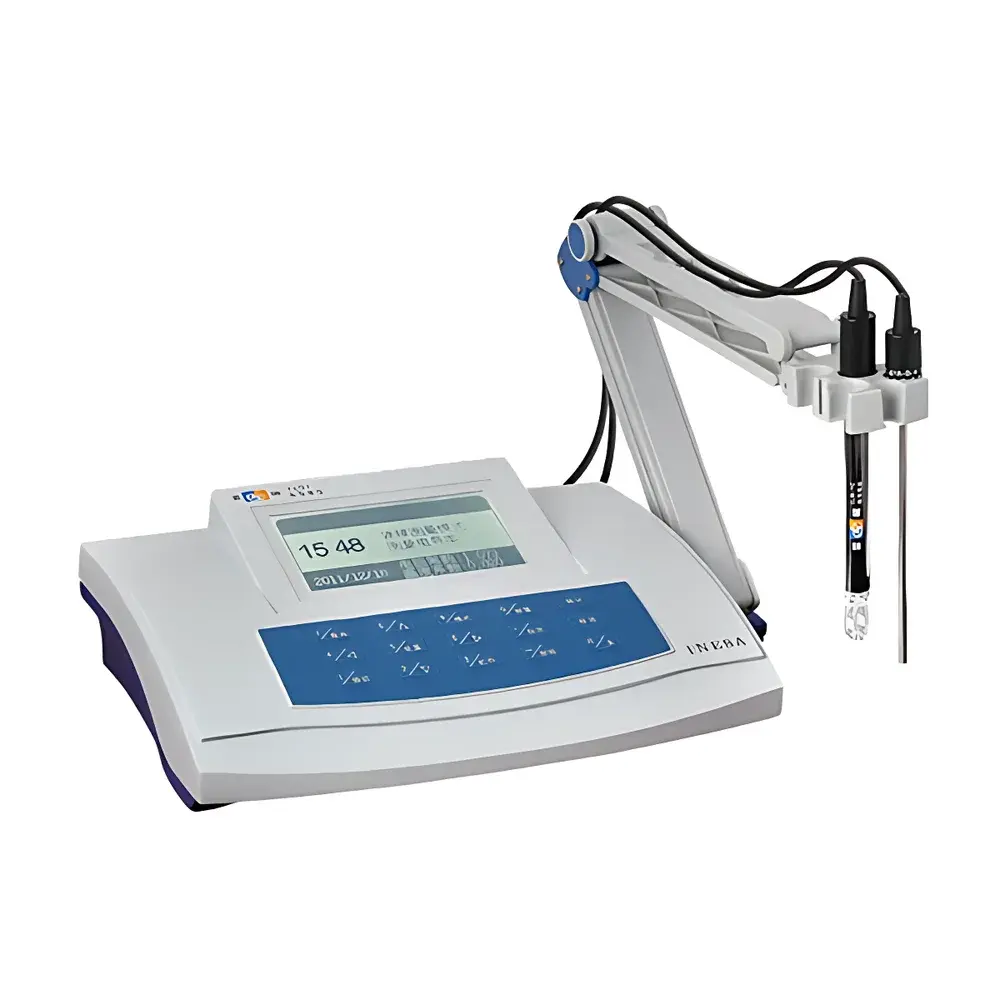
LeiCi TCD1 Conductivity Meter (K-Value Calibration Mode)
| Key | Brand=LeiCi |
|---|
Overview
The LeiCi TCD1 Conductivity Meter (K-Value Calibration Mode) is a precision desktop electrochemical instrument engineered for reliable, multi-parameter measurement of aqueous solutions in regulated laboratory environments. Based on the fundamental principle of conductometric analysis—measuring the electrical conductance of a solution between two electrodes—the TCD1 determines conductivity by applying an alternating current (AC) excitation signal to minimize polarization effects and electrode fouling. The instrument supports K-value calibration mode, enabling direct input and verification of electrode cell constant (K, unit: cm−1), a critical requirement for trace-level conductivity validation, standard solution preparation, and method transfer across laboratories. Its design conforms to core metrological practices defined in ISO 7888 (water quality — determination of electrical conductivity) and supports routine compliance with GLP (Good Laboratory Practice) documentation workflows.
Key Features
- Multi-parameter measurement: simultaneous real-time display of conductivity, resistivity, TDS (total dissolved solids), salinity, and temperature;
- Intelligent frequency switching: single electrode (DJS-1C bright-surface type) automatically selects optimal excitation frequency across the full 0.000 µS/cm–199.9 mS/cm range, eliminating manual electrode swapping;
- Three adaptive read modes: Smart-Read (user-selectable stability criteria: Fast/Medium/Strict); Timed-Read (programmable interval or endpoint termination); Cont-Read (continuous dynamic monitoring with timestamped trend visualization);
- Comprehensive temperature compensation: automatic or manual compensation over −5.0 to 110.0 °C using integrated T-818-B-6 thermistor sensor (±0.2 °C intrinsic accuracy);
- High-contrast dot-matrix LCD with adjustable backlight for low-light operation; rugged polycarbonate front panel with tactile membrane keys rated for >1 million actuations;
- Full auto-ranging, auto-calibration, and auto-zero functions reduce operator dependency and improve inter-user reproducibility;
- Robust data integrity architecture: non-volatile memory retains up to 200 datasets per parameter group (conductivity/TDS/salinity), each with timestamp, temperature, and calibration metadata.
Sample Compatibility & Compliance
The TCD1 is optimized for aqueous samples including ultrapure water, pharmaceutical buffers, environmental surface waters, industrial process streams, and saline media. It accommodates standard DIN/ISO-compliant conductivity cells (e.g., DJS-1C, K = 1.0 cm−1) and supports user-defined K-value entry for traceable calibration against NIST-traceable KCl standards. Instrument performance aligns with ASTM D1125 (Standard Test Methods for Electrical Conductivity and Resistivity of Water) and supports audit-ready GLP documentation through embedded calibration logs, operator ID fields (via optional software), and timestamped measurement history. While not certified for FDA 21 CFR Part 11 out-of-the-box, its USB data export capability enables integration into validated LIMS or ELN systems where electronic signatures and audit trails are externally managed.
Software & Data Management
Data transfer is facilitated via USB interface using LeiCi’s proprietary PC communication software (compatible with Windows 10/11). The software enables bidirectional synchronization: upload calibration settings and measurement protocols; download raw datasets with full metadata (date/time, temperature, electrode K-value, measurement mode, stability flag). Export formats include CSV and XLSX for downstream statistical analysis (e.g., control charts per ISO 2859-1) or regulatory submission packages. All stored data retain instrument-generated timestamps and are protected by hardware-level power-fail safeguard—no data loss occurs during unexpected shutdown. Print functionality supports direct thermal or inkjet output of measurement reports with customizable headers and footers.
Applications
- Pharmaceutical QC: USP purified water and water-for-injection (WFI) conductivity verification at 25 °C;
- Environmental monitoring: EPA Method 120.1 compliance for surface water and wastewater effluent screening;
- Academic research: ion mobility studies, electrolyte concentration profiling, and temperature-dependent conductivity modeling;
- Food & beverage: brine concentration control in pickling, dairy processing, and desalination pilot studies;
- Power generation: boiler feedwater purity assurance per ASTM D4582 and IAPWS guidelines;
- Calibration lab use: K-value verification of reference cells prior to ISO/IEC 17025 accreditation audits.
FAQ
Does the TCD1 support automatic electrode recognition?
No. Electrode identification is manual; users must enter the calibrated K-value (e.g., 0.985 cm−1) prior to measurement. This ensures traceability and avoids firmware-based assumptions about cell geometry.
Can the instrument be used for high-ionic-strength samples above 100 mS/cm?
Yes—within its specified upper limit of 199.9 mS/cm. For such samples, use the DJS-1C electrode with appropriate cleaning protocol (e.g., dilute HNO3 rinse) to prevent salt crystallization on platinum surfaces.
Is temperature compensation applied to all measured parameters?
Yes. Conductivity, TDS, and salinity values are automatically compensated to the reference temperature (typically 25 °C) using the linear or nonlinear (NaCl-based) algorithm selected in setup mode.
What is the minimum sample volume required for accurate measurement?
A minimum immersion depth of 30 mm is required for the DJS-1C electrode. Sample volume should exceed 50 mL to ensure thermal equilibrium and avoid boundary-layer artifacts.
How frequently should the instrument be calibrated?
Calibration frequency follows risk-based assessment per ISO/IEC 17025:2017 Clause 7.7. For routine QC, daily verification with a mid-range KCl standard (e.g., 1413 µS/cm at 25 °C) is recommended; full two-point calibration every 24–48 hours or after electrode cleaning.
Related Products




