
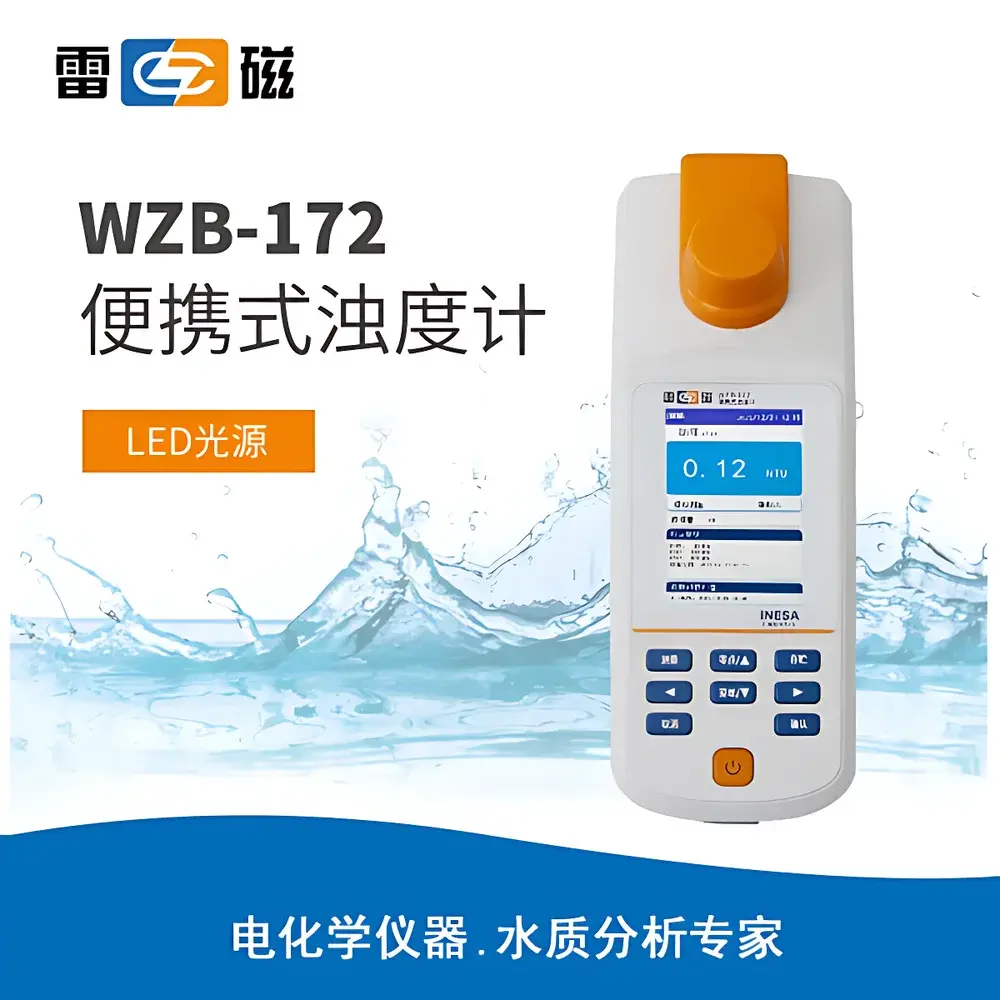
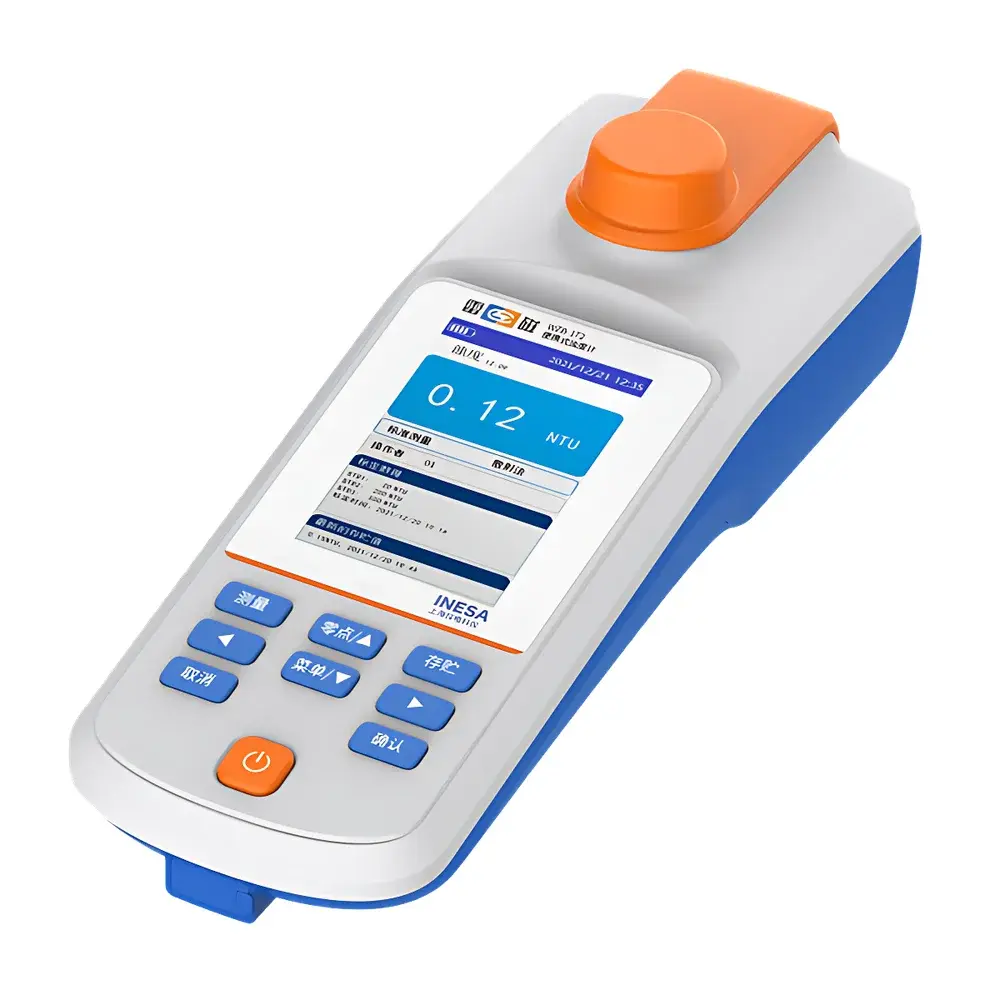
Leici WZB-172 Portable Turbidimeter
| Brand | Leici |
|---|---|
| Origin | Shanghai, China |
| Manufacturer Type | Authorized Distributor |
| Region of Origin | Domestic (China) |
| Model | WZB-172 |
| Price | USD 560 (excl. VAT & shipping) |
| Product Type | Portable |
| Measurement Range | 0.00–500.0 NTU |
| Resolution | 0.01 NTU (at low range), 0.1 NTU (mid), 1 NTU (high) |
| Accuracy | ±6% FS |
| Repeatability | ≤0.5% |
| Zero Drift | ±0.5% FS / 30 min |
| Stability | ±0.5% FS / 30 min |
| Calibration Points | Up to 4-point (2, 20, 200, 500 NTU) |
| Data Storage | 1000 records |
| Display | 4.3-inch color TFT LCD |
| IP Rating | IP65 |
| Operating Temperature | 5–40 °C |
| Relative Humidity | ≤85% RH |
| Power | Rechargeable Li-ion battery |
| Dimensions | 90 × 250 × 90 mm |
| Weight | ~0.8 kg |
Overview
The Leici WZB-172 Portable Turbidimeter is an ISO 7027-compliant optical instrument engineered for field-deployable and routine laboratory turbidity measurement in water quality monitoring applications. It employs a stable 860 nm infrared LED light source and implements dual optical detection geometry—nephelometric (90° scattered light) and ratio-mode scattered-transmitted light—to minimize interference from color, particle absorption, or variable path length. This dual-mode architecture ensures reliable quantification across diverse sample matrices, including drinking water, wastewater effluents, surface water, and process streams where suspended solids concentration must be tracked against regulatory thresholds defined by HJ 1075–2019 (China’s Environmental Monitoring Standard) and international guidelines such as EPA Method 180.1 and ISO 7027–1:2016. The instrument operates on the principle that turbidity—expressed in Nephelometric Turbidity Units (NTU)—is proportional to the intensity of light scattered at 90° relative to the incident beam, with compensation applied via simultaneous transmission measurement to correct for absorbance artifacts.
Key Features
- Infrared LED light source at 860 nm wavelength, compliant with ISO 7027 and HJ 1075–2019 for standardized turbidity reporting
- Dual measurement modes: standard nephelometry (90° scatter) and ratio-mode scatter-transmission for enhanced accuracy in colored or highly absorbing samples
- Auto-ranging capability across three dynamic ranges: 0.00–9.99 NTU (0.01 NTU resolution), 10.0–99.9 NTU (0.1 NTU), and 100–500 NTU (1 NTU)
- 4.3-inch high-resolution color TFT LCD with intuitive icon-driven interface and real-time graphical feedback
- IP65-rated enclosure for dust-tight operation and resistance to low-pressure water jets—suitable for outdoor, plant-floor, or mobile lab use
- Integrated zero-point correction, multi-point calibration (up to four points: 2, 20, 200, and 500 NTU), and factory-default curve restoration
- Support for multiple turbidity units: NTU (nephelometric), FNU (formazin nephelometric units per ISO 7027), and EBC (European Brewery Convention units)
- Two measurement modes: single-shot standard mode and averaging mode (configurable 3–9 readings) to mitigate short-term fluctuations caused by particle settling or flow-induced heterogeneity
Sample Compatibility & Compliance
The WZB-172 accepts standard 25-mm round glass cuvettes (included) conforming to ISO 7027 dimensional tolerances. Its optical design minimizes sensitivity to cuvette scratches, fingerprints, or minor surface contamination through active reference channel normalization. The instrument meets functional requirements for GLP (Good Laboratory Practice) environments: each stored measurement record includes timestamp, operator ID (if configured), calibration status, unit selection, and measurement mode—enabling full traceability. While not certified to FDA 21 CFR Part 11 out-of-the-box, audit-ready data export (via Micro-USB and Leici专用 PC software) supports internal validation protocols required under ISO/IEC 17025-accredited laboratories. It is routinely deployed in municipal water utilities, environmental monitoring stations, food & beverage production QA/QC labs, and academic hydrology research where compliance with national standards (e.g., China’s GB 5749–2022 for drinking water) is mandatory.
Software & Data Management
- Onboard storage capacity: 1000 measurement records with full metadata (date/time, unit, mode, calibration ID)
- Data export via Micro-USB to Windows-based Leici TurbiLink™ desktop software (v3.2+), supporting CSV and PDF report generation
- RS-232 serial output compatible with standard thermal printers for hard-copy documentation during field audits or shift handovers
- GLP-compliant data structure: all calibrations are logged with date, reference value, deviation, and user confirmation; zero-point adjustments are similarly auditable
- No cloud connectivity or remote firmware update capability—ensures data sovereignty and simplifies IT security validation in regulated facilities
Applications
The WZB-172 serves critical roles in decentralized water quality assurance workflows. Field technicians use it for rapid verification of filtration efficiency at intake points or after sedimentation basins. In wastewater treatment plants, operators monitor effluent turbidity pre-discharge to ensure compliance with local discharge permits (e.g., ≤5 NTU for municipal reuse). Beverage manufacturers apply it to assess clarity of brewing liquor, filtered beer, or bottled water prior to packaging. Educational institutions deploy it in environmental science curricula for hands-on instruction in optical scattering theory, calibration traceability, and method validation. Its portability and ruggedized housing make it suitable for emergency response scenarios—including post-flood source water screening or disaster relief water safety assessments—where benchtop instruments are impractical.
FAQ
What turbidity standards are supported for calibration?
Calibration is performed using formazin-based or polymer-based standards traceable to NIST SRM 2134 series. The included long-life calibration kit contains certified values at 2, 20, 200, and 500 NTU (±3% uncertainty).
Can the WZB-172 measure samples with high color or UV-absorbing compounds?
Yes—the 860 nm infrared source reduces interference from yellow-to-brown chromophores common in humic waters; ratio-mode measurement further compensates for non-scattering attenuation.
Is the device compatible with third-party LIMS or SCADA systems?
Direct integration is not supported; however, exported CSV files can be ingested into most LIMS platforms via automated script or manual import. RS-232 output enables basic PLC-level logging.
How often should zero calibration be performed?
Zero adjustment is recommended before each measurement session and after prolonged storage (>24 h). The instrument retains zero offset in non-volatile memory but drift verification is advised when ambient temperature changes exceed ±5 °C.
Does the battery support hot-swapping or continuous operation while charging?
No hot-swap capability; however, the unit remains fully operational during USB-powered charging. Typical runtime is 12–15 hours per full charge under intermittent measurement conditions.



