
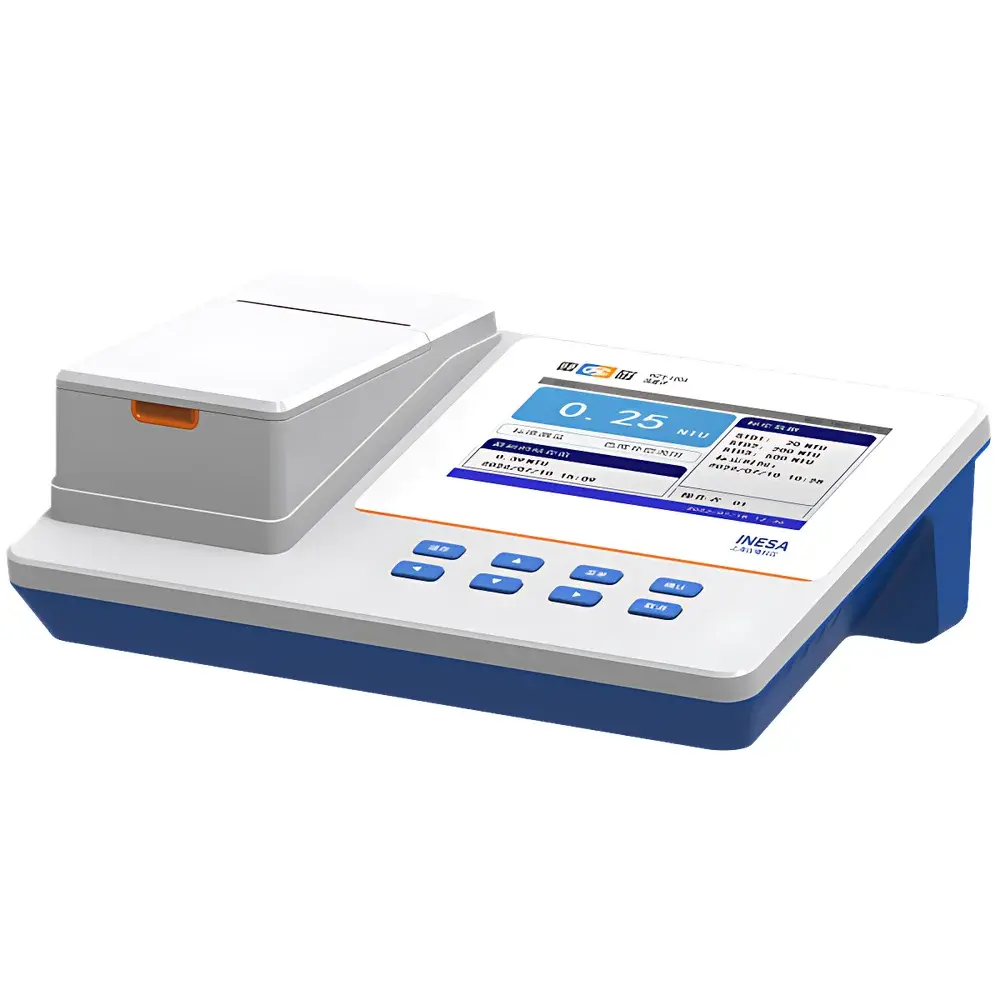
Leici WZS-182E Benchtop Turbidimeter
| Brand | Leici |
|---|---|
| Origin | Shanghai, China |
| Model | WZS-182E |
| Form Factor | Benchtop / Laboratory |
| Measurement Range | (0.00–9.99) NTU |
| Resolution | 0.01 NTU |
| Accuracy | ≤ ±6% |
| Repeatability | ≤ 0.5% |
| Light Source | Tungsten-halogen lamp |
| Compliance | EPA Method 180.1 & HJ 075-2017 |
| Measurement Principles | Nephelometric (90° scattering) and Ratio (scattering + transmission) modes |
| Units | NTU, FNU, EBC |
| Display | High-resolution LCD with intuitive UI |
| Calibration | Built-in standard curves + user-defined single/multi-point calibration |
| Environmental Operating Temperature | Ambient (10–30 °C) |
| Ingress Protection | IP54 |
| Included Accessories | Instrument host, 5 x standardized turbidity vials, long-life calibration standards (20–500 NTU) |
Overview
The Leici WZS-182E is a precision benchtop turbidimeter engineered for reliable, traceable water quality analysis in environmental monitoring laboratories, municipal water treatment facilities, and industrial QC settings. It operates on the nephelometric principle—measuring light scattered at 90° relative to the incident beam—as specified in U.S. EPA Method 180.1 and Chinese environmental standard HJ 075-2017. For enhanced robustness in samples with high particulate load or color interference, the instrument supports ratio-mode measurement, which simultaneously detects both scattered and transmitted light to compensate for absorbance effects. This dual-mode capability ensures metrological integrity across a broad dynamic range—from ultra-low turbidity in purified process water (0.00 NTU) to highly turbid wastewater effluents (up to 500 NTU)—with fully automatic range switching and zero-point adjustment.
Key Features
- Compliant tungsten-halogen light source delivering stable spectral output centered near 860 nm, optimized for minimal interferences from sample color and consistent alignment with regulatory photometric requirements.
- High-resolution 0.01 NTU readability across all three auto-switching ranges, enabling precise detection of subtle changes during filtration validation or coagulation optimization studies.
- Dual measurement methodology: selectable 90° nephelometry (NTU/FNU) for clarity-critical applications and ratio-mode (scattering/transmission) for colored or suspended-solids-rich matrices.
- Multi-unit support (NTU, FNU, EBC) with seamless on-screen conversion—facilitating cross-laboratory data harmonization and international reporting compliance.
- IP54-rated enclosure providing protection against dust ingress and incidental water splashing—suitable for shared lab environments with variable ambient conditions.
- Integrated calibration management system supporting both factory-loaded reference curves and user-configurable single- or multi-point calibrations using NIST-traceable standards.
Sample Compatibility & Compliance
The WZS-182E accommodates standard 25 mm round glass vials (included set of five), ensuring compatibility with internationally recognized sample presentation protocols. Its optical path design minimizes stray light and cell-wall reflection artifacts, contributing to repeatability ≤0.5%—a performance benchmark aligned with ISO 7027-1:2016 recommendations for laboratory-grade turbidimeters. The instrument meets the essential technical criteria of EPA 180.1 for drinking water and wastewater analysis and conforms to HJ 075-2017 for continuous emission monitoring system (CEMS) auxiliary water quality verification. While not pre-certified for GLP or 21 CFR Part 11 environments, its audit-ready calibration logs, timestamped measurement records, and non-volatile memory make it readily adaptable to regulated workflows when paired with documented SOPs.
Software & Data Management
Data output is managed via front-panel interface only; no proprietary PC software or USB connectivity is provided. All measurements—including date/time stamp, selected unit, mode (nephelometric/ratio), and applied calibration ID—are retained in internal memory for up to 200 sample records. Manual data transcription is supported through clear LCD display formatting and consistent field labeling. Users may export results via printed reports if integrated with external thermal printers (not included). For laboratories requiring electronic data capture, the device’s deterministic measurement behavior and stable analog signal chain allow integration into custom LabVIEW or Python-based acquisition systems using optional analog voltage output modules (available separately).
Applications
- Drinking water treatment: verification of filtration efficiency, rapid sand filter breakthrough detection, and post-disinfection clarity assessment.
- Wastewater process control: monitoring clarifier performance, evaluating coagulant dosing efficacy, and validating membrane integrity tests.
- Pharmaceutical water systems: routine testing of Purified Water (PW) and Water for Injection (WFI) per USP <>1231 guidelines—particularly where low-turbidity trending is required.
- Environmental field labs: supporting surface water quality surveys, sediment transport studies, and stormwater runoff characterization under national monitoring programs.
- Educational use: teaching core principles of light scattering physics, calibration traceability, and method validation in undergraduate analytical chemistry curricula.
FAQ
Does the WZS-182E support 21 CFR Part 11-compliant electronic signatures or audit trails?
No—the instrument does not include electronic signature functionality, role-based access control, or encrypted audit trail generation. It is designed for standalone operation in non-GxP environments.
Can I use formazin or AMCO AEPA-1 standards for calibration?
Yes—both primary (formazin) and secondary (AMCO AEPA-1) turbidity standards are compatible. The built-in calibration editor accepts user-entered values for any certified reference material.
Is the tungsten-halogen lamp field-replaceable?
Yes—the lamp module is user-serviceable with standard tools and requires no optical realignment post-replacement.
What is the warm-up time before first measurement?
Stabilization is achieved within 15 minutes of power-on, as verified by internal thermal compensation circuitry and lamp intensity monitoring.
Are quartz cuvettes supported?
No—the optical system is calibrated exclusively for the supplied borosilicate glass vials (25 mm OD, 10 mm path length); quartz or plastic alternatives introduce uncorrected refractive index deviations.






