
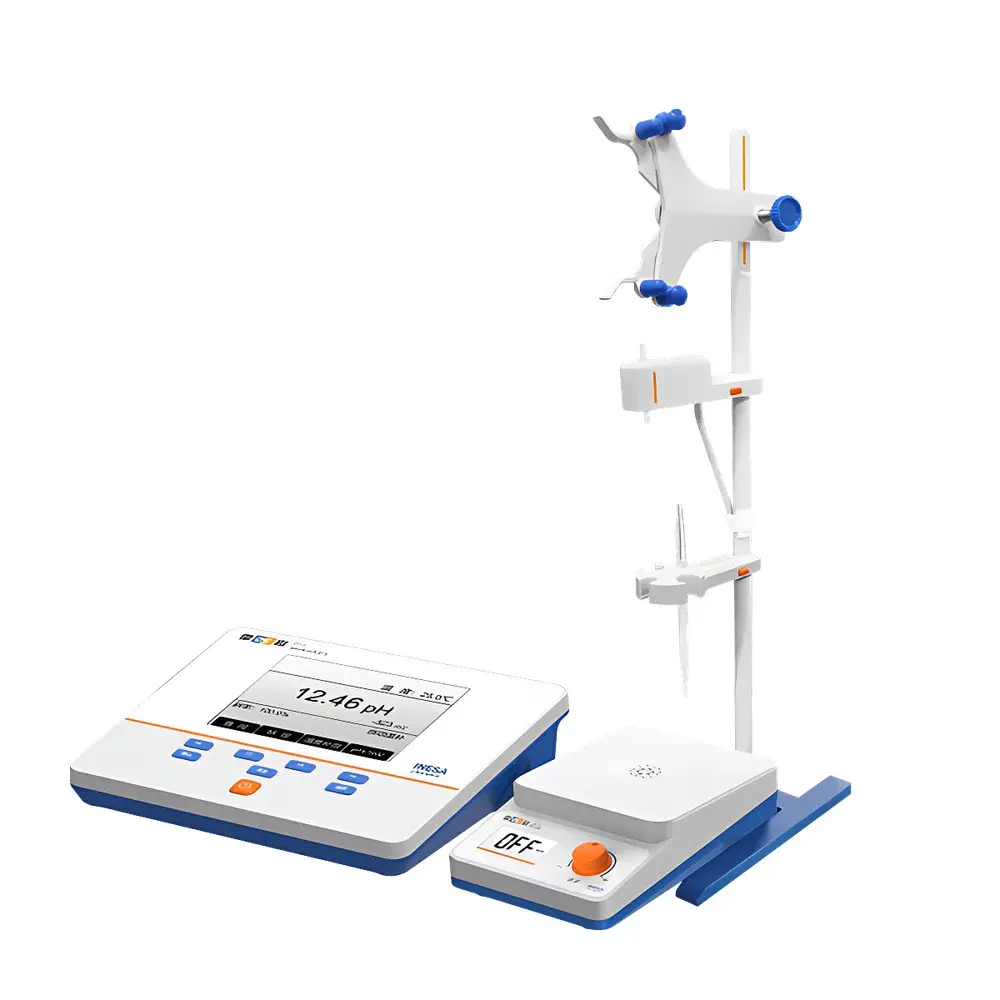
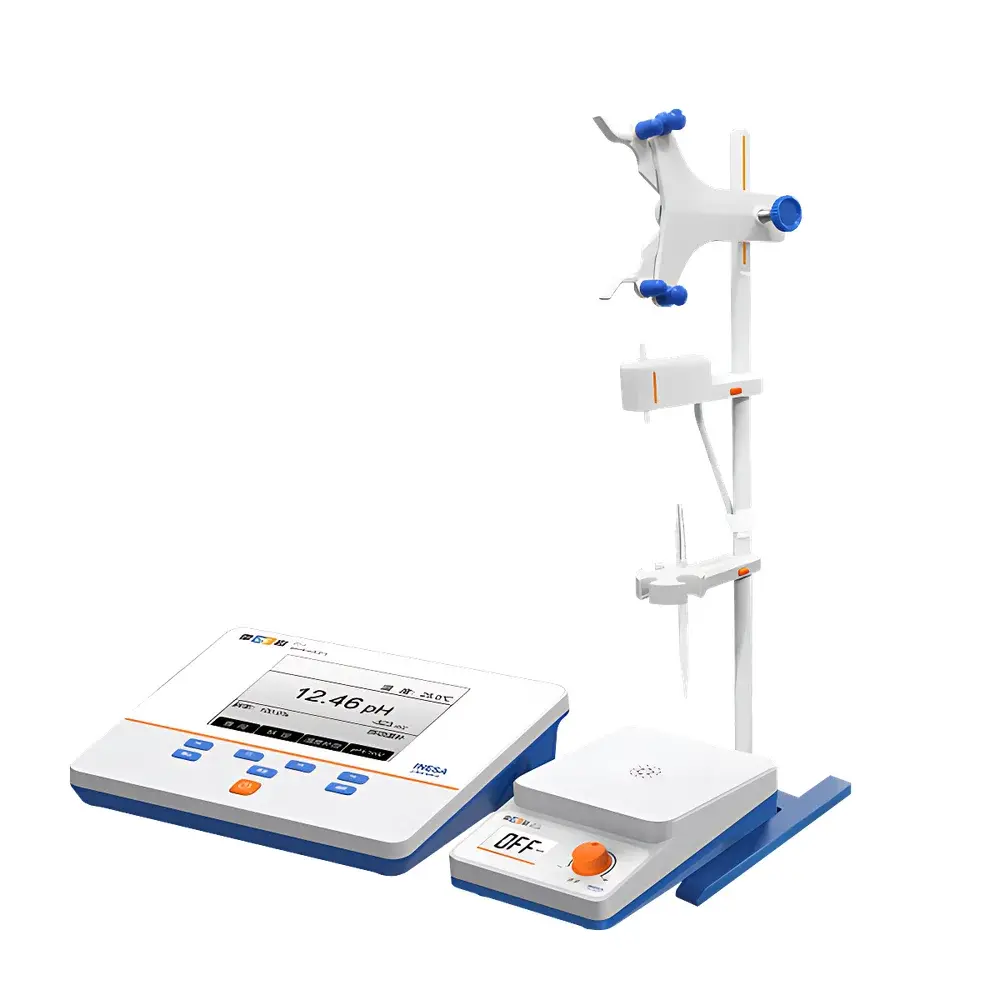
Leici ZD-2 Automatic Potentiometric Titrator
| Brand | Leici |
|---|---|
| Origin | Shanghai, China |
| Model | ZD-2 |
| Instrument Class | 0.5 |
| mV Range | (−1400 to +1400) mV |
| mV Resolution | 1 mV |
| mV Accuracy | ±0.35% FS (±4.9 mV) |
| pH Range | 0.00–14.00 |
| pH Resolution | 0.01 |
| pH Accuracy | ±0.03 pH |
| Titration Endpoint Sensitivity | ±5 mV (mV mode) / ±0.1 pH (pH mode) |
| Temperature Range | 0–100 °C |
| Temp. Resolution | 0.1 °C |
| Temp. Accuracy | ±0.3 °C (electronic unit), ±0.5 °C (0–60 °C), ±1 °C (other ranges) |
| Endpoint Delay Error | ±2 s |
| Volumetric Analysis Accuracy | ±2.5% |
| Repeatability | 0.3% |
| Power Supply | AC 100–240 V → DC 20 V |
| Dimensions | 218 × 180 × 66 mm |
| Weight | ~0.7 kg |
| Operating Environment | 0–40 °C, ≤85% RH |
Overview
The Leici ZD-2 Automatic Potentiometric Titrator is a compact, benchtop analytical instrument engineered for precision volumetric analysis using potentiometric endpoint detection. It operates on the fundamental principle of monitoring potential change (in mV) or hydrogen ion activity (as pH) across a redox, acid–base, precipitation, or complexometric titration. The system employs a two-electrode configuration—typically a reference electrode and an indicator electrode (e.g., glass pH electrode, silver/silver chloride, or platinum)—to detect inflection points in the titration curve with high reproducibility. Designed for routine QC/QA laboratories, academic teaching labs, and small-scale R&D environments, the ZD-2 delivers reliable endpoint determination without requiring advanced automation infrastructure. Its modular architecture supports both manual operator intervention and fully automated sequences, making it suitable for method development, standardization, and compliance-driven testing where traceable, documented results are essential.
Key Features
- Triple-mode titration control: manual, automatic, and user-initiated controlled titration—enabling flexible workflow adaptation
- Dual-parameter measurement capability: simultaneous real-time display of mV and pH values with independent calibration pathways
- Endpoint-driven automation: programmable endpoint thresholds in either mV (±5 mV sensitivity) or pH (±0.1 pH sensitivity), with adjustable delay time (0–99 s) between endpoint detection and pump stop to minimize overshoot
- Intelligent titrant delivery: variable-speed burette drive allows dynamic rate modulation during approach to endpoint—slowing near equivalence point for improved resolution
- Calibration flexibility: up to two-point pH electrode calibration (with slope and offset verification); optional manual or automatic temperature compensation (0.0–100.0 °C)
- Integrated JB-11 magnetic stirrer included as standard—ensuring homogeneous mixing and consistent diffusion kinetics during titration
- RS-232 serial interface for direct connection to dot-matrix or thermal label printers, supporting GLP-compliant hardcopy output with timestamp and parameter logging
Sample Compatibility & Compliance
The ZD-2 accommodates aqueous and moderately polar non-aqueous titrations, including but not limited to hydrochloric acid vs. sodium hydroxide (acid–base), potassium permanganate vs. ferrous ammonium sulfate (redox), silver nitrate vs. chloride (precipitation), and EDTA vs. calcium/magnesium ions (complexometric). Electrode compatibility follows standard BNC and mini-DIN connectors per IEC 60068-2-11, supporting most commercially available pH, redox, and ion-selective electrodes. While not certified for 21 CFR Part 11 compliance out-of-the-box, the instrument’s deterministic endpoint logic, audit-ready printouts, and stable firmware architecture allow integration into GLP/GMP workflows when paired with procedural controls and documented SOPs. It meets general requirements outlined in ISO 8655-6 (burette performance), ASTM E2087 (standard practice for potentiometric titrations), and USP <541> (titrimetry).
Software & Data Management
The ZD-2 operates via embedded firmware with no external PC dependency—ensuring robustness in resource-constrained lab settings. All operational parameters (endpoint setpoints, delay times, stirring speed, calibration coefficients) are stored in non-volatile memory and retained after power cycling. Measurement data—including initial/final mV/pH readings, consumed titrant volume, calculated concentration, and timestamp—is displayed in real time and can be exported via RS-232 to external loggers or LIMS-compatible terminals. Though no proprietary software suite is bundled, ASCII-formatted output enables straightforward parsing by third-party data acquisition tools. For regulated environments, users may implement manual record-keeping protocols aligned with Annex 11 and ALCOA+ principles (Attributable, Legible, Contemporaneous, Original, Accurate).
Applications
- Standardization of titrant solutions (e.g., NaOH, HCl, KMnO₄, AgNO₃) per ISO 6353 and pharmacopoeial monographs
- Determination of total acidity in food extracts, wine, vinegar, and dairy products
- Chloride content analysis in water, wastewater, and concrete admixtures (Mohr or Volhard methods)
- Hardness testing (Ca²⁺/Mg²⁺) in industrial cooling water and boiler feedwater
- Redox titrations for iron content in ores, pharmaceutical intermediates, and electroplating baths
- Acid number and base number measurements in lubricants and transformer oils (ASTM D974, D664)
FAQ
Does the ZD-2 support GLP-compliant data integrity?
Yes—when used with defined procedures, printed records, and controlled access to calibration and method parameters, it satisfies core GLP documentation requirements for titrimetric analysis.
Can I use non-Leici electrodes with this titrator?
Yes—the ZD-2 accepts standard BNC-connected pH and redox electrodes from major manufacturers, provided they comply with typical output impedance and voltage range specifications (±1400 mV).
Is temperature compensation mandatory for accurate results?
Temperature compensation is recommended for high-accuracy work, especially in pH-based titrations where electrode response drifts with thermal variation; the ZD-2 supports both automatic (via Pt100 sensor input) and manual entry modes.
What maintenance is required for long-term reliability?
Routine maintenance includes periodic cleaning of the burette tip and stir bar, verification of electrode hydration and junction integrity, and annual verification of mV/pH accuracy using NIST-traceable buffer standards.
How does the ZD-2 handle titrant depletion or air bubbles in the burette?
The instrument does not include automatic bubble detection or low-titrant alerting; users must visually inspect the burette before each run and purge lines manually using the built-in priming function.
Related Products



