
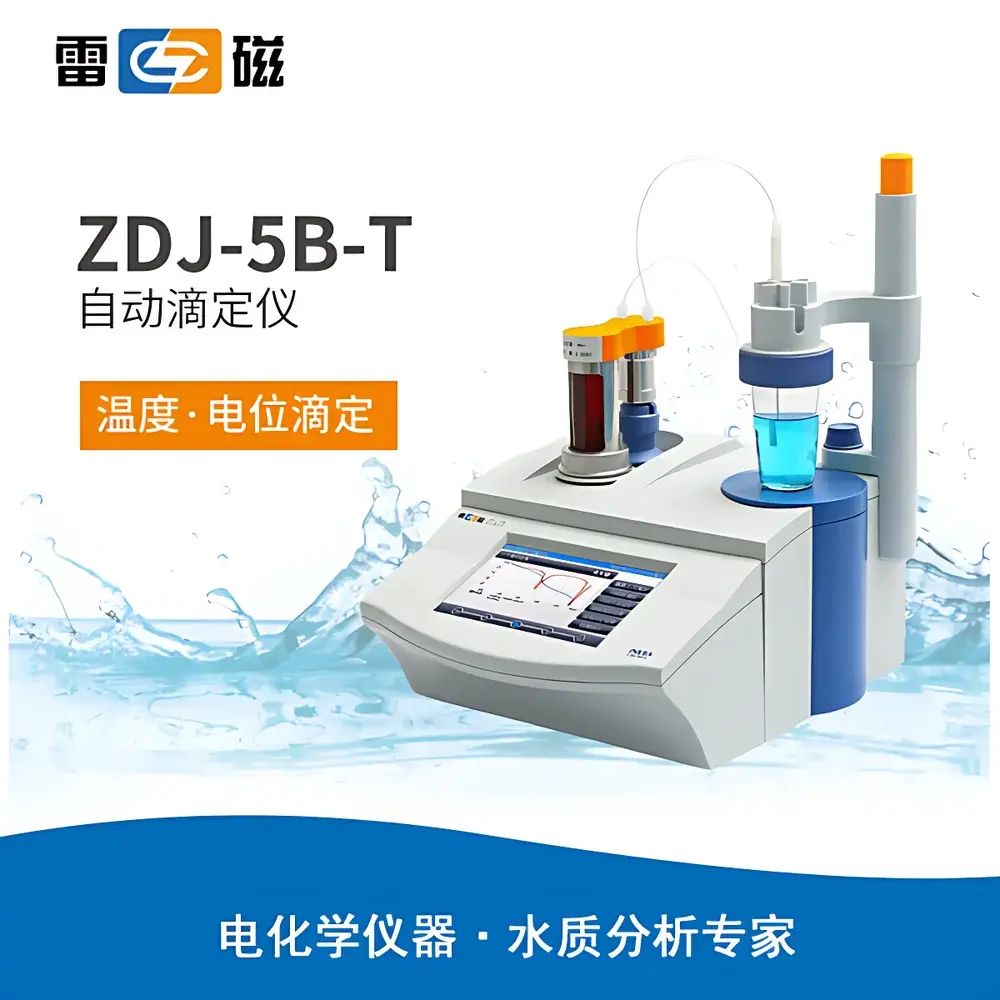
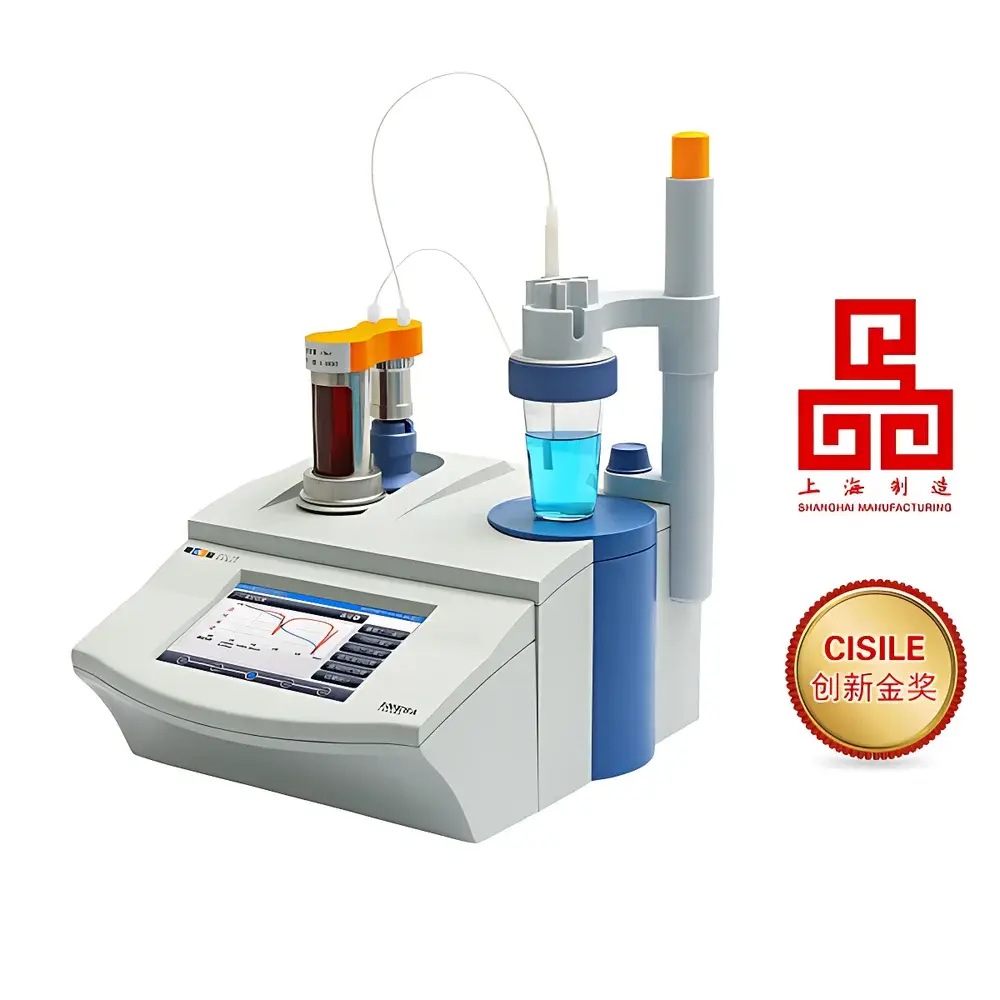
Leici ZDJ-5B-T Automatic Potentiometric Titrator
| Brand | Leici |
|---|---|
| Origin | Shanghai, China |
| Model | ZDJ-5B-T |
| Instrument Type | General-purpose Potentiometric Titrator |
| Application Scope | Universal |
| Measurement Range | (−2000.00 to +2000.00) mV |
| Meter Accuracy | mV: ±0.03% or ±0.2 mV |
| pH | ±0.002 pH |
| Meter Resolution | 0.01 mV, 0.001 pH |
| Titration Precision | 0.0003 mL |
| Titration Resolution | 1/30000 |
Overview
The Leici ZDJ-5B-T Automatic Potentiometric Titrator is a benchtop electrochemical titration system engineered for precision, repeatability, and method flexibility in routine and regulated laboratory environments. It operates on the principle of potentiometric endpoint detection—measuring the potential difference between a reference electrode and an indicator electrode as titrant is incrementally added—enabling accurate determination of equivalence points in acid-base, redox, precipitation, complexometric, and non-aqueous titrations. Integrated temperature titration capability extends its utility to thermometric endpoints, particularly valuable where potentiometric signals are weak or unstable (e.g., in low-conductivity media or heterogeneous systems). Designed for compliance-ready workflows, the instrument meets foundational requirements for GLP (Good Laboratory Practice) data integrity, including audit-trail-capable result storage, user access control, and electronic signature support via optional software configuration.
Key Features
- 7-inch full-color capacitive touchscreen with intuitive, menu-driven navigation—no external keyboard or mouse required;
- Dual-titrant architecture: one built-in titration burette (standard 10 mL) plus support for an optional external burette module, enabling rapid reconfiguration between incompatible titrants without manual disassembly;
- Valve-burette integrated design ensures leak-free operation and minimizes dead volume; compatible with standard 10 mL and 20 mL glass burettes (calibration-certified tolerances: ±0.020 mL for 10 mL, ±0.030 mL for 20 mL);
- Five titration modes: dynamic (adaptive addition), preset endpoint, constant addition (fixed-volume increments), blank titration, and manual override—each configurable with real-time slope monitoring and second-derivative endpoint recognition;
- Comprehensive method management: up to 100 stored titration methods, 10 customizable quick-access shortcuts, editable calculation formulas (e.g., % purity, mg/L, mmol/g), and post-run recalculation using revised parameters or calibration data;
- Integrated temperature measurement module (range: 0.000–60.000 °C; resolution: 0.001 °C; accuracy: ±0.3 °C within 0–60 °C), supporting automatic temperature compensation for electrode response (−5.0 to 105.0 °C range);
- Built-in GLP-compliant data handling: 200 result records with timestamp, operator ID, method name, raw curve data, and metadata—stored internally with tamper-resistant file structure;
- Multi-interface connectivity: RS-232 and USB ports for bidirectional communication with PCs; native UVC-compliant USB mass storage mode for drag-and-drop export of results and methods to USB flash drives.
Sample Compatibility & Compliance
The ZDJ-5B-T accommodates aqueous, non-aqueous, and mixed-solvent matrices across diverse sample types—including pharmaceutical actives, food acids, water hardness analytes, industrial catalysts, and environmental extracts. Its dual-electrode input supports combination pH electrodes, redox (Pt/AgCl), ion-selective (e.g., fluoride, chloride), and thermometric probes. The system complies with core performance benchmarks referenced in ISO 8655-3 (burette accuracy), ASTM E2087 (potentiometric titration practice), and USP (titrimetric analysis). While not pre-certified for 21 CFR Part 11, its firmware architecture supports audit trail logging, electronic signatures, and role-based user permissions—enabling validation by end users under internal SOPs aligned with GMP/GLP frameworks.
Software & Data Management
Supplied with REX Titrator Software (Windows-compatible), the instrument enables remote method deployment, real-time graphing of E vs. V or dE/dV curves, automated report generation (PDF/CSV), and statistical analysis (mean, SD, RSD, confidence intervals) across result sets. All stored titration curves retain full-resolution raw data points (≥10,000 points per run), permitting retrospective endpoint re-evaluation. Data files embed cryptographic checksums to verify integrity upon import/export. USB drive usage triggers automatic firmware and method backup—ensuring continuity during instrument relocation or maintenance cycles.
Applications
- Pharmaceutical QC: assay of active ingredients (e.g., aspirin hydrolysis, amine salt titration) per EP/USP monographs;
- Food & Beverage: titratable acidity (TA) in wines and juices, chloride in dairy products, peroxide value in oils;
- Environmental Testing: alkalinity and hardness in wastewater, cyanide in effluents (via silver nitrate titration);
- Chemical Manufacturing: assay of NaOH/KOH solutions, HCl/H₂SO₄ concentration verification, EDTA chelation capacity;
- Academic Research: kinetic studies using controlled-addition protocols, multi-step titration sequences with conditional endpoint logic.
FAQ
Does the ZDJ-5B-T support electrode calibration verification per ISO 17025 requirements?
Yes—built-in pH calibration routines support 2- or 3-point calibration with NIST-traceable buffers; calibration history (date, buffer IDs, slope, offset, asymmetry potential) is logged with each result.
Can the instrument be validated for GMP-regulated environments?
It provides foundational features required for IQ/OQ: programmable test sequences, calibration traceability, electronic audit trails, and secure user roles—though formal PQ must be conducted per site-specific risk assessment and SOPs.
Is the external burette module compatible with corrosive titrants like bromate or ceric sulfate?
The optional external module uses chemically resistant PTFE valves and tubing; compatibility with specific reagents must be confirmed against material safety data sheets (MSDS) for wetted components.
How is data integrity maintained during power interruption?
The system implements hardware-level uninterruptible memory buffering: all active titration data and method state are preserved during AC loss and restored on reboot—no result corruption or method reset occurs.
What electrode types are natively supported without adapter hardware?
Standard BNC-input pH/mV electrodes, ATC temperature probes (±0.2 °C accuracy), and dedicated thermometric sensors—all conforming to IEC 60068-2-14 thermal shock specifications.




