
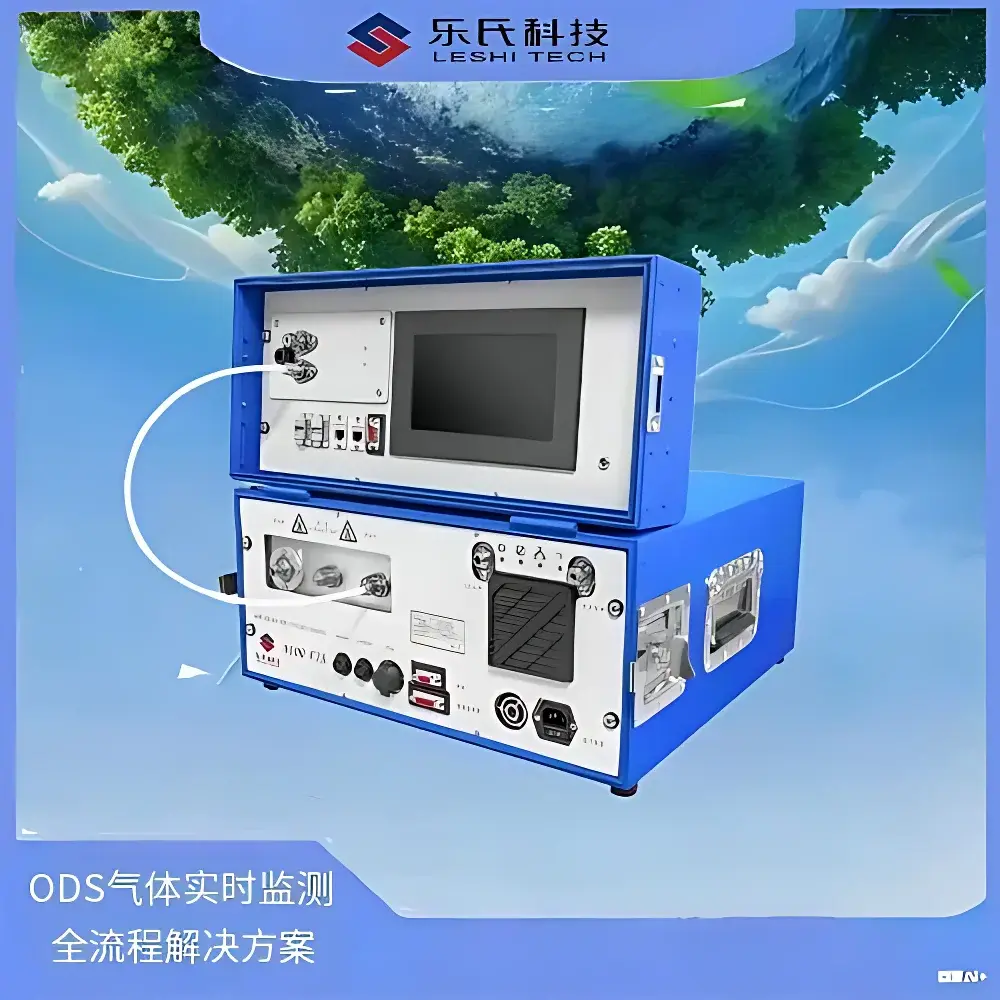
LESHI 9100FIR High-Precision ODS Gas Analyzer
| Brand | Leshi |
|---|---|
| Origin | Beijing, China |
| Manufacturer Type | Authorized Distributor |
| Country of Origin | China |
| Model | 9100FIR-ODS |
| Technology Principle | Fourier Transform Infrared (FTIR) Spectroscopy |
| Target Gases | Ozone-Depleting Substances (ODS), Volatile Organic Compounds (VOCs) |
| Detector Type | High-Sensitivity DTGS Detector |
| Optical Resolution | ≤0.5 cm⁻¹ (typical) |
| Spectral Range | 4000–600 cm⁻¹ |
| Response Time | < 30 s (T₉₀, system-dependent) |
| Repeatability | ±1.5% RSD (at ≥10× detection limit) |
| Compliance Framework | Supports EPA Method TO-14A/TO-15, ISO 13867, EN 14662 |
Overview
The LESHI 9100FIR High-Precision ODS Gas Analyzer is a laboratory- and field-deployable FTIR-based gas monitoring system engineered for regulatory-grade quantification and speciation of ozone-depleting substances (ODS) and selected volatile organic compounds (VOCs). It operates on the fundamental principle of Fourier Transform Infrared (FTIR) spectroscopy—where an interferometer generates broadband infrared radiation, which interacts with gas-phase analytes in a multipass absorption cell; the resulting interferogram is digitized and Fourier-transformed to yield high-fidelity absorbance spectra across the mid-infrared region (4000–600 cm⁻¹). This spectral fingerprint enables unambiguous identification and simultaneous multi-component quantification without chromatographic separation. Designed specifically for environmental compliance monitoring, the 9100FIR meets the analytical rigor required for tracking controlled substances under the Montreal Protocol, including chlorofluorocarbons (CFCs), hydrochlorofluorocarbons (HCFCs), halons, carbon tetrachloride, methyl chloroform, and brominated compounds such as methyl bromide and halon-1301.
Key Features
- High-resolution FTIR optical engine with ≤0.5 cm⁻¹ nominal resolution, optimized for resolving overlapping absorption bands of structurally similar ODS species
- Multi-pass absorption cell (path length configurable up to 20 m) enabling sub-ppb detection limits for key ODS compounds under standard conditions
- Thermoelectrically cooled deuterated triglycine sulfate (DTGS) detector with low-noise electronics and long-term thermal stability
- Onboard chemometric processing suite incorporating partial least squares (PLS) and classical least squares (CLS) algorithms for real-time spectral deconvolution and concentration calculation
- Ruggedized industrial enclosure rated IP54, suitable for continuous operation in ambient monitoring stations or mobile laboratory platforms
- Modular gas handling subsystem with integrated particulate filtration, moisture removal (Nafion™ or chilled mirror), and optional catalytic scrubbers for interferent mitigation
Sample Compatibility & Compliance
The 9100FIR accepts gaseous samples delivered via stainless-steel or electropolished passivated tubing at flow rates of 0.5–2.0 L/min. It accommodates both grab sampling (via Tedlar® or SUMMA® canisters) and continuous stream analysis from stack ducts, ambient air intakes, or fugitive emission sources. The system complies with measurement performance criteria outlined in U.S. EPA Methods TO-14A and TO-15 for ambient VOCs and ODS, and aligns with ISO 13867:2001 for FTIR-based trace gas analysis. All calibration protocols adhere to ISO/IEC 17025 requirements for testing laboratories, and data acquisition supports audit-ready metadata logging—including instrument configuration, calibration history, environmental parameters (T, P, RH), and operator ID—enabling full traceability under GLP and ISO 14001 frameworks.
Software & Data Management
The analyzer is operated through LESHI’s proprietary IRAnalyzer v4.x software, a Windows-based application compliant with FDA 21 CFR Part 11 for electronic records and signatures. The software provides real-time spectral visualization, automated baseline correction, library-matching against a curated ODS/VOC spectral database (NIST, EPA, and proprietary reference spectra), and dynamic interference compensation. All raw interferograms and processed spectra are stored in HDF5 format with embedded metadata. Export options include CSV, XML, and PDF reports conforming to EU ETS reporting templates. Remote diagnostics, firmware updates, and secure data transmission via TLS 1.2 are supported through optional Ethernet or 4G LTE connectivity modules.
Applications
- Regulatory monitoring of ODS emissions from refrigerant reclamation facilities, foam-blowing operations, and aerospace propulsion testing sites
- Verification of phase-out compliance under national ODS inventories mandated by the Montreal Protocol and its Kigali Amendment
- Source apportionment studies in urban and industrial zones where halogenated VOCs contribute to tropospheric ozone formation
- Calibration transfer validation for portable GC-MS or PID instruments deployed in field surveys
- Long-term trend analysis in background air monitoring networks (e.g., AGAGE stations) requiring stable, drift-corrected FTIR baselines
- Method development and reference analysis for laboratory accreditation (e.g., CNAS, UKAS) under ISO/IEC 17025 Clause 7.2.2
FAQ
What ODS compounds can the 9100FIR quantify with certified accuracy?
The system is validated for CFC-11, CFC-12, CFC-113, HCFC-22, HCFC-141b, HCFC-142b, Halon-1211, Halon-1301, methyl chloroform, carbon tetrachloride, and methyl bromide per EPA TO-15 and ISO 13867 protocols.
Does the 9100FIR support automatic zero/span calibration?
Yes—it integrates dual-stage automated calibration using certified gas standards (NIST-traceable) and zero air generators, with configurable scheduling and full audit trail generation.
Can it be integrated into existing SCADA or EMS platforms?
Yes—via Modbus TCP, OPC UA, or RESTful API interfaces, supporting seamless integration with environmental management systems and central data hubs.
Is the system suitable for unattended operation in remote locations?
Yes—designed for 24/7 operation with internal temperature stabilization, power-loss recovery, and remote health monitoring capabilities.
How is measurement uncertainty determined and documented?
Uncertainty budgets are calculated per ISO/IEC Guide 98-3 (GUM), incorporating contributions from spectral noise, calibration gas uncertainty, path-length variation, and environmental parameter drift—fully reportable in generated certificates.
Related Products







