
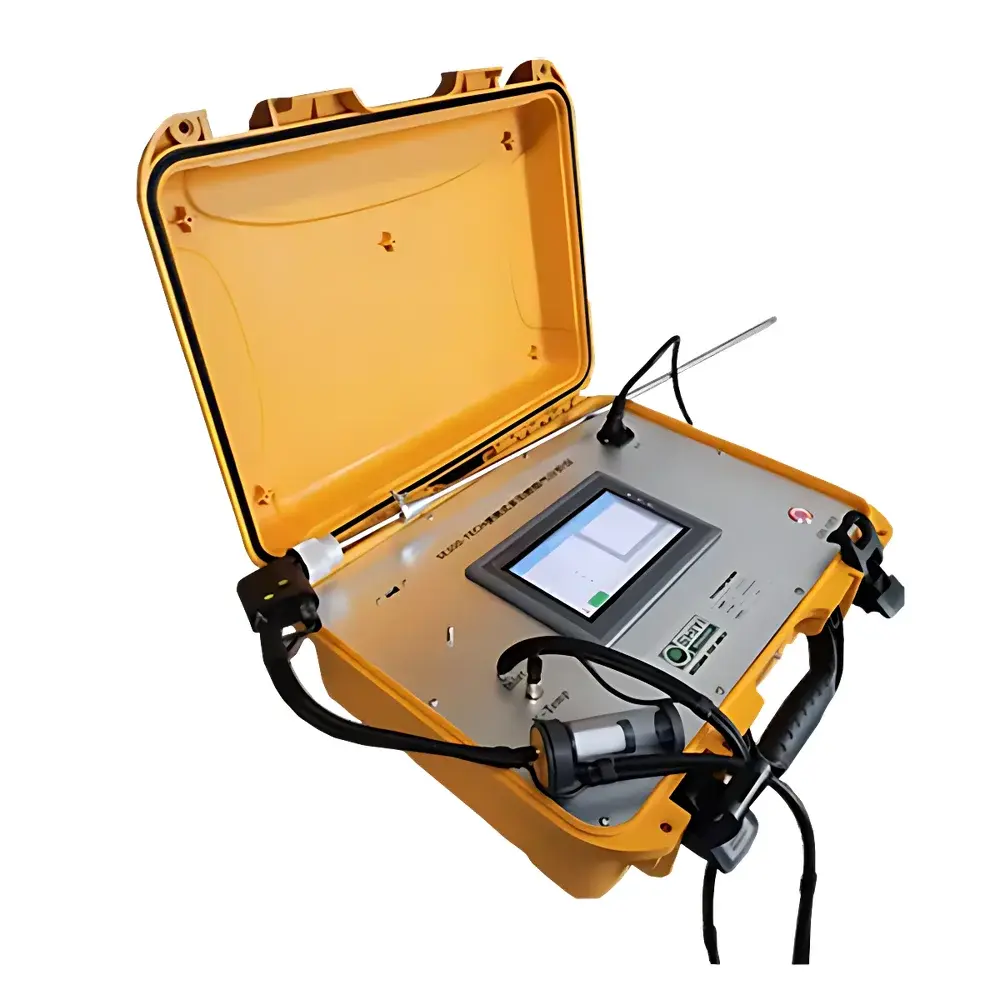
LESHI SE300-Tech Portable Multi-Gas Flue Gas Analyzer
| Brand | LESHI |
|---|---|
| Model | SE300-Tech |
| Type | Portable Flue Gas Analyzer |
| Detection Principle | NDIR (CO, CO₂, HC, SO₂), Electrochemical (O₂, NO, NO₂, NH₃, H₂S), Optional NDUV (NO, NO₂, SO₂) |
| Gas Channels | Up to 6 simultaneously measurable gases (standard configuration) |
| Compliance | Designed for field-deployable combustion efficiency and emissions verification per ISO 12039, EN 15267, and EPA Method 6C/7E prerequisites |
| Power | Rechargeable Li-ion battery (≥4 hr continuous operation) |
| Display | 5.7" TFT LCD with touch interface |
| Data Storage | Removable MMC card (up to 32 GB) |
| Connectivity | USB 2.0, Bluetooth 4.2, optional RS-232 |
| Operating Temperature | 0–40 °C |
| Protection Rating | IP42 |
| Weight | ≤2.8 kg |
Overview
The LESHI SE300-Tech Portable Multi-Gas Flue Gas Analyzer is an engineered field instrument designed for real-time, multi-parameter combustion gas analysis in industrial, regulatory, and mobile testing environments. It operates on a hybrid detection architecture integrating non-dispersive infrared (NDIR) spectroscopy for CO, CO₂, hydrocarbons (HC), and SO₂; electrochemical cells for O₂, NO, NO₂, NH₃, and H₂S; and optional non-dispersive ultraviolet (NDUV) modules for enhanced selectivity in NO, NO₂, and SO₂ measurement under high-moisture or cross-interference conditions. The analyzer supports stoichiometric combustion evaluation—including excess air calculation, dew point estimation, and thermal efficiency derivation—based on simultaneous acquisition of up to six gas concentrations, flue gas temperature, and differential pressure (via optional probe). Its modular sensor design complies with fundamental metrological traceability requirements for portable emission monitoring systems (PEMS), enabling field use in accordance with preliminary screening protocols aligned with ISO 12039 (stationary source emissions — determination of mass concentration of carbon monoxide, carbon dioxide and oxygen), EN 15267-3 (performance certification of automated measuring systems), and U.S. EPA Method 6C/7E applicability criteria.
Key Features
- Compact, hand-carriable chassis (≤2.8 kg) with ergonomic handle and IP42-rated enclosure for indoor/outdoor deployment
- 5.7-inch high-contrast TFT LCD touchscreen with intuitive icon-driven navigation and multilingual UI support (English, German, Spanish, French)
- Integrated Peltier thermoelectric cooler and peristaltic condensate removal pump ensuring stable sample conditioning at dew points down to 2 °C
- High-capacity sampling pump (≥1.2 L/min) with real-time flow rate visualization and automatic flow compensation across variable backpressure conditions
- Hot-swap sensor module architecture: all gas sensors and particulate filters are replaceable without disassembly of the main housing
- Onboard data logging via removable MMC card (pre-formatted, plug-and-play); supports timestamped CSV and Excel-compatible .XLSX export via USB or Bluetooth
- Configurable gas channel selection: standard 6-channel setup includes O₂, CO, CO₂, NO, NO₂, and SO₂; optional expansion to NH₃, H₂S, CH₄, or total hydrocarbons (THC) with validated cross-sensitivity correction
Sample Compatibility & Compliance
The SE300-Tech is validated for direct sampling of cooled, filtered flue gases from fossil fuel (natural gas, LPG, city gas, blast furnace gas), liquid fuel (light/heavy oil), and solid fuel (coal, wood) combustion processes. It accommodates exhaust streams with particulate loadings ≤5 mg/m³ and moisture content ≤25 vol% (post-cooling). For automotive tailpipe applications, it meets transient measurement readiness per ISO 8714 and SAE J1667 preconditions when used with standardized dilution tunnel adapters. All electrochemical sensors conform to IEC 61000-6-2/6-3 immunity and emission standards. Firmware supports audit-trail-enabled data capture compliant with GLP-aligned workflows; raw sensor outputs and calibration logs are digitally signed and time-stamped to facilitate regulatory review.
Software & Data Management
The embedded firmware (v3.2+) provides real-time calculation of combustion parameters—including lambda (λ), net calorific value (NCV), flue gas loss (%), and CO/CO₂ ratio—using built-in fuel-specific stoichiometric databases (ASTM D3588-17 referenced). Data export functions generate ISO/IEC 17025-compatible reports with metadata headers (operator ID, location GPS tag, ambient T/P, calibration due date). PC software (Windows/macOS compatible) enables post-processing of time-series datasets, trend overlay, and compliance flagging against user-defined limit thresholds (e.g., EU IED BREF BAT-AELs, China GB 13223-2011). No cloud dependency: all processing occurs locally, preserving data sovereignty for government and industrial users subject to ITAR or national data residency requirements.
Applications
- Combustion optimization and boiler tuning in power generation, district heating, and industrial steam systems
- Regulatory stack testing and periodic emissions verification for cement kilns, refineries, and chemical reactors
- Mobile roadside diesel/gasoline vehicle exhaust screening in environmental enforcement campaigns
- In-field emergency response to industrial gas leaks or uncontrolled combustion events
- Academic research on alternative fuel combustion behavior (biomass, syngas, hydrogen blends)
- Technical training and vocational education in energy engineering and environmental science curricula
FAQ
What gas species are included in the base configuration?
The standard SE300-Tech configuration measures O₂, CO, CO₂, NO, NO₂, and SO₂. Additional gases—including NH₃, H₂S, CH₄, and THC—can be added via factory-configured sensor modules.
Does the analyzer support automatic zero/span calibration?
Yes—built-in auto-zero function using ambient air (O₂ reference) and optional external span gas ports for manual or semi-automated calibration verification.
Is the device certified for use in hazardous areas?
No. The SE300-Tech is rated for general-purpose industrial environments (non-explosive atmospheres). Intrinsically safe variants require custom engineering and third-party ATEX/IECEx certification.
Can measurement data be integrated into SCADA or EMS platforms?
Yes—via Modbus RTU over RS-232 or ASCII protocol over USB/Bluetooth; integration documentation and register maps are provided with OEM licensing.
What is the recommended calibration interval?
Per ISO 12039 Annex C, quarterly functional checks are advised; full electrochemical sensor replacement every 12–18 months depending on cumulative exposure hours and contaminant load.
Related Products







