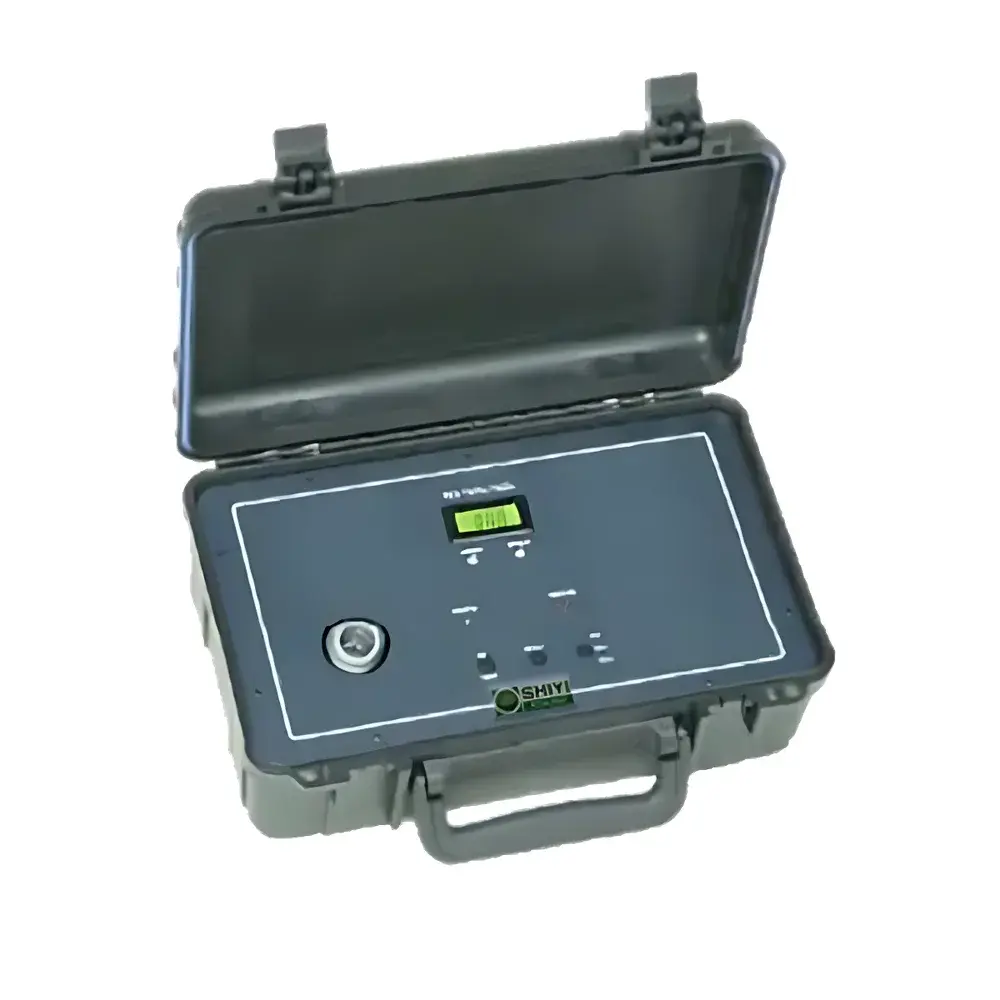
LESHI SE301 Portable Electrochemical & Paramagnetic Oxygen Analyzer
| Brand | Leshi |
|---|---|
| Origin | Beijing, China |
| Model | SE301 |
| Sensor Type | Electrochemical (low-range) & Optional Paramagnetic |
| Measurement Ranges | 0–500 ppm, 0–1%, 0–5.0%, 0–10.0%, 0–25.0%, 0–50.0%, 0–100% O₂ |
| Accuracy | ±1% of reading (full-scale dependent) |
| Response Time (T90) | 8–10 s (electrochemical) |
| Repeatability | ±1% FS |
| Resolution | 0.1 ppm (0–500 ppm range), 0.1% (higher ranges) |
| Display | Backlit LCD with real-time digital readout |
| Sampling System | Integrated diaphragm pump, stainless-steel probe (12 ft PTFE-lined sampling hose), dual-stage particulate/moisture filter, flow meter, automatic condensate removal trap |
| Data Interface | USB port, optional data logger support |
| Power | Rechargeable Li-ion battery (≥8 h continuous operation), AC adapter included |
| Enclosure | IP65-rated ruggedized housing |
| Compliance | Designed to meet requirements of HJ 57–2017 (China), GB/T 16157–1996, and supports method principles aligned with ASTM D4084–22 (electrochemical O₂) and ISO 10156 (paramagnetic O₂ detection) |
Overview
The LESHI SE301 Portable Oxygen Analyzer is an engineered field-deployable instrument for precise, real-time quantification of molecular oxygen (O₂) across a wide dynamic concentration range—from trace-level (0–500 ppm) to ambient and enriched atmospheres (up to 100% vol). It operates on two complementary physical principles: electrochemical sensing for high-sensitivity low-concentration measurements and optional paramagnetic detection for enhanced stability and linearity in mid-to-high range applications. The electrochemical module utilizes a sealed, temperature-compensated galvanic cell with gold cathode and lead anode, optimized for long-term drift stability and minimal cross-sensitivity to CO₂, CO, NOₓ, and hydrocarbons. The paramagnetic variant employs a dynamic “dumbbell” sensor architecture—featuring rare-earth selenide-cobalt permanent magnets and precision torsion fiber suspension—to exploit oxygen’s unique magnetic susceptibility (χ ≈ +1,800 × 10⁻⁶ cm³/mol), offering inherent specificity and negligible zero drift over extended operation.
Key Features
- Rugged IP65-rated enclosure with ergonomic carry handle and shock-absorbing rubber overmold—designed for industrial site deployment, including boiler rooms, chemical process floors, and outdoor stack monitoring.
- Modular sensor architecture: field-swappable electrochemical cells (rated ≥24 months typical service life) and optional paramagnetic sensor head (no consumables, >5-year operational lifetime).
- Integrated sample conditioning system: stainless-steel heated probe (optional), 12-ft chemically inert PTFE-lined sampling hose, dual-stage filtration (10 µm particulate + hydrophobic membrane), thermoelectric condensate trap with auto-drain valve, and laminar-flow mass flow meter (±2% FS accuracy).
- Onboard pressure regulation: adjustable positive-pressure purge (for sensor protection) and negative-pressure draw via brushless diaphragm pump (flow rate 0.4–0.8 L/min, programmable).
- Backlit high-contrast LCD display with dual-unit readout (ppm/%), real-time trend graphing, and configurable alarm thresholds (high/low, latching/non-latching).
- USB-C interface supporting direct data export to FAT32-formatted USB drives; firmware-upgradable via PC utility; optional Bluetooth 5.0 module for wireless telemetry (sold separately).
Sample Compatibility & Compliance
The SE301 accommodates gas streams with temperatures up to 180°C (probe-dependent), dew points ≤5°C post-conditioning, and particulate loading <5 mg/m³. It is validated for use with flue gases from coal-, oil-, gas-, and biomass-fired combustion systems; inerted reactor headspaces; medical-grade oxygen supply lines; and ambient air quality monitoring in confined spaces. The analyzer conforms to Chinese environmental monitoring standards HJ 57–2017 (determination of O₂ in fixed source exhaust gas) and GB/T 16157–1996 (stationary source emission sampling methodology). Its measurement methodology aligns with ASTM D4084–22 (Standard Test Method for Oxygen in Gaseous Fuels by Electrochemical Sensors) and ISO 10156:2010 (Gases and gas mixtures — Determination of fire potential and oxidizing ability — Part 2: Oxidizing ability), ensuring technical coherence with international regulatory frameworks. For GLP/GMP environments, audit-trail-enabled data logging (via optional SD card module) supports 21 CFR Part 11-compliant record retention when paired with validated software.
Software & Data Management
Instrument firmware includes embedded data logging (up to 100,000 timestamped records), user-defined averaging intervals (1–60 s), and configurable auto-zero calibration cycles. The companion PC software (SE301 Manager v3.2) provides spectral trending, statistical summary (min/max/avg/stdev), CSV/XLSX export, and calibration certificate generation. All stored data include metadata: sensor ID, calibration date, operator tag, ambient T/P, and flow rate. When used with the optional external data logger (Model DL-SE301), continuous 30-day unattended operation is supported with onboard memory and scheduled USB auto-sync. Raw sensor output signals (4–20 mA analog output available as OEM option) are digitally filtered using adaptive median filtering to suppress transient electrical noise without compromising response fidelity.
Applications
- Combustion optimization: Real-time O₂ feedback for excess air ratio (λ) control in boilers, furnaces, and thermal oxidizers—enabling fuel savings of 2–5% through stoichiometric tuning.
- Leak detection & air infiltration assessment: Quantifying unintended air ingress in vacuum vessels, gloveboxes, and inerted storage tanks via differential O₂ rise rate analysis.
- Process safety monitoring: Continuous verification of nitrogen purge effectiveness in reactors prior to solvent charging or catalyst activation.
- Pharmaceutical manufacturing: Verification of residual O₂ in lyophilization chambers and modified-atmosphere packaging (MAP) lines per USP guidance.
- Educational laboratories: Demonstrating gas laws, reaction stoichiometry, and sensor physics (e.g., magnetic susceptibility contrast between O₂ and N₂) with repeatable, classroom-safe operation.
FAQ
What is the recommended calibration frequency for routine industrial use?
For electrochemical sensors, quarterly zero/span calibration is advised under stable operating conditions; monthly calibration is recommended when exposed to high-humidity or corrosive gas matrices. Paramagnetic modules require annual verification against certified reference gas.
Can the SE301 measure O₂ in high-CO₂ environments such as biogas or fermentation off-gas?
Yes—the electrochemical sensor exhibits <0.5% cross-sensitivity to CO₂ up to 20% vol, and the paramagnetic option is fully immune to CO₂ interference, making both configurations suitable for bioprocess monitoring.
Is the stainless-steel probe suitable for direct insertion into hot flue gas?
The standard probe is rated for continuous exposure up to 150°C; for >150°C applications, a water-cooled probe extension (accessory kit P-SE301-CW) must be installed upstream of the primary filter.
Does the instrument support automated bump testing?
Yes—built-in self-test mode performs electronic diagnostics and sensor response validation using internal reference circuitry; full bump test requires external certified span gas (e.g., 100 ppm O₂ in N₂).
How is moisture managed during long-duration sampling?
The integrated thermoelectric condenser maintains sample dew point at ≤5°C; condensate is continuously drained via gravity-fed trap with visual level indicator and overflow shutoff—eliminating manual maintenance during 8-hour shifts.