
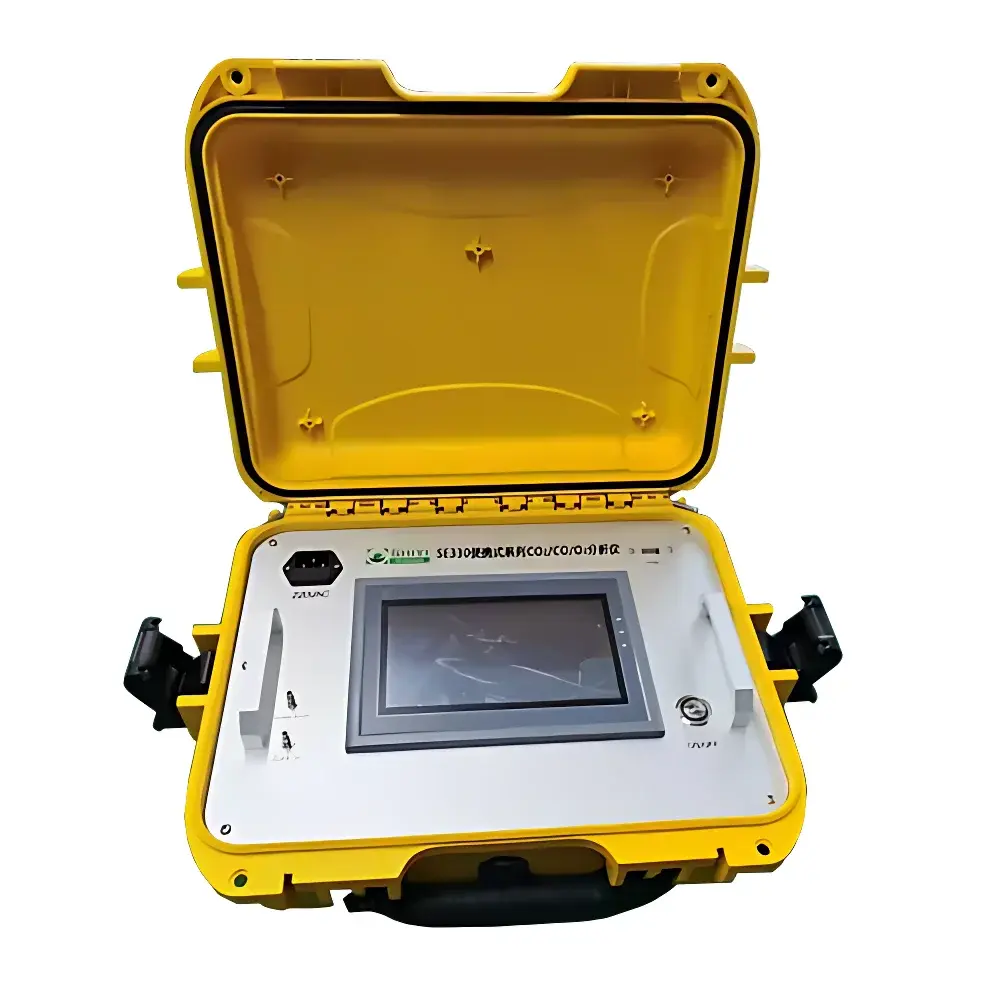
LESHI SE330 Portable Multi-Gas Analyzer for CO₂, CO, and O₂
| Brand | LESHI |
|---|---|
| Origin | Beijing, China |
| Model | SE330 |
| Instrument Type | Portable |
| Gas Targets | CO₂, CO, O₂ |
| Detection Principle | NDIR (CO₂), Electrochemical (CO & O₂) |
| Measurement Range | CO₂: 0–2000 ppm (standard), CO: 0–2000 ppm / 0–4.00% (dual-range), O₂: 0–25% vol |
| Sensor Lifespan | CO & O₂ sensors: 3–4 years |
| CO₂ NDIR detector | indefinite under contamination-free operation |
| Display | Backlit LCD touchscreen |
| Built-in Components | Sampling pump, particulate filter, flow meter, condensate removal system |
| Probe | Stainless-steel probe with flexible sampling hose |
| Compliance Context | Designed for field-deployable compliance with occupational hygiene standards (e.g., OSHA PELs, ACGIH TLVs), indoor air quality protocols (ISO 16000 series), and combustion efficiency assessment per EN 15316-4-2 and ASTM D7549 |
Overview
The LESHI SE330 Portable Multi-Gas Analyzer is an engineered field instrument for simultaneous, real-time quantification of carbon dioxide (CO₂), carbon monoxide (CO), and oxygen (O₂) in flue gas, ambient air, and confined-space atmospheres. It employs a hybrid sensing architecture: non-dispersive infrared (NDIR) spectroscopy for CO₂ detection—ensuring direct, interference-resistant measurement without stoichiometric assumptions—and electrochemical cells for selective, low-power CO and O₂ sensing. Unlike computational or parametric estimation methods, the SE330 delivers primary concentration values traceable to physical absorption and redox kinetics. Its design prioritizes operational robustness in variable thermal and humidity conditions, with integrated condensate management enabling stable performance during extended stack sampling. The analyzer meets functional requirements for combustion diagnostics—including excess air ratio (λ) calculation, combustion efficiency derivation, and draft loss assessment—as defined in EN 12952-15 and ASTM D7549.
Key Features
- True NDIR-based CO₂ measurement: Eliminates cross-sensitivity from hydrocarbons or water vapor common in catalytic or thermal conductivity sensors.
- Dual-range CO detection: Switchable 0–2000 ppm (high-resolution for ambient/indoor monitoring) and 0–4.00% (v/v) (for high-concentration flue gas applications), with automatic range selection and <5 s response time (t₉₀).
- User-replaceable electrochemical sensors: Modular O₂ and CO sensor cartridges designed for field swap without calibration recalibration—reducing downtime and service dependency.
- Integrated sample conditioning: Onboard diaphragm pump (flow rate: 0.8–1.2 L/min), sintered stainless-steel particulate filter (5 µm retention), laminar-flow digital flow meter (±2% FS accuracy), and passive Peltier-assisted condensate trap.
- Ruggedized human interface: 3.5-inch capacitive touchscreen with anti-glare coating, adjustable backlight, and intuitive icon-driven menu navigation compliant with IEC 61000-4 EMC standards.
- Thermal stability architecture: Internal temperature compensation across –5 °C to +45 °C operating range; warm-up time ≤ 90 seconds to operational readiness.
Sample Compatibility & Compliance
The SE330 accommodates gaseous samples with particulate loading ≤ 10 mg/m³ and dew point ≤ 4 °C at sampling inlet. It is validated for use with natural gas, propane, fuel oil, biomass, and coal combustion effluents. While not certified to CE/UKCA for intrinsic safety, it conforms to occupational exposure monitoring frameworks including OSHA 29 CFR 1910.1200 (HCS), ACGIH TLV® guidelines for CO (25 ppm TWA) and CO₂ (5000 ppm TWA), and ISO 16000-23 for indoor air CO₂ assessment. Data logging supports GLP-aligned metadata tagging (operator ID, location GPS coordinates via optional Bluetooth module, timestamp, ambient T/P). Firmware supports audit-trail-enabling configuration locks per FDA 21 CFR Part 11 principles when paired with LESHI’s secure desktop software suite.
Software & Data Management
Data acquisition and reporting are managed via LESHI Analytical Suite v4.2 (Windows/macOS), which provides configurable report templates (PDF/CSV/XLSX), spectral overlay for CO₂ baseline verification, and automated calculation of derived parameters: excess air (%), CO/O₂ ratio, and theoretical vs. actual combustion temperature. Raw sensor outputs are stored with 1-second resolution; internal flash memory retains ≥ 100,000 records. USB-C and Bluetooth 5.0 interfaces enable encrypted data export and remote firmware updates. All calibration events—including zero/span checks and sensor replacement logs—are immutably timestamped and exportable for regulatory review.
Applications
- Combustion optimization: Continuous monitoring of boiler, furnace, and kiln exhaust to maintain stoichiometric balance, minimize NOₓ formation, and verify burner tuning per EN 15502.
- Confined space entry assurance: Pre-entry and continuous atmospheric testing for O₂ deficiency (35 ppm), and CO₂ buildup (>5000 ppm) per OSHA 1910.146.
- Indoor environmental quality (IEQ) surveys: Real-time CO₂ tracking in schools, offices, and healthcare facilities to validate ventilation rates against ASHRAE Standard 62.1.
- Academic emissions research: Field-deployable platform for mobile carbon flux studies, landfill gas profiling, and biogas composition validation.
- Environmental agency inspections: Targeted stack screening for regulatory compliance audits under national air pollutant emission standards (e.g., China’s GB 13271, EU IED Annex V).
FAQ
Is the CO₂ measurement based on infrared absorption or calculated from O₂ and CO readings?
CO₂ is measured directly using a factory-calibrated NDIR detector—no algorithmic derivation is involved.
Can the instrument operate continuously while connected to AC power?
Yes—the internal Li-ion battery supports ≥ 6 hours of operation, and continuous AC-powered use is supported without battery degradation.
What maintenance intervals are recommended for field use?
Particulate filters should be inspected weekly and replaced every 3 months under typical industrial use; electrochemical sensors require annual verification with certified span gas.
Does the SE330 support external data integration via Modbus or analog output?
Analog 4–20 mA outputs are available for CO, CO₂, and O₂ on request; Modbus RTU over RS-485 is supported via optional communication module.
How is calibration traceability documented?
Each unit ships with NIST-traceable calibration certificate; on-site calibration can be performed using LESHI-certified gas standards (ISO 6141-compliant), with full electronic log retention.







