
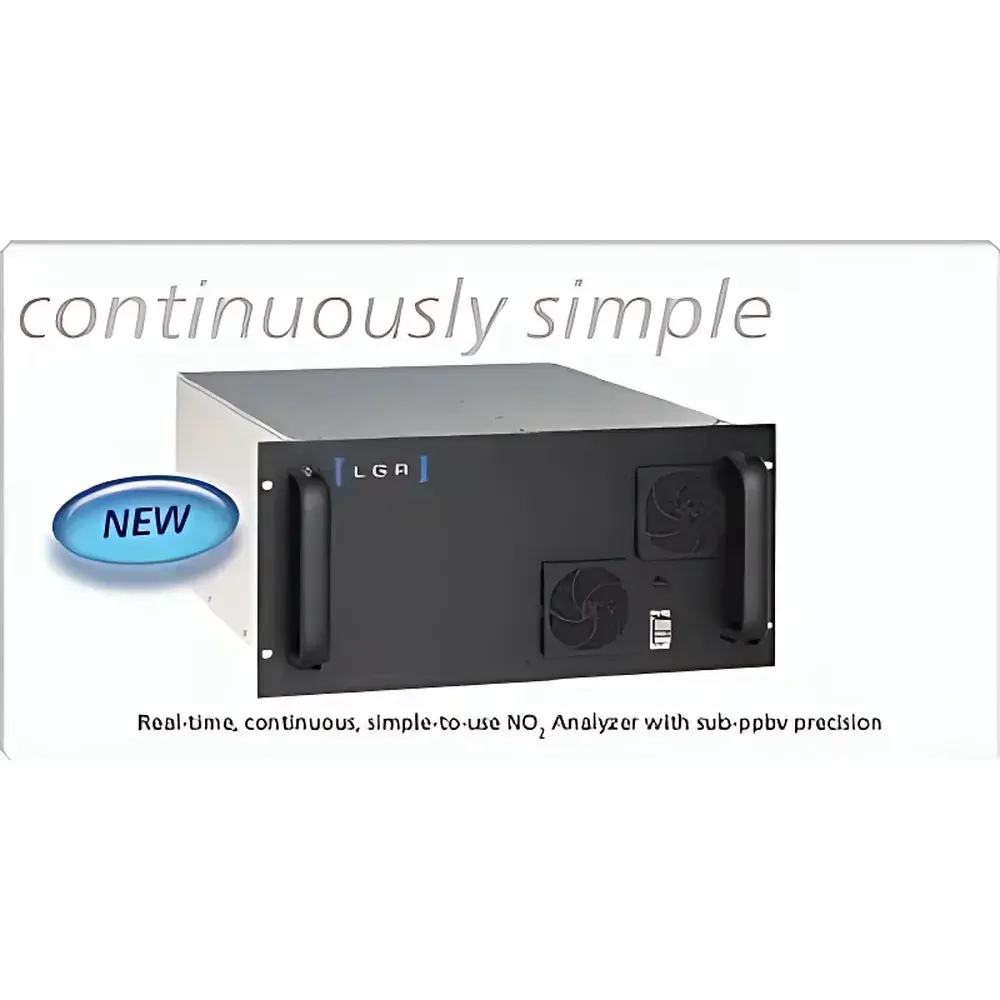
LGR Model 907-0009 / 908-0009 / 911-0009 NO₂ Analyzer
| Origin | USA |
|---|---|
| Manufacturer | Los Gatos Research |
| Type | OA-ICOS-based Ambient NO₂ Monitor |
| Models | 907-0009 (Rack-Mount Standard), 908-0009 (Benchtop Standard), 911-0009 (Enhanced Performance Rack-Mount) |
| Detection Limit | 0.05 ppb (1σ, 60 s) |
| Precision | 50 ppt (1σ, 1 s) |
| Response Time (Cavity Flush) | 10 s (Internal Pump) / 1 s (Optional External Vacuum Pump) |
| Drift | ≤50 ppt (24 h, EP model, STP, 15-min avg) |
| Measurement Range | 0.01–1000 ppb (full-spec) |
| Optional Extended Range | 0–3000 ppb |
| Linearity | Full-scale linear |
| Zero Calibration | Auto-zero via metal oxide scrubber (no zero gas required) |
| Sample Temp. | 0–50 °C |
| Operating Temp. | 5–45 °C |
| Humidity | 0–100% RH (non-condensing) |
| Power | 115/230 VAC, 50/60 Hz, 100 W (Std) / 150 W (EP) |
| Dimensions & Weight | Benchtop Std: 25.4 × 96.5 × 35.6 cm, 27 kg |
| Rack Std | 22.2 × 48.3 × 61 cm, 27 kg |
| Rack EP | 35.6 × 48.3 × 61 cm, 40 kg |
| Outputs | RS-232, Analog (0–10 V / 4–20 mA), Ethernet, USB |
| Internal Data Storage | Linux-based embedded computer with HDD logging |
Overview
The LGR NO₂ Analyzer series (Models 907-0009, 908-0009, and 911-0009) is a high-sensitivity, field-deployable ambient air monitoring instrument engineered for continuous, quantitative measurement of nitrogen dioxide (NO₂) at sub-part-per-trillion levels. It employs Off-Axis Integrated Cavity Output Spectroscopy (OA-ICOS), a patented laser absorption technique developed by Los Gatos Research. Unlike conventional chemiluminescence or electrochemical sensors, OA-ICOS utilizes a thermally stabilized, ultra-long optical pathlength (equivalent to >10 km) within a high-finesse optical cavity to achieve exceptional detection sensitivity and spectral selectivity. This enables direct, interference-free quantification of NO₂ in complex atmospheric matrices—without cross-sensitivity to NO, NOₓ, H₂O, or common VOCs. The analyzer operates on the fundamental principle of Beer–Lambert absorption at a precisely tuned near-infrared wavelength (≈662 nm), where NO₂ exhibits strong, isolated rovibrational transitions. Its design meets the technical requirements for regulatory-grade ambient air quality monitoring under U.S. EPA Reference Method equivalency frameworks and supports compliance with ISO 10156, ISO 8573-1 (for sample line integrity), and EU Directive 2008/50/EC Annex IX performance criteria.
Key Features
- Sub-ppb detection limit: 0.05 ppb (1σ, 60-second average), with 50 ppt precision at 1-second integration
- Real-time measurement capability at 1 Hz native acquisition rate, fully synchronized with internal timing clock
- Integrated Nafion-based membrane dryer and catalytic metal oxide scrubber for automatic moisture removal and chemical zeroing—eliminates need for external zero-air generators or calibration gas cylinders
- Embedded Linux computing platform with onboard hard disk storage; data logged with UTC timestamps, sensor diagnostics, and environmental metadata (T, RH, pressure)
- Robust thermal and mechanical architecture: aluminum chassis, vibration-damped optical bench, and passive/active temperature stabilization ensuring long-term stability across diurnal temperature cycles
- Configurable analog outputs (0–10 V / 4–20 mA), RS-232 serial interface, Gigabit Ethernet (TCP/IP, Modbus TCP), and USB 2.0 for flexible integration into SCADA, DAQ, or cloud-based telemetry systems
- Two hardware configurations: standard-performance (907-/908-0009) and enhanced-performance (911-0009) variants featuring upgraded vacuum pumping, extended dynamic range, and reduced long-term drift (<50 ppt over 24 h)
Sample Compatibility & Compliance
The analyzer accepts ambient air samples directly through a heated or unheated inlet line (recommended 1/4″ PFA or SilcoNert® tubing). It accommodates sample flow rates from 0.5 to 2.0 L/min and tolerates full-range relative humidity (0–100% RH, non-condensing) without signal quenching or condensation-induced artifacts. Built-in pressure and temperature compensation algorithms correct for variations in ambient conditions per ISO 4223 and ASTM D6348. All models comply with CE marking directives (EMC 2014/30/EU, LVD 2014/35/EU) and are designed to support GLP/GMP data integrity workflows: audit trails, user access control (via SSH), and electronic signatures are enabled when paired with LGR’s optional Data Acquisition Software (Model 904-0002). The system satisfies key elements of FDA 21 CFR Part 11 for electronic records when deployed with validated configuration and change control protocols.
Software & Data Management
Data acquisition and remote management are supported via LGR’s proprietary software suite, compatible with Windows, macOS, and Linux hosts. The included Data Acquisition Software (Model 904-0002) provides time-synchronized logging of multiple instruments—including GPS position, meteorological inputs (anemometer, hygrometer), and co-located analyzers—using configurable trigger logic and metadata tagging. Raw spectra, calibrated concentrations, diagnostic flags (e.g., cavity misalignment, dew point warning), and system health logs are stored in HDF5 format, enabling traceable reprocessing and third-party analysis in Python (h5py), MATLAB, or R. Firmware updates are delivered over Ethernet using signed packages; all configuration changes are timestamped and logged with operator ID. Optional multi-channel multiplexing (8- or 16-port MIU modules) allows sequential sampling from multiple locations without sacrificing temporal resolution or calibration fidelity.
Applications
- Ambient air quality monitoring networks (AQS, EEA, national reference stations)
- Mobile platforms: vehicle-mounted, drone-deployable (with power and shock mitigation), and shipboard installations
- Indoor air quality assessment in schools, hospitals, and urban microenvironments
- Emissions testing and fence-line monitoring at industrial facilities (e.g., power plants, refineries, traffic corridors)
- Atmospheric chemistry research: NO₂ photolysis studies, ozone formation potential modeling, and boundary layer profiling
- Calibration transfer and reference standard verification for lower-cost sensor networks (LPAS, MOX arrays)
FAQ
Does the analyzer require zero gas or span gas for routine operation?
No. The integrated metal oxide scrubber provides continuous chemical zeroing; no external zero-air source is needed. Span calibration is recommended quarterly using certified NO₂ permeation tubes or dynamic dilution systems.
Can the instrument operate unattended for extended periods?
Yes. With onboard data logging, watchdog timers, automatic restart after power loss, and remote diagnostics via Ethernet, it supports >30-day autonomous deployment in remote sites.
Is the measurement affected by water vapor or CO₂ interference?
No. OA-ICOS spectral resolution (≤0.001 cm⁻¹) resolves NO₂ lines independently of H₂O and CO₂ absorption bands; the built-in dryer further suppresses residual broadening effects.
What maintenance is required?
Annual inspection of inlet filters, dryer membrane integrity, and optical window cleanliness. No consumables other than standard particulate filters (replaced every 3–6 months depending on site conditions).
How is traceability ensured for regulatory reporting?
Each unit ships with NIST-traceable factory calibration certificate; field recalibration uses EPA-approved permeation standards. All raw and processed data include embedded calibration coefficients, uncertainty budgets, and version-controlled firmware IDs.
Related Products







