
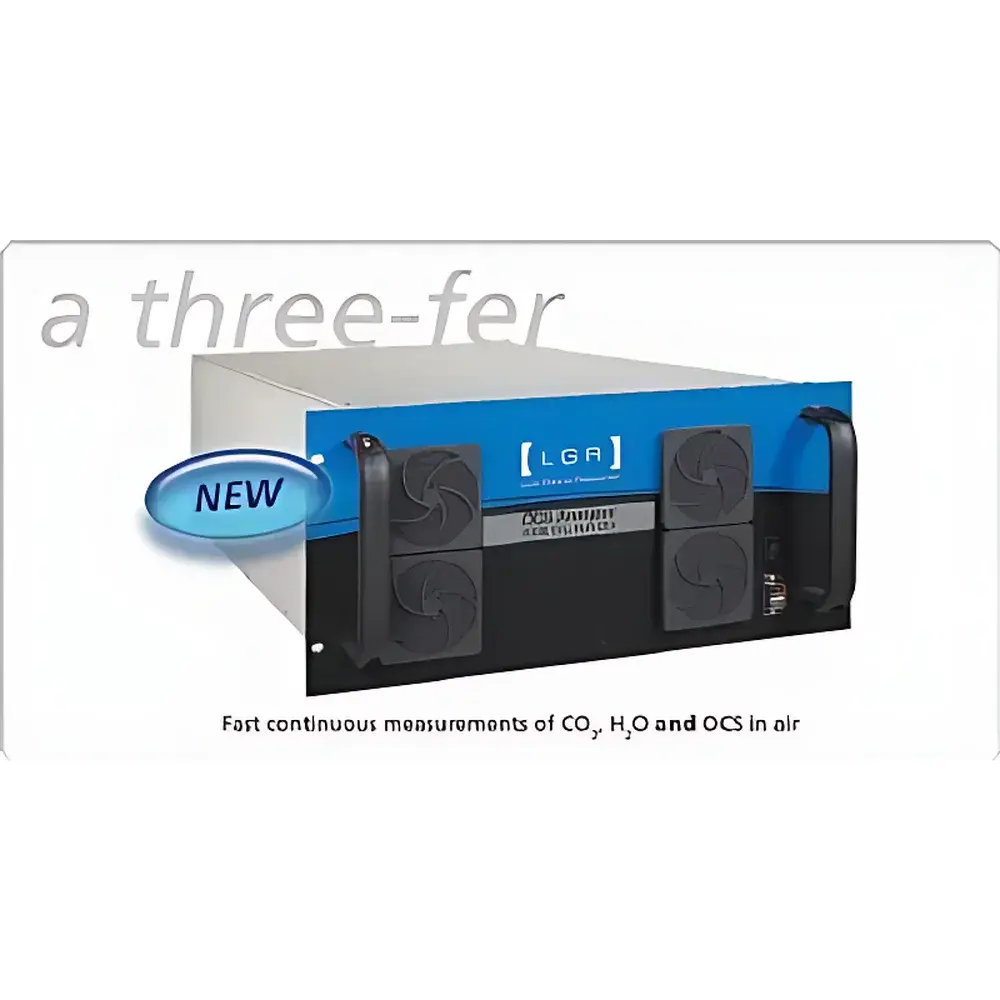
LGR Model 907-0028 / 914-0028 Carbonyl Sulfide (OCS) Analyzer with Simultaneous CO₂ and H₂O Measurement
| Origin | USA |
|---|---|
| Manufacturer Type | Authorized Distributor |
| Origin Category | Imported |
| Model Numbers | 907-0028, 914-0028 |
| Pricing | Upon Request |
Overview
The LGR Model 907-0028 (Standard) and 914-0028 (Enhanced Performance, EP) Carbonyl Sulfide (OCS) Analyzers are high-precision, field-deployable trace gas analyzers engineered for ecosystem-scale carbon cycle research. These instruments leverage Off-Axis Integrated Cavity Output Spectroscopy (OA-ICOS)—LGR’s proprietary fourth-generation cavity-enhanced absorption spectroscopy technology—to deliver simultaneous, real-time, and calibration-free quantification of OCS, CO₂, and H₂O in ambient air. Unlike traditional Cavity Ring-Down Spectroscopy (CRDS), OA-ICOS provides superior immunity to laser alignment drift, faster temporal response, and robust performance under variable environmental conditions—critical for eddy covariance flux towers, chamber-based studies, and combustion diagnostics.
OCS is a naturally occurring atmospheric trace gas that co-enters plant stomata during photosynthesis but is not emitted or consumed during respiration. This asymmetric biological behavior makes OCS an ideal endogenous tracer for gross primary production (GPP). By measuring OCS alongside CO₂ and H₂O at sub-second intervals, researchers obtain direct, non-invasive insight into canopy-level photosynthetic activity—free from the confounding effects of respiratory CO₂ efflux. The analyzer’s inherent stability, pressure/temperature insensitivity, and lack of cryogenic cooling requirements enable reliable operation across diverse field sites—from boreal forests and agricultural plots to urban boundary layers and industrial exhaust streams.
Key Features
- Simultaneous, high-speed measurement of OCS, CO₂, and H₂O at up to 10 Hz (with optional external vacuum pump)
- OA-ICOS optical architecture: no moving parts, no mirror alignment sensitivity, and minimal maintenance
- Standard configuration achieves OCS precision of 10 ppt (1σ, 1 s), CO₂ precision of 0.3 ppm (1σ, 1 s), and H₂O precision of 30 ppm (1σ, 1 s)
- Enhanced Performance (EP) variant delivers improved stability: OCS drift ≤3 ppt (24 h, 15-min averaging), CO drift ≤0.5 ppb, CO₂ drift ≤0.1 ppm
- Full-scale linearity across wide dynamic ranges: OCS (0.2–400 ppb), CO₂ (10–10,000 ppm), H₂O (4000 ppm–100% RH, non-condensing)
- Integrated onboard computer for autonomous data logging; supports timestamped storage on internal SSD
- Multiple digital interfaces: RS-232, Ethernet (TCP/IP), USB 2.0; analog outputs (0–5 V or 4–20 mA) configurable per species
- Optional multi-channel multiplexer (8- or 16-port) enables automated sampling from multiple inlets or chambers
- Dynamic dilution system (optional) extends OCS upper range by 100× while preserving accuracy and response time
Sample Compatibility & Compliance
The analyzer accepts untreated, unfiltered ambient air across a sample temperature range of 0–50 °C and relative humidity of 0–100% RH (non-condensing). It exhibits negligible cross-sensitivity to common atmospheric interferents (e.g., CH₄, N₂O, SO₂, NO₂) and is unaffected by ambient pressure fluctuations—eliminating the need for active pressure regulation in most field deployments. The EP model incorporates active thermal stabilization (±0.003 °C) and ultra-stable pressure control (±0.001 torr), enabling compliance with GLP/GMP data integrity requirements for long-term ecological monitoring programs. Data output formats adhere to CF (Climate and Forecast) metadata conventions, facilitating interoperability with FluxNet, AmeriFlux, and ICOS infrastructure. While not certified for regulatory emissions reporting, its metrological traceability aligns with ISO/IEC 17025 principles when operated within specified environmental and calibration protocols.
Software & Data Management
LGR’s proprietary Data Acquisition Software (included with model 904-0002) provides synchronized logging of OCS, CO₂, and H₂O alongside external sensor inputs (e.g., 3D sonic anemometer, GPS, soil moisture probes) via USB or RS-232. The software supports user-defined averaging intervals, automatic zero/span validation scheduling, and export in CSV, NetCDF, or MATLAB-compatible formats. All raw spectral data and processed concentration time series are stored with full audit trail—including instrument status flags, diagnostic logs, and firmware version stamps—meeting FDA 21 CFR Part 11 electronic record requirements when deployed in validated laboratory environments. Remote configuration and real-time monitoring are supported via secure Ethernet connection using standard HTTP/HTTPS protocols.
Applications
- Gross primary production (GPP) estimation via OCS–CO₂ co-variation in eddy covariance systems
- Soil–atmosphere OCS exchange quantification using automated chamber networks
- Atmospheric chemistry studies: OCS lifetime, stratospheric transport, and anthropogenic source attribution
- Combustion process optimization and emission characterization (e.g., biomass burning, fossil fuel combustion)
- Calibration transfer and intercomparison campaigns between ground-based, airborne, and satellite platforms
- Long-term trend analysis in background monitoring stations (e.g., Mauna Loa, Alert, Cape Grim)
FAQ
What is the fundamental advantage of OA-ICOS over CRDS for OCS measurement?
OA-ICOS eliminates stringent laser alignment constraints inherent to CRDS, resulting in greater mechanical robustness, lower sensitivity to vibration and thermal drift, and faster system recovery after power cycling.
Can the analyzer be used without external pumping?
Yes—the standard configuration operates with internal flow control and achieves <1 Hz system response; however, optional N920/N940 vacuum pumps reduce gas exchange time to 1.2 s or 0.5 s, respectively, meeting strict eddy covariance timing requirements.
Is calibration required for routine operation?
No. The analyzer is factory-calibrated using NIST-traceable reference gases; field verification with zero air and span standards is recommended every 3–6 months depending on application criticality.
Does the instrument support remote diagnostics and firmware updates?
Yes—Ethernet connectivity enables secure remote access for live spectral viewing, parameter adjustment, log file retrieval, and over-the-air firmware upgrades.
How does the analyzer handle water vapor interference in OCS and CO₂ measurements?
H₂O is measured concurrently and used in real time to apply first-principles spectroscopic correction algorithms, eliminating the need for Nafion dryers or chilled mirrors that introduce lag and adsorption artifacts.







