
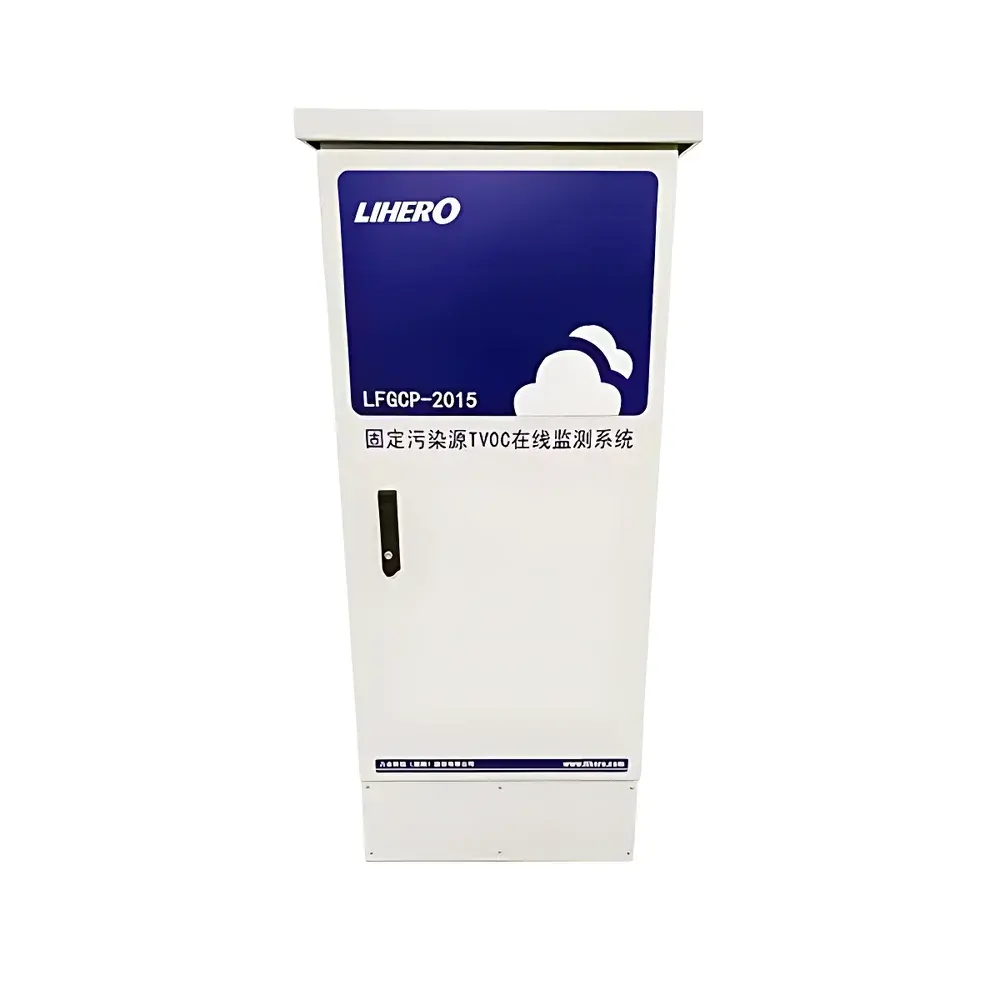
Lihero Fixed-Source PID Online Monitoring System
| Brand | Lihero |
|---|---|
| Origin | Hunan, China |
| Manufacturer Type | Authorized Distributor |
| Product Origin | Domestic (China) |
| Model | Fixed-Source PID Online Monitoring System |
| Pricing | Available Upon Request |
Overview
The Lihero Fixed-Source PID Online Monitoring System is a continuous emission monitoring solution engineered for real-time detection and quantification of volatile organic compounds (VOCs) from stationary industrial sources—such as stack exhausts, fume hoods, thermal oxidizers, and process vents. Utilizing photoionization detection (PID) technology, the system operates on the principle of ultraviolet (UV) photon-induced ionization of VOC molecules with ionization potentials (IP) lower than the lamp energy (typically 10.6 eV). Ionized species generate a proportional current signal, enabling ppb-to-ppm level concentration measurement with high selectivity for aromatic hydrocarbons, ketones, aldehydes, amines, and other photoionizable organics. Designed for permanent installation in demanding industrial environments, the system complies with core functional requirements outlined in HJ 75–2017 and HJ 1013–2018 (Chinese Technical Specifications for CEMS), and supports alignment with international frameworks including ISO 14001 environmental management systems and EU Industrial Emissions Directive (IED) reporting expectations.
Key Features
- Robust fixed-source integration: Modular probe assembly with high-temperature sampling line (up to 200 °C), heated filter housing, and corrosion-resistant 316L stainless-steel flow path for stable operation under variable stack conditions.
- Automatic zero-point calibration: Integrated dual-stage zero-air generator with catalytic scrubber ensures drift-free baseline correction at user-defined intervals (e.g., every 6–24 hours), minimizing manual intervention and maintaining long-term measurement integrity.
- Expandable architecture: Standard Modbus RTU/TCP and 4–20 mA analog outputs enable seamless integration with existing DCS/SCADA systems; optional add-on modules include FID backup channel, O₂ sensor, temperature/pressure transducers, and particulate matter (PM) pre-filter diagnostics.
- Explosion-proof compliance: Sensor enclosure rated Ex d IIB T4 Gb per GB 3836.1–2021 (equivalent to ATEX II 2G IIB T4), certified for Zone 1 hazardous areas adjacent to emission stacks or boundary fence lines.
- Low-maintenance design: Solid-state UV lamp with >12,000-hour lifetime, self-cleaning sample path via pulsed purge gas, and onboard diagnostics for flow rate, lamp intensity, and detector saturation status.
Sample Compatibility & Compliance
The system is validated for continuous sampling of hot, humid, and particulate-laden flue gases without condensation-induced signal attenuation. It accommodates gas matrices containing up to 15% v/v CO₂, <100 ppm SO₂, and <50 mg/m³ total suspended particulates when used with optional cyclonic pre-separator. All firmware and data handling protocols adhere to HJ 76–2017 requirements for data validity validation, including automatic identification of invalid readings due to zero/span failure, power interruption, or communication loss. Audit-ready data logs retain timestamps, calibration events, alarm triggers, and maintenance records for ≥18 months—supporting GLP-aligned environmental reporting and regulatory inspection readiness.
Software & Data Management
The embedded Linux-based controller runs Lihero CEMS Suite v3.2, providing local HMI via 7-inch capacitive touchscreen and remote access via secure HTTPS/TLS interface. Data is timestamped with NTP-synchronized accuracy (±100 ms), stored in CSV and SQLite formats, and transmitted in real time to central platforms using MQTT or HTTP POST protocols. Role-based user accounts (Operator, Technician, Administrator) enforce granular access control. Full audit trail functionality meets traceability requirements under China’s “Emission Permit Management Regulation” and provides foundational compatibility with FDA 21 CFR Part 11–aligned electronic record systems when deployed in pharmaceutical or fine chemical manufacturing settings.
Applications
- Continuous compliance monitoring for chemical synthesis reactors, polymer extrusion lines, and paint spray booths under national VOC emission standards (e.g., DB11/1227–2015, DB31/1026–2017).
- Boundary fence-line monitoring to assess off-site VOC dispersion and support community air quality reporting obligations.
- Leak detection and repair (LDAR) program verification for valves, flanges, and connectors in petrochemical facilities.
- Process optimization feedback loop—correlating real-time VOC spikes with operational parameters (e.g., solvent recovery efficiency, catalyst deactivation onset).
- Integration into municipal or provincial environmental big-data platforms for cross-facility emission trend analysis and hotspot identification.
FAQ
What VOC compounds can this PID system reliably detect?
It detects most photoionizable VOCs with ionization potentials below 10.6 eV—including benzene, toluene, xylene, styrene, acetone, MEK, isopropanol, and formaldehyde—with relative response factors (RRFs) traceable to NIST SRM 1861a calibration standards.
Is third-party certification available for regulatory submission?
Yes—system-level verification reports per HJ 1013–2018 are provided upon request; field validation per HJ 75–2017 can be coordinated through authorized Lihero service partners.
Can the system operate unattended for extended periods?
Fully autonomous operation is supported for ≥30 days between routine checks, contingent on stable utility supply, ambient temperature between –20 °C and +50 °C, and scheduled zero calibration intervals.
How is data security ensured during transmission?
All network communications use TLS 1.2 encryption; local storage employs AES-256 full-disk encryption; and firmware updates require signed digital certificates verified by the onboard bootloader.
Does the system support remote diagnostics and firmware updates?
Yes—remote SSH access (disabled by default), over-the-air (OTA) firmware upgrades via authenticated HTTPS, and real-time health telemetry (lamp output, flow stability, detector gain) are enabled through the CEMS Suite web portal.
Related Products







