
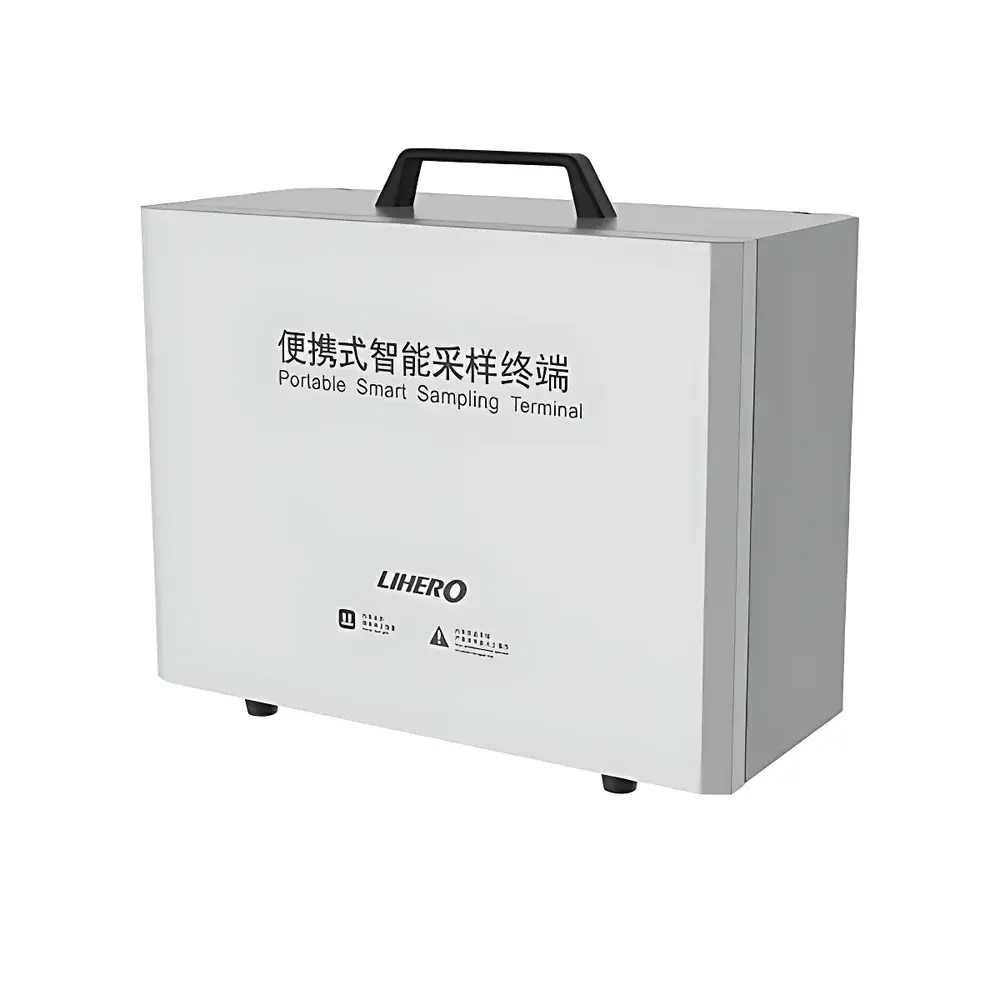
Lihero ISAM 100 Portable Intelligent Sampling Terminal
| Brand | Lihero |
|---|---|
| Origin | Hunan, China |
| Manufacturer Type | Authorized Distributor |
| Country of Origin | China |
| Model | ISAM 100 |
| Pricing | Available Upon Request |
Overview
The Lihero ISAM 100 Portable Intelligent Sampling Terminal is an autonomous, field-deployable environmental sampling system engineered for real-time, context-aware water sample acquisition in distributed monitoring scenarios. It operates on a programmable logic architecture that integrates hydrological sensing, actuator control, and secure telemetry to execute multi-mode sampling strategies—including time-proportional, level-triggered, flow-proportional, and remotely initiated sampling—without continuous on-site supervision. Designed for deployment at discharge points, stormwater outfalls, industrial effluent channels, and riverine cross-sections, the ISAM 100 bridges spatial and temporal gaps in conventional fixed-station networks by enabling rapid, low-cost node expansion. Its core measurement principle relies on synchronized sensor input (e.g., ultrasonic level, electromagnetic flow, rainfall intensity) to dynamically trigger peristaltic pump activation, valve sequencing, and bottle indexing—ensuring representative composite or discrete samples aligned with regulatory sampling protocols such as ISO 5667-3 and EPA Method 1664.
Key Features
- Multi-mode sampling logic: Supports scheduled, time-proportional, level-based, flow-proportional, and remote-command-triggered sampling—configurable via onboard interface or cloud platform.
- Integrated sensor fusion: Accepts analog/digital inputs from external sensors (e.g., ultrasonic level transmitters, magnetic flow meters, tipping-bucket rain gauges) to enable event-driven sampling based on user-defined thresholds.
- Intelligent bottle management: Equipped with motorized carousel and RFID-tagged sampling vials; enables remote bottle selection, aspiration verification, and anti-tampering lockout to prevent unauthorized or accidental sample disposal.
- Onboard data logging & diagnostics: Records timestamped sampling events, pump cycles, sensor readings, power status, and system faults with local non-volatile storage (≥12 months’ log retention); supports encrypted upload to central SCADA or LIMS platforms via LTE/4G or LoRaWAN.
- Self-maintenance functions: Includes automated line flushing, pump priming, and reservoir emptying sequences to minimize biofilm accumulation and cross-contamination between sampling events.
- Mobile-first operational interface: Native Android/iOS application provides authenticated access for field technicians to initiate manual sampling, replace vials, annotate sample metadata (e.g., site ID, operator ID, visual observations), configure sampling parameters, and perform diagnostic tests—all without physical access to the terminal housing.
Sample Compatibility & Compliance
The ISAM 100 is validated for aqueous matrices including municipal wastewater, industrial effluents, surface water, and stormwater runoff. Sample containers accommodate standard 500 mL–2 L polyethylene or glass bottles compliant with EPA SW-846 Chapter 3 preservation requirements. All wetted materials (PVC tubing, EPDM diaphragms, stainless-steel fittings) meet NSF/ANSI Standard 61 for drinking water system components. Firmware and communication protocols adhere to IEC 62443-3-3 for industrial cybersecurity; data transmission conforms to TLS 1.2+ encryption standards. The system supports audit-trail generation required under GLP and ISO/IEC 17025-accredited laboratories, with immutable timestamps, user authentication logs, and change history for all configuration updates.
Software & Data Management
The terminal operates with embedded Linux-based firmware and communicates via MQTT or HTTP(S) RESTful APIs to Lihero’s CloudConnect™ platform—a web-based dashboard supporting role-based access control (RBAC), geospatial asset mapping, dynamic alerting (SMS/email/webhook), and automated report generation (PDF/CSV). Raw sampling metadata—including GPS coordinates, battery voltage, ambient temperature, sensor raw values, and pump duty cycle—is stored in a time-series database with configurable retention policies. Platform-level integration is available with third-party systems via OPC UA or custom API adapters, facilitating interoperability with existing EMS, EHS, or regulatory reporting tools (e.g., US EPA CDX, China MEP Online Reporting System). All data exports include digital signatures and SHA-256 checksums to ensure integrity and traceability.
Applications
- Source identification and pollution tracing in watershed-scale investigations
- Compliance verification for industrial discharge permits (e.g., NPDES, China’s Pollutant Discharge Permit System)
- Event-based monitoring during rainfall-runoff episodes or process upsets
- Supporting forensic water quality analysis in liability determination cases
- Augmenting sparse fixed-network deployments in rural or peri-urban zones
- Calibration and validation of online analyzers (e.g., COD, NH₃-N, turbidity sensors)
FAQ
Does the ISAM 100 support integration with existing SCADA or LIMS platforms?
Yes—via standardized RESTful APIs, MQTT brokers, or optional OPC UA gateway modules.
What is the typical battery life under continuous operation with cellular telemetry?
Up to 6 months on dual 12 V/12 Ah LiFePO₄ batteries when configured for 4G transmission every 15 minutes and sampling ≤4 times daily.
Can sampling intervals be adjusted remotely after field deployment?
Yes—through the CloudConnect™ portal or mobile app, with immediate firmware-level parameter synchronization and version-controlled change logging.
Is the system certified for use in hazardous locations (e.g., Class I Div 2)?
Not intrinsically rated; however, optional ATEX/IECEx-certified enclosures are available upon request for specific deployment environments.
How is data security enforced during over-the-air firmware updates?
All OTA updates require signed firmware packages verified via ECDSA-256, with rollback protection and dual-bank flash memory architecture to ensure fail-safe recovery.



