
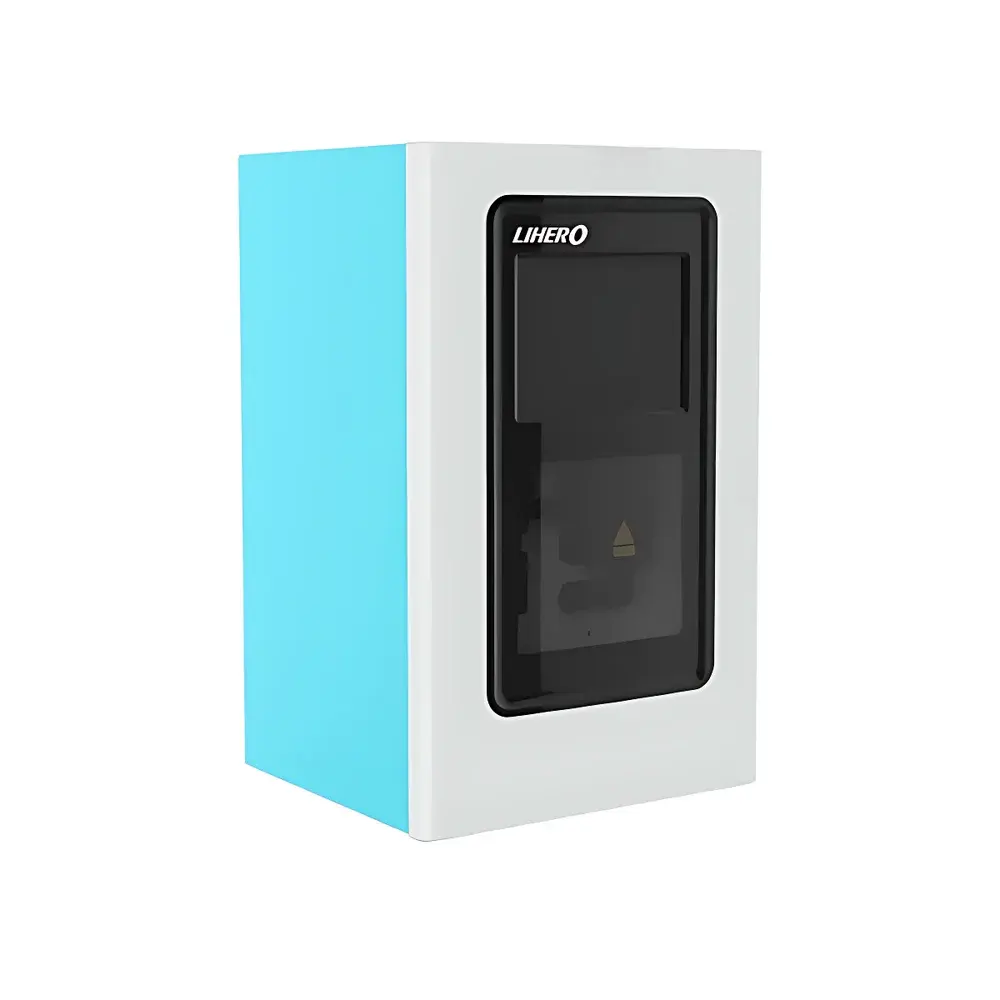
Lihero LFS-2002 Nitrite-Nitrogen (NO₂⁻-N) Water Quality Analyzer
| Brand | Lihero |
|---|---|
| Model | LFS-2002 (NO₂) |
| Measurement Principle | N-(1-Naphthyl)ethylenediamine Dihydrochloride Spectrophotometry (ISO 6775, APHA 4500-NO₂⁻ B) |
| Wavelength | 540 nm ± 2 nm |
| Detection Range | 0–1.0 mg/L NO₂⁻-N (extendable to 0–5.0 mg/L with dilution) |
| Detection Limit | ≤ 0.005 mg/L NO₂⁻-N |
| Accuracy | ±5% of reading or ±0.01 mg/L (whichever is greater) |
| Repeatability | RSD ≤ 3% |
| Sample Volume | 10–50 mL |
| Digestion | High-temperature (120°C), high-pressure sealed digestion module |
| Turbidity & Color Compensation | Real-time dual-wavelength optical correction |
| Calibration Modes | Zero check, span check, standard verification, curve auto-calibration, spike recovery test |
| Data Logging | Internal SD card + RS485/Modbus RTU + optional 4G/ETH remote upload |
| Operating System | Embedded Linux (real-time kernel) |
| Power Supply | 220 VAC ±10%, 50 Hz |
| IP Rating | IP65 (enclosure) |
| Compliance | GB/T 32203–2015, HJ 537–2009, ISO 6775:1984, APHA Standard Methods 4500-NO₂⁻ B |
Overview
The Lihero LFS-2002 Nitrite-Nitrogen (NO₂⁻-N) Water Quality Analyzer is a fully automated, laboratory-grade online and grab-sample analyzer engineered for precise, trace-level quantification of nitrite nitrogen in surface water, groundwater, drinking water, wastewater effluent, and industrial process streams. It implements the internationally standardized N-(1-naphthyl)ethylenediamine dihydrochloride (NED) spectrophotometric method (ISO 6775:1984; APHA Standard Methods 4500-NO₂⁻ B; HJ 537–2009), wherein nitrite ions react with sulfanilamide under acidic conditions to form a diazonium salt, followed by coupling with NED to generate a stable, measurable magenta-colored azo dye at 540 nm. The instrument integrates photometric detection with real-time optical path self-balancing, high-fidelity analog signal conditioning, and embedded thermal control (40 ± 0.5 °C reaction incubation), ensuring high reproducibility and minimal matrix interference.
Key Features
- Optical self-balancing photometric system with dual-wavelength compensation—dynamically corrects for turbidity and chromatic interferences without manual filtration or pretreatment.
- High-efficiency sealed digestion module operating at 120 °C and elevated pressure, enabling complete oxidation of interfering reductants and consistent color development kinetics.
- Comprehensive on-board diagnostic suite: real-time sensor health monitoring, photodiode drift detection, reagent depletion alerts, flow path blockage recognition, and optical window fouling assessment.
- Automated calibration and verification protocol suite—including zero-point verification, multi-point span checks, standard solution integrity validation, full calibration curve auto-generation, and programmable spike recovery testing per EPA Method 300.1 requirements.
- Fault-resilient architecture with event-triggered logging: all anomalies (e.g., out-of-range absorbance, reagent exhaustion, temperature deviation > ±1 °C, flow interruption) are timestamped, stored locally on SD card, and transmitted via Modbus RTU or optional 4G/ETH interface.
- Embedded Linux-based real-time operating system supporting deterministic I/O scheduling, secure firmware updates, and TLS-encrypted remote configuration via web UI or SCADA integration.
Sample Compatibility & Compliance
The LFS-2002 accepts raw, unfiltered water samples with turbidity up to 200 NTU and true color ≤ 500 Pt-Co units. It meets the performance criteria outlined in China’s GB/T 32203–2015 for online water quality analyzers and aligns with U.S. EPA guidance for nitrite analysis in ambient water monitoring programs. Its measurement traceability is maintained through NIST-traceable potassium nitrite reference standards (SRM 2121a). The system supports GLP-compliant data integrity workflows, including electronic audit trails, user-access controls, and immutable event logs—facilitating readiness for regulatory inspections under ISO/IEC 17025, ISO 9001, and local environmental authority mandates.
Software & Data Management
Data acquisition, processing, and reporting are managed via the integrated Lihero AquaControl™ firmware v3.2. All measurements are timestamped with GPS-synced UTC and stored with metadata (sample ID, operator code, calibration status, ambient temperature/humidity). Export formats include CSV, PDF reports (with embedded chromatograms and QC flags), and XML for LIMS integration. Remote access enables over-the-air parameter adjustment, diagnostic viewing, and alarm acknowledgment—fully compliant with IEC 62443-3-3 cybersecurity profiles for industrial control systems.
Applications
- Continuous monitoring of nitrite nitrogen at drinking water treatment plant intake and distribution points.
- Regulatory compliance testing for municipal wastewater discharge permits (e.g., China’s GB 18918–2002 Class I-A limits).
- Process control in aquaculture facilities where nitrite accumulation poses acute toxicity risk to fish gills.
- Research-grade quantification in limnological studies assessing nitrification/denitrification rates in sediment-water interfaces.
- Validation support for laboratory benchtop spectrophotometers during method transfer and cross-platform verification.
FAQ
What is the minimum detectable concentration for nitrite-nitrogen using this analyzer?
The method detection limit (MDL) is 0.005 mg/L NO₂⁻-N, validated per EPA Guidance Document 40 CFR Part 136, Appendix B.
Does the system require daily manual maintenance or reagent replenishment?
Reagents (sulfanilamide, NED, phosphoric acid buffer) are housed in pressurized, light-shielded cartridges with RFID-tagged lot tracking; typical cartridge life is 30 days at one measurement per hour.
Can the LFS-2002 be integrated into an existing SCADA or EMS platform?
Yes—it provides native Modbus RTU (RS485) and optional Modbus TCP/IP or OPC UA server functionality with configurable polling intervals and alarm severity mapping.
How does the instrument handle high-turbidity samples such as river water during flood season?
The dual-wavelength (540 nm/700 nm) optical correction algorithm continuously subtracts non-specific scattering contributions, eliminating need for pre-filtration while maintaining accuracy within ±5% up to 200 NTU.
Is the calibration curve stored permanently, and can it be exported for third-party review?
Calibration parameters—including slope, intercept, correlation coefficient (r² ≥ 0.999), and residual error plots—are saved in encrypted binary format and exportable as CSV or PDF with digital signature verification.
Related Products







