
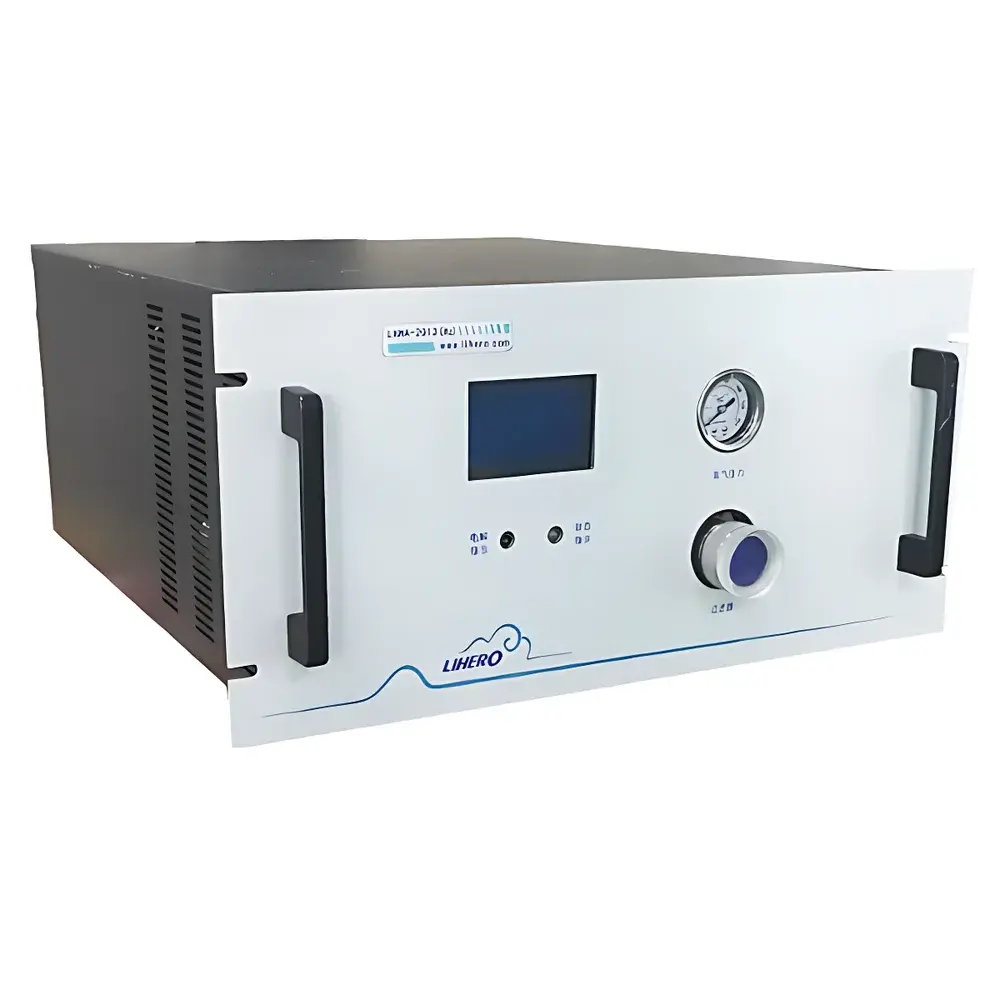
Lihero LHHA-2013 Hydrogen Generator
| Brand | Lihero |
|---|---|
| Model | LHHA-2013 (H₂) |
| Principle | PEM-free alkaline water electrolysis |
| Output Purity | ≥99.999% H₂ |
| Flow Rate | Up to 300 mL/min (adjustable) |
| Output Pressure | 0–0.4 MPa (adjustable, stabilized) |
| Water Reservoir Capacity | 3.5 L stainless steel integrated tank |
| Power Supply | AC 220 V ±10%, 50 Hz |
| Dimensions | 360 × 280 × 520 mm |
| Weight | 22 kg |
| Safety Protections | Over-pressure shutdown, over-flow cutoff, low-water alarm, thermal overload protection |
| Communication Interface | RS-232 serial port for remote monitoring and control |
Overview
The Lihero LHHA-2013 Hydrogen Generator is an on-demand, laboratory-grade gas supply system engineered for continuous, high-purity hydrogen production via alkaline water electrolysis. Unlike PEM-based systems, this generator employs a robust, non-precious-metal electrolytic cell operating at ambient temperature and pressure, delivering consistent H₂ output without reliance on compressed gas cylinders. The core process involves the electrochemical decomposition of deionized water into stoichiometric hydrogen (at the cathode) and oxygen (at the anode), with real-time separation of evolved gases. Oxygen is safely vented to atmosphere through a dedicated exhaust path, while hydrogen passes sequentially through a hydrogen/water separator, desiccant-based dryer, precision pressure regulator, and final stabilizing valve before delivery. Designed for integration with analytical instruments—including GC, GC-MS, and hydrogenation reactors—the LHHA-2013 eliminates logistical constraints associated with cylinder handling, storage, and regulatory compliance for compressed gases.
Key Features
- Intelligent microcontroller-based operation with full Chinese LCD interface—displaying real-time flow rate, system pressure, water level, and operational status.
- Auto-refill function triggered by integrated water-level sensors, ensuring uninterrupted operation during extended runs.
- Hermetically sealed electrolysis chamber with corrosion-resistant nickel-plated electrodes and optimized alkaline electrolyte management—minimizing alkali mist carryover and operator exposure.
- Dedicated 3.5 L stainless steel reservoir isolates the electrolyte from ambient air, suppressing evaporation and thermal drift while extending cell service life beyond 5,000 operating hours under standard conditions.
- Comprehensive safety architecture: pressure relief valve, dual-stage over-pressure cutoff (mechanical + electronic), flow-limiting firmware logic, and automatic thermal shutdown at >75 °C internal temperature.
- RS-232 serial interface compliant with standard ASCII command protocol—enabling bidirectional communication with host GC systems or centralized lab management software for audit-ready event logging.
Sample Compatibility & Compliance
The LHHA-2013 is compatible with all standard 1/8″ or 1/4″ stainless steel or copper tubing connections used in analytical laboratories. It meets general electrical safety requirements per IEC 61010-1 (2012) for laboratory equipment and incorporates design elements aligned with ISO/IEC 17025:2017 clause 6.4.3 on controlled environmental conditions for gas supply integrity. While not certified to UL or CE for standalone medical or industrial use, its construction adheres to GLP-relevant engineering practices—including traceable component sourcing, non-volatile memory for fault history, and password-protected configuration access. No external humidification or post-generation filtration is required for GC carrier or fuel gas applications meeting ASTM D3612 Class I purity specifications.
Software & Data Management
The embedded controller stores up to 1,000 operational events—including startup/shutdown timestamps, pressure excursions, water refill cycles, and fault codes—with time-stamped records retrievable via RS-232 using terminal emulation software (e.g., PuTTY or Tera Term). Raw data exports as CSV files support integration into LIMS platforms or custom Python/MATLAB analysis pipelines. Firmware supports remote diagnostics and parameter updates via secure serial handshake; no cloud connectivity or internet-facing services are implemented—ensuring data sovereignty and alignment with FDA 21 CFR Part 11 principles for electronic records where local validation protocols are applied.
Applications
- Carrier and fuel gas source for capillary and packed-column gas chromatography (GC) systems requiring ultra-high-purity hydrogen (≤0.1 ppm O₂, ≤0.1 ppm H₂O).
- Reducing atmosphere generation for catalytic hydrogenation studies in synthetic chemistry labs.
- Calibration gas supply for hydrogen sensors and electrochemical detectors.
- On-site hydrogen feed for small-scale PEM fuel cell testing rigs where intermittent, low-flow demand exists.
- Replacement for high-pressure H₂ cylinders in QA/QC environments seeking improved safety margins and reduced audit burden related to gas inventory tracking.
FAQ
What type of water must be used for optimal performance?
Deionized water with resistivity ≥5 MΩ·cm and total organic carbon (TOC) < 50 ppb is mandatory. Tap or distilled water will cause rapid electrode fouling and invalidates warranty.
Does the generator require periodic electrolyte replacement?
Yes—alkaline electrolyte (typically 15–20% KOH w/w) must be replenished every 6–12 months depending on usage intensity and water quality; procedure is documented in the technical manual.
Can the output pressure be modulated during operation?
Yes—pressure is continuously adjustable between 0 and 0.4 MPa via front-panel digital setpoint or RS-232 command, with closed-loop stabilization maintained within ±0.005 MPa.
Is the unit suitable for Class 1 Division 1 hazardous locations?
No—this generator is rated for general laboratory use only (non-explosion-proof enclosure) and must be installed in well-ventilated, non-classified areas per NFPA 55 guidelines.
How is oxygen byproduct managed?
Oxygen is routed through a dedicated vent line terminated outside the lab or into a fume hood duct; no catalytic recombination is employed.



