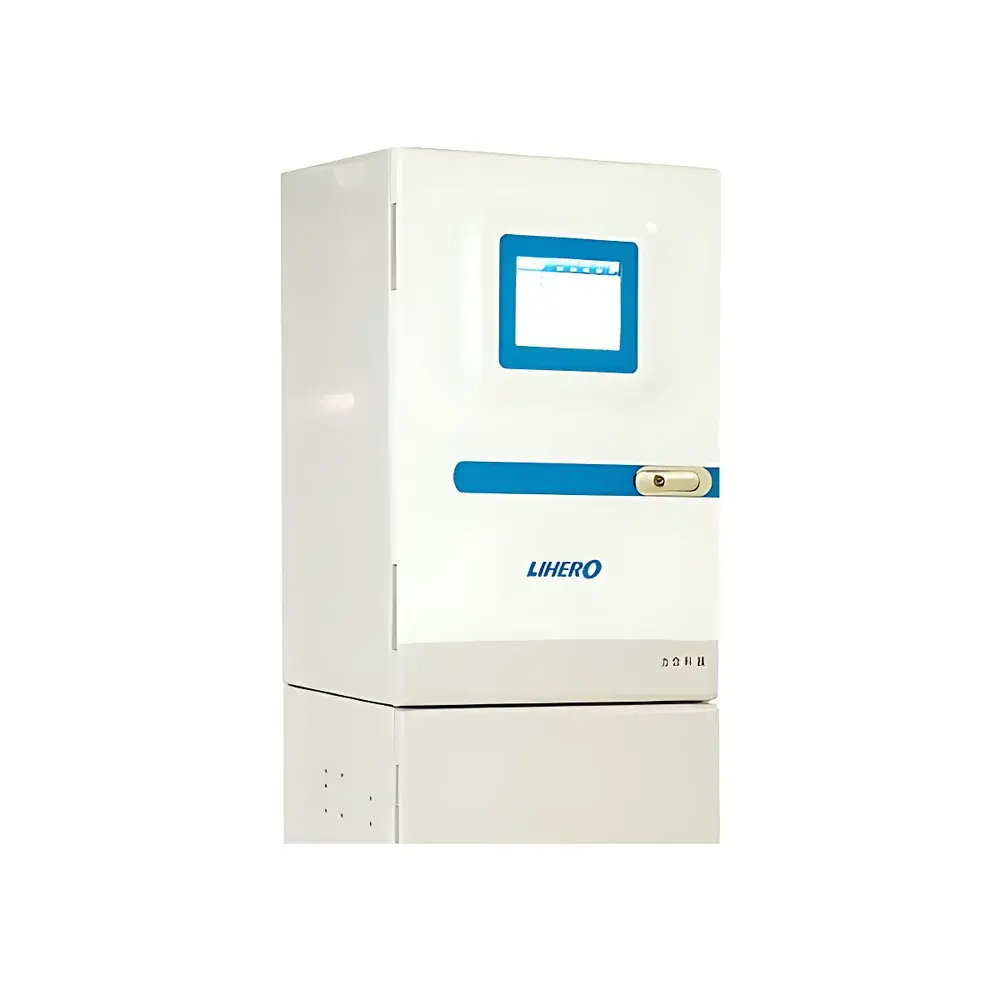
Lihero LIS-2013(TA) Total Alkalinity Online Analyzer
| Brand | Lihero |
|---|---|
| Model | LIS-2013(TA) |
| Measurement Principle | Colorimetric Spectrophotometry or Acid-Base Titration |
| Display | Embedded OS with 7-inch TFT Touchscreen (Chinese UI) |
| Sample Inlet | Positive-Pressure Auto-Sampling System |
| Reagent Consumption | ≤2.5 mL per analysis |
| Reagent Storage | Sealed Cartridge Design, Shelf Life Extended by >40% vs. Open Bottles |
| Data Storage | Internal Flash Memory ≥16 GB (≥12 months of 5-min interval data) |
| Sampling Channels | Up to 4 independent inlets with flow monitoring and dry-run alarm |
| Compliance | Designed for ISO 9001-certified manufacturing |
| Power Supply | 220 VAC ±10%, 50/60 Hz |
| Enclosure Rating | IP65 |
| Operating Temperature | 5–40 °C |
| Dimensions (W×D×H) | 483 × 450 × 220 mm |
| Weight | 18.5 kg |
Overview
The Lihero LIS-2013(TA) Total Alkalinity Online Analyzer is an industrial-grade, continuous-monitoring instrument engineered for real-time quantification of total alkalinity (expressed as mg/L CaCO₃) in aqueous process streams—including cooling water, boiler feedwater, wastewater effluents, and desalination intake sources. It operates on either colorimetric spectrophotometry (using bromocresol green or methyl orange indicators) or endpoint titration with standardized sulfuric acid—both methods fully compliant with ASTM D1067 and ISO 9963-1 protocols. Unlike laboratory-based titrators, the LIS-2013(TA) integrates fluidic automation, temperature-compensated photometry, and adaptive endpoint detection to deliver field-deployable accuracy (±2.5% of reading or ±3 mg/L, whichever is greater) under variable flow, pressure, and turbidity conditions. Its modular architecture enables seamless integration into existing DCS/SCADA networks via Modbus RTU/TCP or 4–20 mA analog output.
Key Features
- Embedded Linux-based control system with 7-inch resistive touchscreen interface—localized Chinese HMI eliminates language barriers for on-site operators without requiring external PCs.
- Positive-pressure sample introduction system eliminates reliance on vacuum pumps or peristaltic tubing, reducing clogging risk and ensuring consistent volumetric delivery across 0.5–5 L/min flow ranges.
- Sealed reagent cartridge design minimizes evaporation, oxidation, and contamination—extending shelf life of indicator and titrant solutions beyond 180 days at ambient storage.
- Onboard non-volatile memory retains ≥12 months of high-resolution measurement logs (timestamp, raw absorbance/titration curve, calibration status, alarm events), accessible via USB export or Ethernet download.
- Multi-channel sampling capability supports up to four independently valved inlets, each configurable with programmable cycle intervals, flow verification, and dry-run detection with relay-triggered shutdown.
- Ruggedized chassis meets IP65 ingress protection standards and operates continuously within 5–40 °C ambient environments—validated for deployment in utility corridors, chemical plant basements, and outdoor metering kiosks.
Sample Compatibility & Compliance
The LIS-2013(TA) accommodates samples with suspended solids ≤50 mg/L and turbidity ≤100 NTU without pre-filtration; higher particulate loads require optional inline 10-µm filtration. It complies with CE electromagnetic compatibility (EMC) Directive 2014/30/EU and RoHS 2011/65/EU material restrictions. While not certified for SIL2/SIL3 applications, its fault-detection logic (e.g., photodiode drift monitoring, reagent depletion alerts, pH electrode validation during titration mode) aligns with IEC 61511 functional safety guidelines for non-safety-critical process analytics. Data integrity features—including immutable timestamps, operator ID tagging, and write-protected archive partitions—support alignment with GLP documentation requirements and internal QA audits.
Software & Data Management
Firmware v3.2+ includes built-in data historian with configurable retention policies and CSV/Excel-compatible export. Optional Lihero Analytical Suite (LAS) software provides remote configuration, trend visualization, calibration certificate generation, and deviation reporting per ISO/IEC 17025 clause 7.7. Audit trails record all parameter changes, method modifications, and manual overrides with user credentials and UTC timestamps—enabling traceability for FDA 21 CFR Part 11 compliance when deployed with electronic signature-enabled authentication modules.
Applications
- Real-time alkalinity control in municipal water softening plants to optimize lime-soda ash dosing.
- Boiler water chemistry monitoring to prevent caustic embrittlement and scale formation in thermal power stations.
- Effluent compliance tracking for textile and pulp & paper mills discharging to regulated receiving waters.
- Process stability assurance during electroplating bath regeneration where carbonate accumulation affects plating uniformity.
- Feedwater qualification in reverse osmosis pretreatment systems to mitigate membrane fouling from bicarbonate precipitation.
FAQ
What measurement principle does the LIS-2013(TA) use by default?
It defaults to colorimetric analysis using bromocresol green indicator; titration mode is selectable via firmware configuration.
Can the analyzer operate unattended for extended periods?
Yes—designed for 30-day minimum maintenance intervals; reagent cartridges, optical windows, and pH electrodes are rated for ≥6 months of continuous service under typical industrial conditions.
Is remote diagnostics supported?
Yes—Modbus TCP enables integration with third-party SCADA; optional 4G LTE module (LIS-COMM-4G) adds cellular telemetry and over-the-air firmware updates.
Does it meet US EPA or EU WFD reporting requirements?
While not EPA-certified as a Method 310.1 device, its performance specifications satisfy data quality objectives (DQOs) outlined in EPA Guidance Document QA/G-5 for continuous emission monitoring equivalents.
How is calibration verified in situ?
Two-point calibration (low/high standard traceable to NIST SRM 3109a) is performed automatically; drift correction is applied using reference blank measurements every 2 hours.
Related Products