
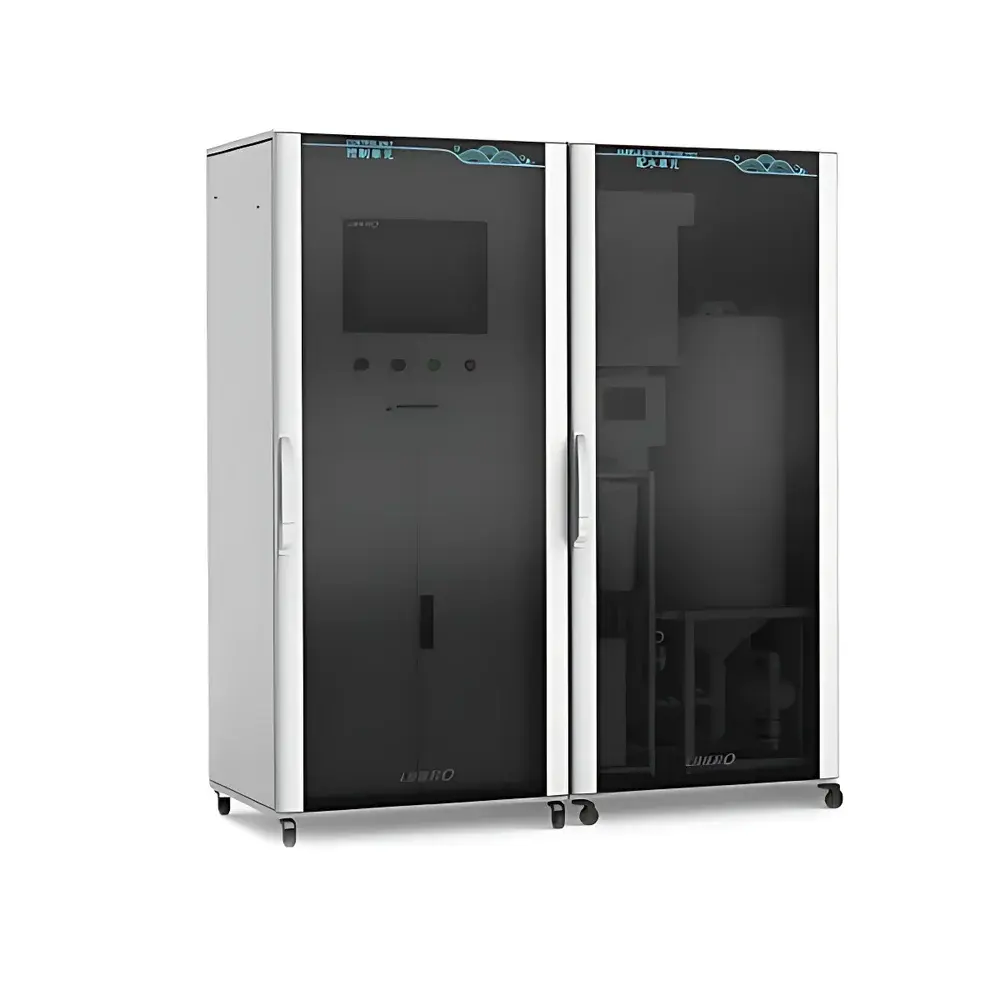
Lihero Pre-Treatment Unit for Water Sample Conditioning
| Brand | Lihero |
|---|---|
| Origin | Hunan, China |
| Manufacturer Type | Authorized Distributor |
| Country of Manufacture | China |
| Model | Pre-Treatment Unit |
| Pricing | Available Upon Request |
Overview
The Lihero Pre-Treatment Unit is an automated, modular water sample conditioning system engineered for analytical laboratories and online water quality monitoring stations requiring consistent, representative, and low-turbidity feed samples. It integrates multiple physical separation principles—including ultrasonic cavitation homogenization, gravitational sedimentation, vacuum-assisted filtration, and centrifugal separation—into a single coordinated workflow. Unlike manual or single-mode pretreatment methods, this unit dynamically selects the optimal sequence based on real-time turbidity feedback, ensuring minimal bias in downstream analysis (e.g., ICP-MS, UV-Vis spectrophotometry, ion chromatography). The system operates under programmable logic control with closed-loop sensor input, maintaining sample integrity while reducing particulate interference that compromises optical path clarity, membrane fouling, and instrument drift.
Key Features
- Multi-Mode Adaptive Conditioning: Automatically switches between ultrasonic dispersion, sedimentation hold, vacuum filtration, and centrifugal separation based on user-defined turbidity thresholds (measured via integrated 860 nm NIR turbidimeter), minimizing operator intervention and method variability.
- Ultrasonic Homogenization Module: Equipped with a 40 kHz piezoelectric transducer array delivering controlled cavitation energy to de-agglomerate suspended solids ≥5 µm without chemical addition—preserving native speciation of metals, nutrients, and organic analytes.
- Graded Filtration Capability: Supports interchangeable filter cartridges with nominal pore sizes ranging from 0.45 µm (for bacteria- and colloid-retentive pre-filtration) to 63 µm (for coarse debris removal prior to pump intake), compliant with ASTM D5116 and ISO 5667-3 sampling protocols.
- Self-Maintaining Fluid Path: Features fully automated cleaning cycles including backflushing (using process water or designated rinse buffer), pressurized air scouring (0.3–0.6 MPa), and ultrasonic tank immersion—validated to restore >98% flow recovery across filter media, including stainless-steel mesh inserts and PTFE-coated ceramic membranes.
- Robust Mechanical Architecture: Constructed from electropolished 316L stainless steel wetted parts and EPDM-free fluidic seals; rated for continuous operation at ambient temperatures (5–40 °C) and maximum inlet pressure of 0.8 MPa; IP65-rated enclosure for semi-outdoor deployment.
Sample Compatibility & Compliance
The unit is validated for use with surface water, groundwater, wastewater effluent, and treated drinking water matrices. It meets the mechanical preconditioning requirements outlined in EPA Method 1664B (oil and grease), ISO 15587-1 (water quality — sampling — part 1), and China’s HJ/T 91-2002 standard for environmental water sampling. All filtration components comply with USP Class VI biocompatibility testing, and the control firmware supports audit-trail logging per FDA 21 CFR Part 11 when integrated with compatible LIMS platforms. No reagents or consumables beyond certified filter cartridges are required during routine operation.
Software & Data Management
Controlled via a 7-inch resistive touchscreen HMI with embedded Linux OS, the unit provides intuitive step-based method programming, real-time turbidity trend visualization, and event-triggered alarm notifications (e.g., filter clogging, vacuum loss, ultrasonic timeout). Data export options include CSV via USB 2.0, Modbus TCP/IP for SCADA integration, and optional OPC UA server support. All operational logs—including cycle timestamps, sensor readings, actuator states, and cleaning history—are timestamped, digitally signed, and retained for ≥18 months onboard, satisfying GLP documentation requirements for environmental testing labs.
Applications
- Preconditioning of raw water samples prior to trace metal analysis by ICP-OES/ICP-MS
- Reducing matrix interference in UV-Vis absorbance measurements for nitrate, phosphate, and COD determination
- Protecting high-pressure liquid chromatography (HPLC) and capillary electrophoresis (CE) autosamplers from particulate damage
- Enabling stable long-term operation of online turbidity, TOC, and conductivity sensors in municipal water networks
- Supporting standardized sampling workflows in accredited environmental testing laboratories (CNAS ISO/IEC 17025)
FAQ
What types of water matrices has the unit been validated for?
Surface water, groundwater, secondary wastewater effluent, and chlorinated potable water—tested per ISO 5667-3 protocols with spike recovery validation for As, Pb, Cu, and Cr(VI).
Can the unit be integrated into an existing online monitoring skid?
Yes—modular DIN-rail mounting, 4–20 mA analog inputs/outputs, Modbus RTU over RS-485, and dry-contact relay outputs enable seamless integration with PLC-based SCADA systems.
Is calibration required for the integrated turbidity sensor?
The built-in 860 nm nephelometric sensor is factory-calibrated against Formazin standards (0–400 NTU range); field verification using AMCO-AE reference suspensions is recommended quarterly.
What maintenance intervals are specified for filter cartridges?
Cartridge replacement frequency depends on influent turbidity: typical service life is 2–6 weeks at <50 NTU, extending to 3+ months at <5 NTU; system logs track cumulative filtration volume and triggers alerts at 90% nominal capacity.
Does the unit meet explosion-proof or hazardous-area certification?
Not inherently—but ATEX Zone 2 / Class I Div 2 hazardous location compliance can be achieved through optional purge-and-pressurization kit (certification documentation available upon request).



