
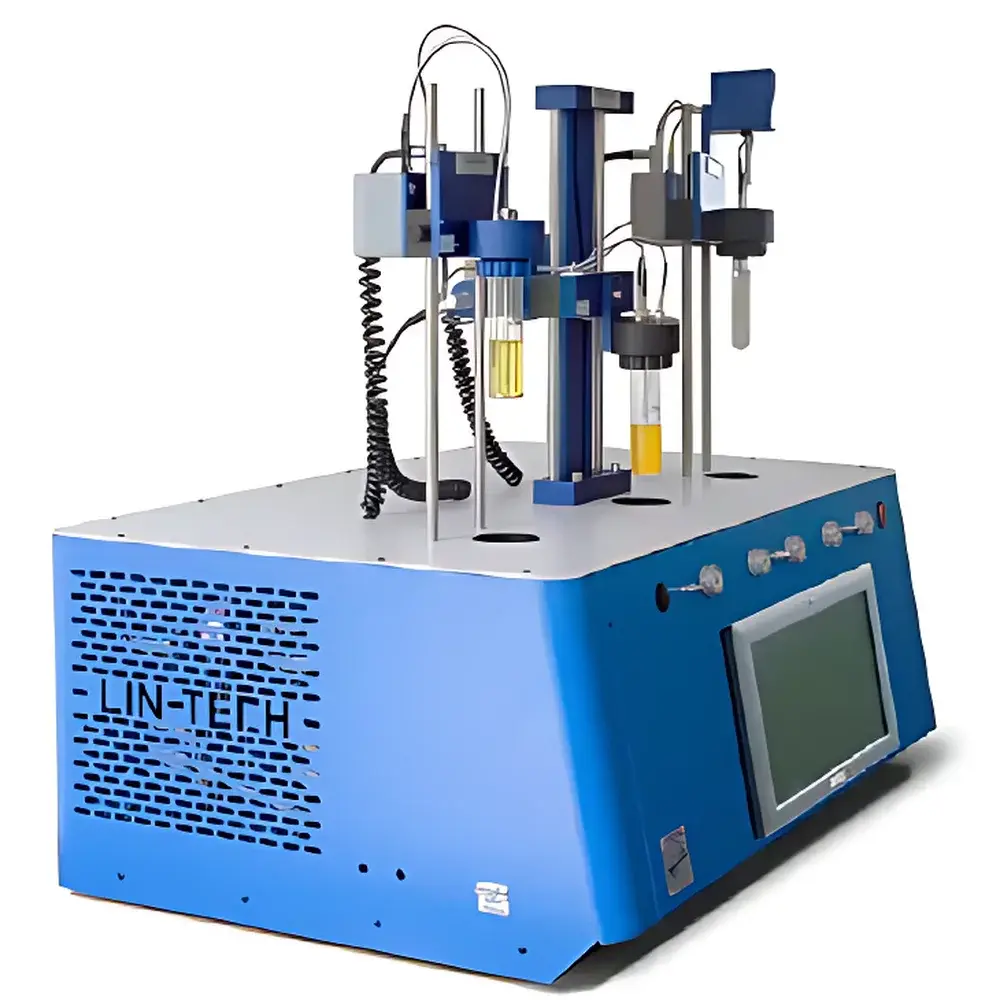
Linetechnic 100/200/300/410 Fully Automated Cloud Point, Pour Point, Freeze Point and Cold Filter Plugging Point Analyzer
| Brand | Linetechnic |
|---|---|
| Origin | Switzerland |
| Model Series | 100 / 200 / 300 / 410 |
| Application Domain | Petroleum Low-Temperature Property Testing |
| Compliance Framework | ASTM D2500, D97, D5949, D6371 |
Overview
The Linetechnic 100/200/300/410 Fully Automated Cloud Point, Pour Point, Freeze Point and Cold Filter Plugging Point (CFPP) Analyzer is an integrated low-temperature property testing platform engineered for precision, repeatability, and regulatory compliance in petroleum product laboratories. It employs thermoelectrically controlled dual-bath architecture with independent temperature zones to simultaneously execute standardized ASTM, ISO, IP, EN, and DIN methods for four critical low-temperature performance parameters. The instrument operates on the principle of controlled cooling combined with optical detection (for cloud and freeze point) and mechanical flow assessment (for pour point and CFPP), ensuring traceable, operator-independent results. Designed for routine QC/QA workflows in refineries, fuel testing labs, and third-party certification facilities, it eliminates manual observation bias and thermal hysteresis errors inherent in manual bath-based procedures.
Key Features
- Fully automated, multi-parameter analysis in a single instrument—no hardware reconfiguration required between cloud point, pour point, freeze point, or CFPP tests.
- Dual-zone Peltier-cooled baths with ±0.1 °C temperature stability and programmable ramp rates (0.1–3.0 °C/min), enabling precise adherence to method-specified cooling profiles.
- Optical turbidity detection system with high-sensitivity photodiode array for unambiguous cloud and freeze point identification per ASTM D5949 and ISO 23869.
- Integrated tilt-and-flow mechanism compliant with ASTM D97 and ISO 3016 for pour point determination, coupled with standardized CFPP filtration module meeting ASTM D6371 and EN 116 requirements.
- Modular head design supporting up to 10 analysis heads per LabLink workstation—ideal for high-throughput labs requiring parallel sample processing.
- Self-diagnostics and real-time sensor health monitoring, including automatic temperature probe validation and drift compensation during operation.
Sample Compatibility & Compliance
The analyzer accommodates standard 15–25 mL sample volumes in ASTM-compliant glass test jars (e.g., ASTM D2500 jar, D97 tube). It supports diesel fuels, heating oils, biodiesel blends (B5–B20), jet fuels (Jet A-1, JP-8), lubricating oils, and base stocks. All test sequences enforce strict adherence to international standards: cloud point (ASTM D2500/D5949, ISO 3015/23869), pour point (ASTM D97/D5853, ISO 3016/8217), freeze point (ASTM D2386/D5901, ISO 23869), and CFPP (ASTM D6371, EN 116, ISO 3013). Instrument firmware and software architecture are designed to support GLP/GMP environments, with full audit trail capability, electronic signatures, and data integrity controls aligned with FDA 21 CFR Part 11 requirements.
Software & Data Management
LabLink software—certified for Windows OS platforms (Windows 2000 through Windows 10)—serves as the central control and data management interface. It provides method-driven workflow automation, with preloaded standard methods (ASTM, ISO, IP, EN, DIN) and customizable user-defined protocols—including rapid-cooling modes and constant ΔT (sample-to-bath) profiles for research-grade thermal behavior studies. Calibration modules support both standard and advanced probe calibration routines, with timestamped records, graphical deviation plots, and user-editable offset compensation. All raw and processed data—including time-temperature curves, endpoint timestamps, and pass/fail flags—are stored in Excel-compatible CSV format. The system maintains >60,000 test records locally and integrates seamlessly with laboratory information management systems (LIMS) via ODBC and HL7-compliant export protocols. Audit logs capture operator ID, method version, calibration status, and anomaly events for full traceability.
Applications
This analyzer is deployed across upstream, midstream, and downstream petroleum operations: verifying cold flow properties of winter-grade diesel prior to distribution; validating jet fuel freeze point compliance for aviation safety; assessing biodiesel blend stability under low-temperature storage conditions; supporting formulation development of low-temperature lubricants; and fulfilling contractual specifications for marine distillate fuels (ISO 8217). It is also utilized by national metrology institutes and accredited testing laboratories (ISO/IEC 17025) for proficiency testing and reference material certification.
FAQ
Does the instrument support ASTM D5949 for automated cloud point?
Yes—the system implements optical detection and algorithmic endpoint recognition fully compliant with ASTM D5949 and ISO 23869.
Can I run pour point and CFPP tests sequentially on the same sample?
No—each test requires dedicated sample preparation and geometry; however, the instrument enables rapid method switching between analyses on separate samples without hardware modification.
Is remote diagnostics available?
LabLink supports secure remote access via VPN-enabled network configurations for technical support and preventive maintenance scheduling.
What is the temperature range of the cooling baths?
Standard configuration: –70 °C to +70 °C; extended low-temperature option available to –80 °C upon request.
How is data integrity ensured for regulatory submissions?
All data files include embedded digital signatures, immutable timestamps, and method revision identifiers; audit trails meet ALCOA+ principles and are exportable in PDF/A-2 format for regulatory review.




