
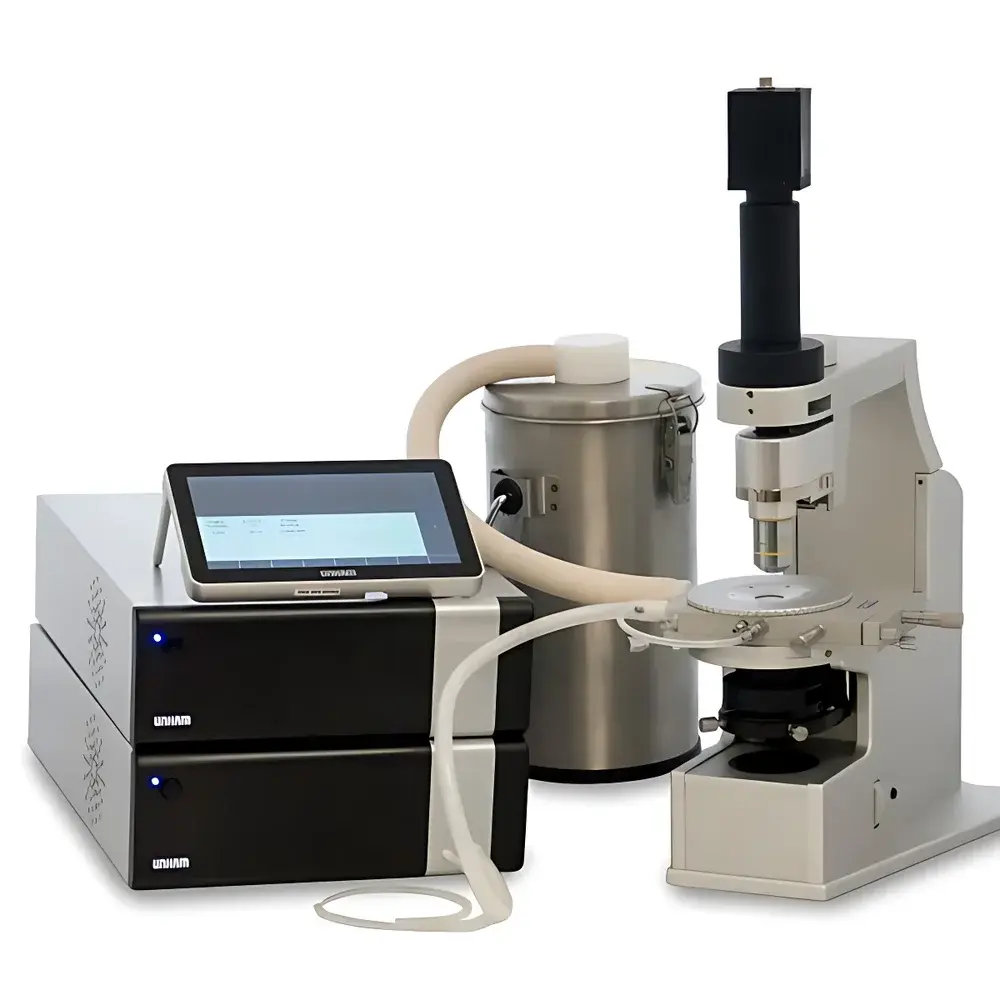
Linkam THMSG600 Geological Heating and Cooling Stage
| Brand | Linkam |
|---|---|
| Origin | United Kingdom |
| Model | THMSG600 |
| Temperature Range | −196 °C to +600 °C |
| Temperature Stability | < 0.01 °C |
| Temperature Resolution | 0.01 °C |
| Heating/Cooling Rate | 0.01–150 °C/min |
| Optical Aperture Diameter | 1.3 mm |
| Sample X/Y Translation Range | 16 mm |
| Heating Zone Diameter | 22 mm |
| Window Thickness (Cover Slip) | 0.17 mm |
| Minimum Objective/Condenser Working Distance | 4.5 mm / 12.5 mm |
| Dimensions | 137 × 92 × 22 mm |
Overview
The Linkam THMSG600 Geological Heating and Cooling Stage is a precision-engineered thermal stage designed specifically for petrographic and mineralogical analysis under polarized light microscopy. Built upon the proven architecture of the THMS600 platform, the THMSG600 incorporates targeted mechanical, thermal, and optical refinements to meet the rigorous demands of geological sample characterization—including phase transition observation, eutectic and melting point determination, fluid inclusion studies, and solid-state reaction kinetics. Its core operating principle relies on resistive heating combined with liquid nitrogen–assisted rapid cooling via the optional LNP95 cryogenic system, enabling precise, bidirectional thermal control across an exceptionally wide range (−196 °C to +600 °C) while maintaining sub-millikelvin thermal stability (< 0.01 °C). The stage integrates seamlessly with major brands of transmitted-light polarizing microscopes—including Zeiss, Leica, Olympus, and Nikon—without requiring optical realignment or custom adapters.
Key Features
- Ultra-broad operational temperature range: −196 °C (liquid nitrogen boiling point) to +600 °C, suitable for high-temperature mineral decomposition and low-temperature polymorphic transitions.
- High-resolution thermal control: 0.01 °C setpoint resolution and < 0.01 °C short-term stability, essential for reproducible observation of narrow thermal events such as incongruent melting or exsolution boundaries.
- Optimized optical path: 1.3 mm central aperture with a 0.17 mm-thick fused silica window ensures minimal wavefront distortion and compatibility with high-NA objectives (≥40×) and strain-free condensers.
- Side-loading sample mechanism minimizes stage vibration and thermal perturbation during specimen insertion, critical for in situ observation of delicate crystal growth or melt migration.
- Hermetically sealed chamber with gas inlet/outlet ports enables controlled atmosphere experiments using N₂, Ar, or CO₂—supporting redox-sensitive mineral systems and preventing oxidation or hydration artifacts.
- Integrated X/Y manual translation (16 mm travel) allows precise repositioning of geological thin sections without stage removal; compatible with motorized stages for automated mapping (optional).
- Compact footprint (137 × 92 × 22 mm) and direct-mount bracket design ensure mechanical stability and eliminate parfocal drift during thermal cycling.
Sample Compatibility & Compliance
The THMSG600 accommodates standard 26 × 48 mm and 40 × 60 mm geological thin sections, as well as polished grain mounts and synthetic inclusion capsules (e.g., quartz or NaCl hosts). Its 22 mm heating zone uniformly covers typical petrographic slide dimensions. The stage conforms to ISO 11357 (Plastics — Differential Scanning Calorimetry) and ASTM D3418 (Standard Test Method for Transition Temperatures of Polymers by DSC) thermal measurement frameworks—though adapted for optical detection rather than calorimetric output. All electrical components comply with IEC 61010-1 safety standards for laboratory equipment. When operated with Linkam’s TMS94 software and audit-trail-enabled configuration, the system supports GLP-compliant data acquisition per FDA 21 CFR Part 11 requirements for regulated geological research laboratories.
Software & Data Management
Control and data acquisition are managed through Linkam’s TMS94 software suite (Windows-based), which provides synchronized thermal profiling, real-time image timestamping, and multi-channel video capture (via USB3 or HDMI interfaces). The software supports programmable ramp-hold-cool sequences with up to 100 user-defined steps, derivative temperature logging (dT/dt), and export of calibrated thermal metadata embedded in TIFF or AVI files. Image annotation tools allow overlay of temperature labels, scale bars, and polarization state indicators directly onto captured frames. Raw thermal logs (.csv) include timestamps, setpoints, actual sensor readings, and error flags—enabling traceable post-processing in MATLAB, Python (NumPy/Pandas), or commercial data analysis platforms. Optional LabVIEW and .NET SDKs facilitate integration into custom automation workflows.
Applications
- Identification and quantification of mineral phase transitions (e.g., α–β quartz inversion at 573 °C, calcite–aragonite stability fields).
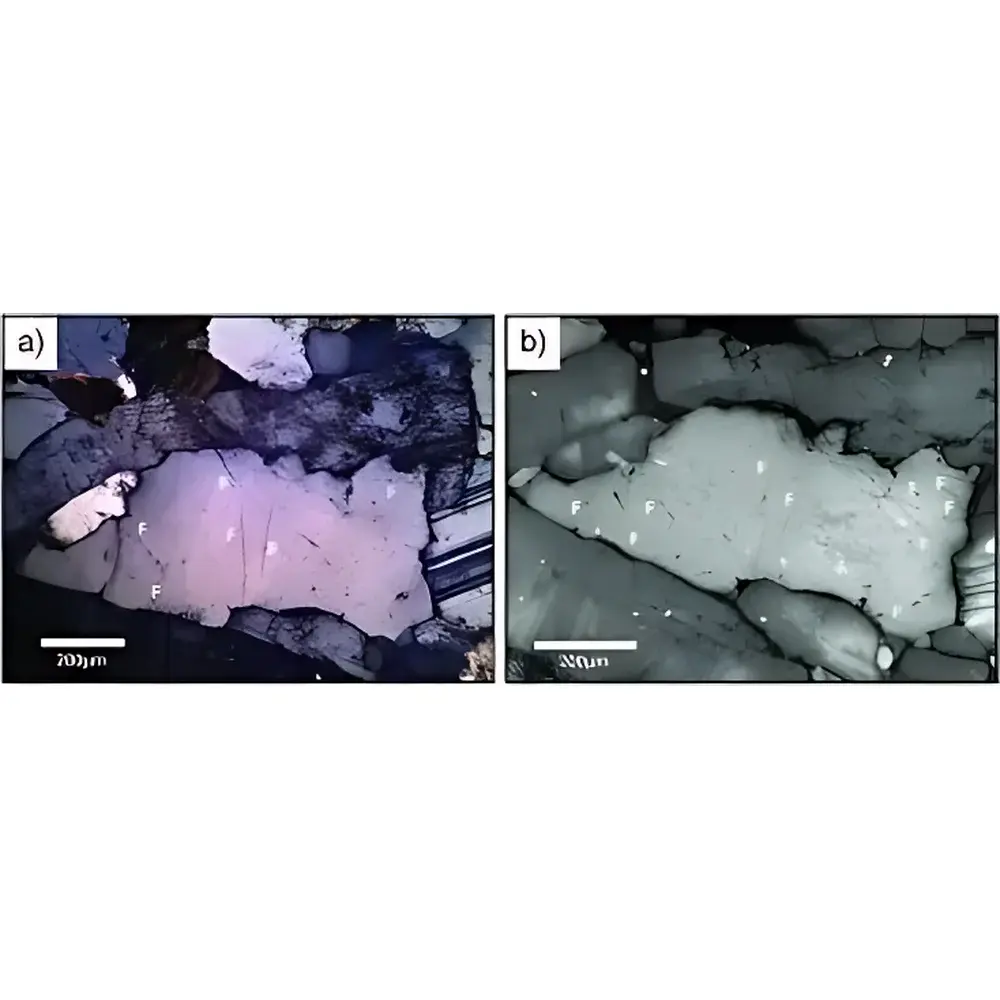
- In-situ observation of fluid inclusion homogenization temperatures (Th) and ice-melting points (Tm_ice) for paleobarometric and paleothermometric reconstruction.
- Characterization of metamorphic reaction textures under controlled P–T paths, including dehydration and decarbonation reactions.
- Study of magma crystallization sequences via cooling-rate-dependent nucleation and growth kinetics in synthetic basaltic or granitic melts.
- Analysis of clay mineral swelling/shrinkage behavior and smectite-to-illite transformation kinetics under hydrous thermal conditions.
- Validation of thermodynamic models (e.g., PERPLEX, Theriak-Domino) using experimentally constrained univariant and invariant points.
FAQ
What microscope brands and models is the THMSG600 compatible with?
The stage is mechanically and optically optimized for standard upright polarizing microscopes from Zeiss (Axio Imager series), Leica (DM4P/DM6M), Olympus (BX53/BX63), and Nikon (Eclipse Ci-L/Ni-U), provided minimum working distance requirements (4.5 mm objective, 12.5 mm condenser) are met.
Can the THMSG600 be used under oil immersion objectives?
No—oil immersion is incompatible due to thermal expansion mismatch, risk of oil carbonization above 100 °C, and potential damage to the 0.17 mm window. Dry objectives with long working distances are required.
Is inert gas purging mandatory for all experiments?
Not mandatory, but strongly recommended for experiments involving oxidizable minerals (e.g., sulfides, Fe-bearing olivines) or hydrous phases where ambient moisture may interfere with transition observations.
Does the system support automated temperature ramping during video capture?
Yes—TMS94 software synchronizes thermal program execution with frame-grabbing, embedding accurate temperature metadata into each video frame header for pixel-level thermal correlation.
What calibration documentation is supplied with the THMSG600?
Each unit ships with a UKAS-accredited temperature calibration certificate (traceable to NPL standards) covering three points across the full range (−196 °C, 25 °C, and 600 °C), plus a separate optical alignment report verifying aperture centration and window flatness.



