
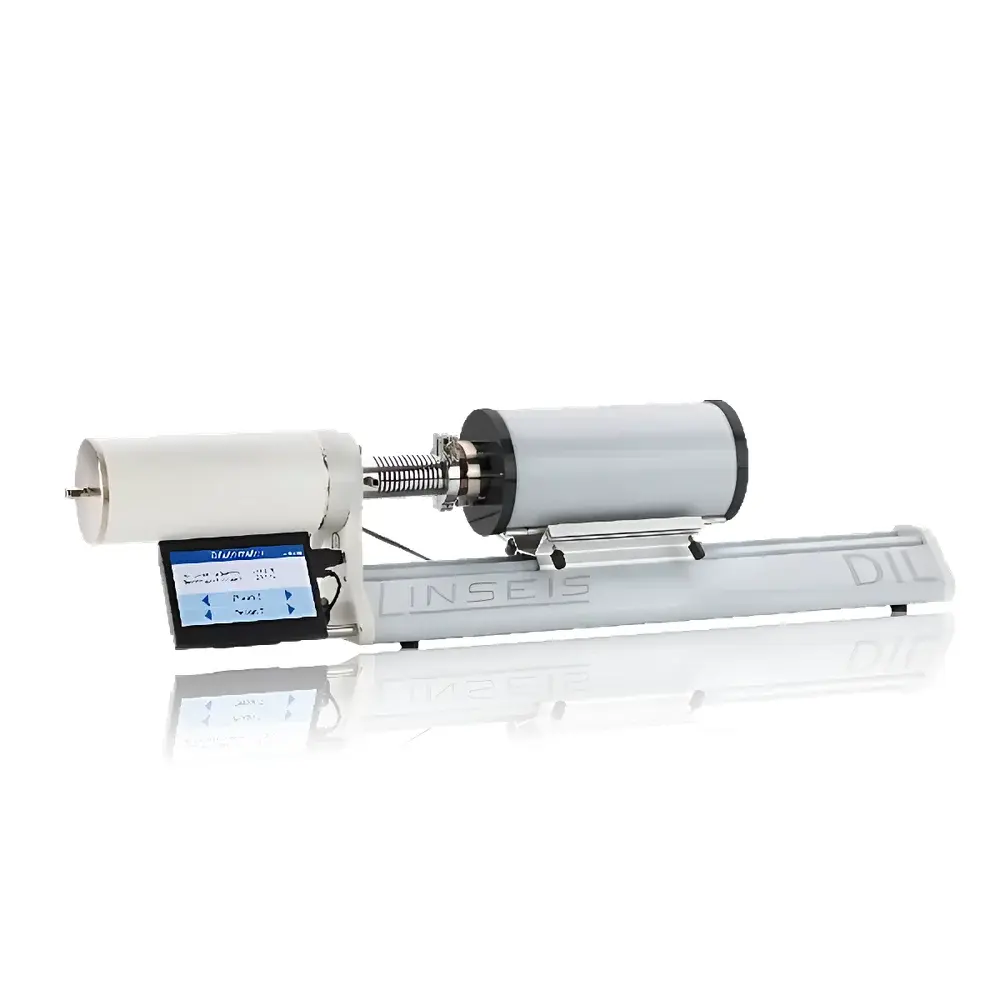
LINSEIS DIL L76 PT Horizontal Push-Rod Dilatometer
| Brand | LINSEIS |
|---|---|
| Origin | Germany |
| Model | DIL L76 PT |
| Temperature Range | RT to 1600 °C |
| Measurement Range | ±2500 µm |
| Delta L Resolution | 0.05 nm |
| Contact Force | Manually adjustable up to 3 N |
| Sensor Type | High-precision LVDT (Linear Variable Differential Transformer) |
| Furnace Options | Quartz (up to 1100 °C), Al₂O₃ (up to 1600 °C) |
| Software | LINSEIS Thermal Analysis Suite with CTE calculation, softening point detection, and automated cooling trigger |
| Compliance | Designed for GLP-compliant thermal property characterization in industrial QC and R&D labs |
Overview
The LINSEIS DIL L76 PT is a high-precision horizontal push-rod dilatometer engineered for reliable, repeatable measurement of dimensional changes in solid materials under controlled thermal conditions. Operating on the fundamental principle of contact-based linear displacement detection, the instrument utilizes a mechanically coupled push-rod system that transmits sample expansion or contraction directly to a high-stability LVDT sensor. This architecture ensures minimal thermal lag and mechanical hysteresis—critical for accurate determination of coefficients of linear thermal expansion (CTE), sintering behavior, phase transitions, glass transition temperatures (Tg), softening points, decomposition onset, and density evolution during heating or cooling cycles. The DIL L76 PT is specifically optimized for routine quality control and advanced research in ceramics, glasses, refractories, construction materials, metals, and composites—industries where precise thermal dimensional stability data informs formulation, processing optimization, and failure analysis.
Key Features
- Modular furnace design supporting interchangeable heating elements: quartz tube furnace (≤1100 °C) and high-purity alumina (Al₂O₃) furnace (≤1600 °C), enabling seamless adaptation across application-specific temperature domains.
- LVDT displacement sensor with dual-resolution capability: 0.05 nm resolution for ultra-fine CTE quantification at low-temperature regimes, and 1 nm resolution for high-dynamic-range measurements up to ±25,000 µm—ensuring fidelity across both subtle polymer transitions and large-scale ceramic sintering shrinkage.
- Manually adjustable contact force (0–3 N), calibrated via precision micrometer mechanism, allowing optimization for brittle, porous, or low-modulus samples without inducing creep or surface deformation.
- Integrated automatic sample length detection and real-time delta-L feedback enable self-calibrating baseline correction prior to each run—reducing operator dependency and enhancing inter-laboratory reproducibility.
- Thermally isolated horizontal configuration minimizes convection-induced artifacts and eliminates sag-related errors common in vertical dilatometers, especially during softening or viscous flow events.
- Optional accessories include liquid nitrogen (LN₂) cryostat for sub-ambient testing, multi-gas mass flow controllers (1–3 channels), optical encoder for independent position verification, and Rate-Controlled Sintering (RCS) modules for dynamic densification profiling.
Sample Compatibility & Compliance
The DIL L76 PT accommodates cylindrical or rectangular specimens with standard diameters of 4–12 mm and lengths up to 25 mm. It supports both rigid (e.g., sintered alumina, borosilicate glass) and semi-rigid materials (e.g., green ceramic bodies, metallic powders, polymer compacts). Sample holders are chemically inert and thermally stable across the full operational range. The system complies with ASTM E228, ISO 11359-1/-2, and DIN 51045 standards for linear thermal expansion measurement. Its software architecture supports audit trails, electronic signatures, and user-access-level management—facilitating alignment with FDA 21 CFR Part 11 requirements for regulated environments. All hardware components—including furnace insulation, push-rod guides, and sensor housings—are designed for long-term thermal cycling stability and resistance to oxidation or outgassing in inert, reducing, or oxidizing atmospheres.
Software & Data Management
The LINSEIS Thermal Analysis Suite provides a unified platform for instrument control, real-time data acquisition, and post-run evaluation. Key functionalities include automated softening point detection with programmable stop criteria (e.g., ΔL ≥ X µm or % strain ≥ Y%), derivative-based inflection point identification for Tg and phase transitions, multi-segment heating/cooling ramp definition, and batch processing of CTE vs. temperature curves. Raw displacement and temperature time-series data are stored in vendor-neutral ASCII format, fully compatible with third-party statistical analysis tools (e.g., MATLAB, Python pandas). Optional modules include the LINSEIS Thermal Database for centralized storage, version-controlled method templates, and GLP/GMP-compliant reporting with embedded metadata (operator ID, calibration certificate IDs, environmental logs).
Applications
- Quantitative CTE profiling of architectural tiles, refractory bricks, and structural concretes across service-relevant temperature windows (25–1000 °C).
- Sintering kinetics analysis of advanced ceramics (e.g., SiC, ZrO₂, Si₃N₄), including onset temperature, maximum shrinkage rate, and final density estimation.
- Softening point determination of soda-lime and borosilicate glasses using programmable thermal arrest upon reaching defined deformation thresholds—preventing probe adhesion and furnace contamination.
- Thermal stability assessment of metal-ceramic composites and functionally graded materials subjected to thermal cycling between −196 °C and 1600 °C.
- Decomposition onset detection in carbonates, hydroxides, and hydrated phases via abrupt length change signatures correlated with TGA or DSC data.
- Quality assurance of production batches in glass container manufacturing, where CTE mismatch between body and neck ring directly impacts sealing integrity.
FAQ
What temperature ranges are supported by the DIL L76 PT, and how are they achieved?
The system achieves RT–1600 °C through interchangeable furnace modules: a quartz-tube furnace rated to 1100 °C and an alumina-fiber-insulated furnace rated to 1600 °C. Each furnace includes integrated thermocouple positioning and PID-controlled heating zones.
Can the DIL L76 PT measure both expansion and contraction accurately?
Yes—the bidirectional measurement range of ±2500 µm (standard) and ±25000 µm (extended) enables precise tracking of both thermal expansion and sintering shrinkage, with zero-point stability maintained over multi-hour experiments.
Is softening point detection automated, and how is it triggered?
Yes—software-defined thresholds based on absolute displacement (µm) or relative strain (%) initiate automatic cooling ramp activation, preventing irreversible probe fusion and preserving measurement integrity.
Does the system support inert or reactive gas environments?
Yes—gas handling options include manual rotameters or digital mass flow controllers for single- or multi-gas configurations (e.g., Ar, N₂, H₂/Ar, CO/CO₂), with leak-tight connections certified to 10⁻⁷ mbar·L/s.
How is calibration traceability ensured?
Each instrument ships with NIST-traceable calibration certificates for displacement (LVDT linearity & sensitivity) and temperature (thermocouple EMF response), updated annually per ISO/IEC 17025 laboratory practice.



