
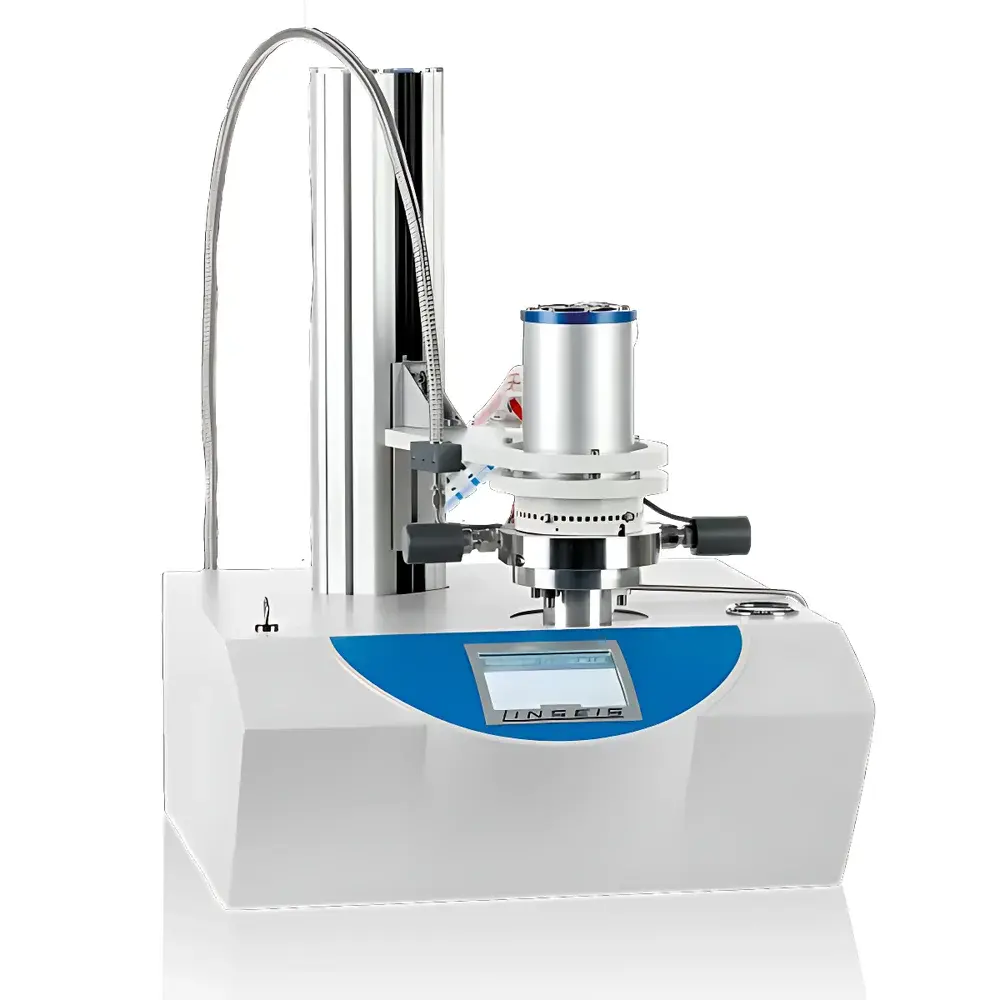
LINSEIS STA HP L85 High-Pressure Simultaneous Thermal Analyzer
| Brand | LINSEIS |
|---|---|
| Origin | Germany |
| Model | STA HP L85 |
| Temperature Range | 170 °C to 1200 °C (optional 1600 °C / 1800 °C) |
| Temperature Stability | ±0.05 °C |
| Max Sample Mass | 35,000 mg |
| Operating Pressure | up to 150 bar |
| TGA Resolution | 0.1 μg |
| DSC Sensitivity | approx. 4–22.5 μW |
| DSC Resolution | 0.3–1 μW |
| DTA Resolution | 0.03 nV |
| Vacuum Level | ≤10⁻⁴ mbar (pump-dependent) |
| Sensor Types | E / K / S / B / C |
| Gas Control | Quantitative mass-flow-controlled inlet systems |
| Optional Accessories | Steam generator, top-loading modular sensor kits (TG-only or TG-DSC) |
Overview
The LINSEIS STA HP L85 is a high-pressure simultaneous thermal analyzer engineered for precise, correlative measurement of mass change (thermogravimetry, TG) and heat flow (differential scanning calorimetry, DSC) under rigorously controlled pressure and atmosphere conditions. Based on over 25 years of LINSEIS expertise in high-pressure thermal analysis, the STA HP L85 integrates a fast-heating microfurnace capable of operation up to 1200 °C (with optional upgrades to 1600 °C or 1800 °C), a high-stability top-loading microbalance (35,000 mg capacity, 0.1 μg resolution), and a modular, plug-and-play DSC/TG sensor architecture. Its core measurement principle relies on concurrent detection of sample mass loss/gain and enthalpic events—including endothermic phase transitions, exothermic oxidation, decomposition kinetics, and solid–gas reaction equilibria—within a single, spatially and temporally aligned thermal cycle. Unlike conventional ambient-pressure STA systems, the STA HP L85 maintains full metrological integrity under pressures up to 150 bar, enabling thermodynamic characterization of reactions governed by Le Chatelier’s principle, such as steam gasification, hydrothermal synthesis, catalytic reforming, and high-pressure decomposition pathways.
Key Features
- True simultaneous TG-DSC measurement under identical temperature, pressure, and gas composition conditions—eliminating inter-run variability and enabling direct correlation of mass and energy data.
- Top-loading balance design with automatic mass readout and active drift compensation, optimized for reproducible handling of large-volume or high-density samples (up to 35 g).
- Modular sensor platform supporting interchangeable DSC types (E, K, S, B, C) and configurable TG-only or combined TG-DSC modes—reducing downtime during method switching.
- High-precision pressure control system (0–150 bar) integrated with mass-flow-controlled gas dosing, compatible with reactive (H₂O, O₂, CO₂, H₂, CH₄), inert (Ar, N₂, He), and corrosive atmospheres.
- Optional steam generator with temperature-stabilized vapor delivery for reproducible hydrothermal and gasification studies.
- Fast thermal response furnace (≥100 K/min heating rate) with ±0.05 °C temperature stability and traceable calibration against NIST-traceable standards.
- Ultra-high vacuum compatibility (≤10⁻⁴ mbar) for low-background DSC measurements and volatile species suppression.
Sample Compatibility & Compliance
The STA HP L85 accommodates diverse sample forms—including powders, granules, pellets, fibers, and thin films—within standard alumina, platinum, or graphite crucibles rated for high-pressure service. Its robust mechanical design meets ISO 11357-1 (Plastics — Differential Scanning Calorimetry) and ASTM E1131 (Standard Test Method for Compositional Analysis by Thermogravimetry) requirements. For regulated environments, the system supports audit-ready data acquisition compliant with FDA 21 CFR Part 11 when paired with LINSEIS ThermoSoft™ software configured for electronic signatures, user access levels, and immutable audit trails. All pressure components conform to PED 2014/68/EU and ASME BPVC Section VIII Div. 1 standards. Calibration certificates are issued per ISO/IEC 17025-accredited procedures, and temperature accuracy is verified using certified reference materials (e.g., In, Sn, Zn, Al, Ag).
Software & Data Management
ThermoSoft™ v9.x provides full instrument control, real-time visualization, and advanced post-processing for multi-parameter thermal datasets. The software enables synchronized pressure ramping with temperature programs, automated baseline correction for high-pressure DSC, kinetic modeling (e.g., Kissinger, Ozawa-Flynn-Wall), and multi-step gas switching protocols. Raw data files (.tdt) store all metadata—including pressure setpoints, gas flow rates, vacuum status, and sensor configuration—in ASCII format for third-party analysis. Export options include ASTM E1981-compliant .csv, .xls, and universal .tdms formats. Data security features include encrypted local storage, role-based permissions, and integration with enterprise LIMS via OPC UA or RESTful API.
Applications
The STA HP L85 is deployed across R&D and quality control laboratories in energy materials (e.g., coal/biomass gasification kinetics under steam at 150 bar), catalysis (metal oxide redox cycling under syngas), battery materials (high-pressure lithiation/delithiation of cathodes), nuclear fuels (uranium oxide decomposition in Ar/H₂ mixtures), and pharmaceutical polymorph screening under humidified CO₂. A representative application is steam gasification of carbonaceous feedstocks: C(s) + H₂O(g) ⇌ CO(g) + H₂(g). By varying total pressure from 1 to 150 bar while maintaining constant H₂O partial pressure, users quantify equilibrium shifts, activation energies, and char reactivity—data essential for reactor design and life-cycle assessment of synthetic fuel production pathways (e.g., Fischer–Tropsch feedstock optimization).
FAQ
What pressure ranges does the STA HP L85 support, and how is pressure stability maintained?
The system operates from ambient to 150 bar, with pressure stability ±0.1 bar over 24 h, achieved via dual-stage pressure regulation, temperature-compensated transducers, and closed-loop feedback control.
Can the same sensor be used for both TG-only and TG-DSC measurements?
No—sensor modules are purpose-built; TG-DSC configurations require integrated thermocouple pairs and symmetric furnace geometry, while TG-only sensors maximize mass sensitivity and thermal inertia.
Is the 1800 °C option compatible with high-pressure operation?
The 1800 °C furnace variant is limited to ≤5 bar due to material constraints of the high-temperature insulation and crucible system.
How is moisture introduced quantitatively for steam gasification experiments?
Via the optional LINSEIS steam generator, which delivers precisely metered, temperature-stabilized water vapor (±0.5 °C) using gravimetric flow control and inline dew-point monitoring.
Does the system meet GLP/GMP documentation requirements?
Yes—when operated with ThermoSoft™ in 21 CFR Part 11 mode, it provides full electronic records, signature verification, and audit trail generation required for GLP studies and GMP process validation.



