
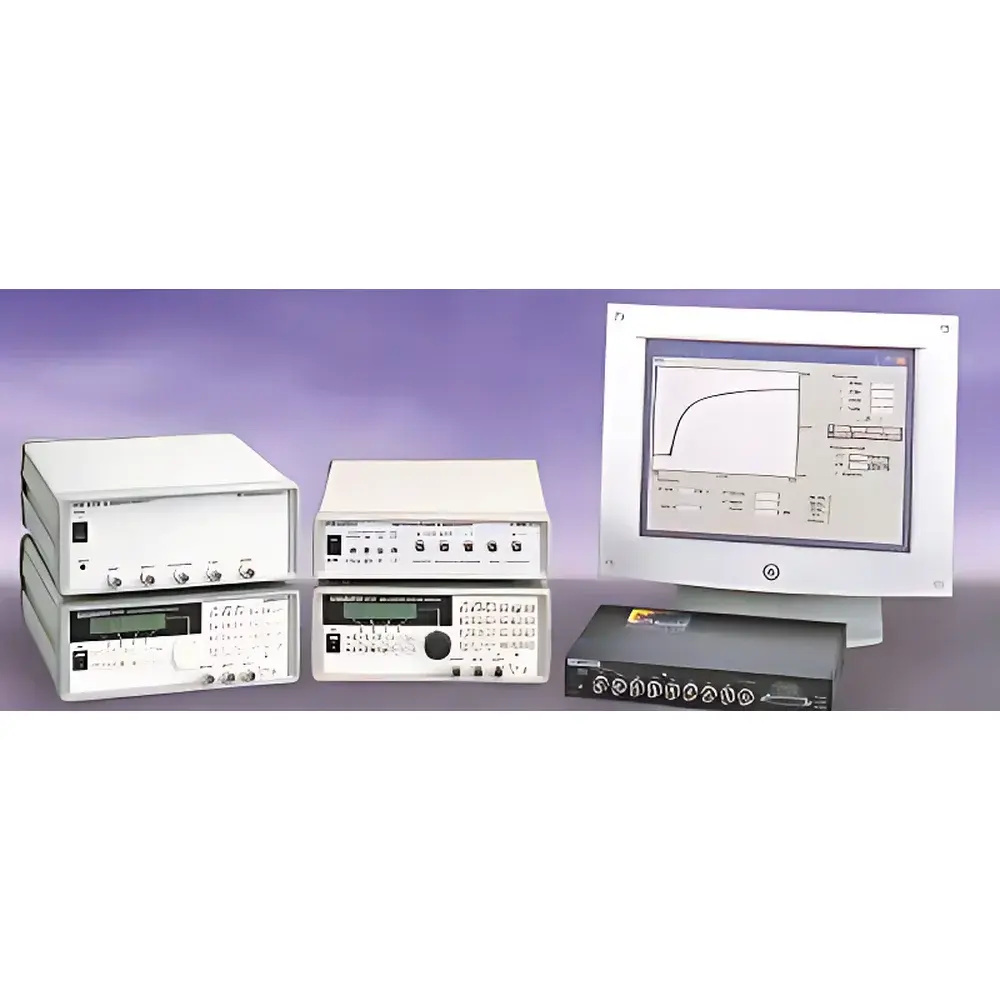
Liquid Crystal Elastic Constant Analyzer EC-1 by TOYO Corporation
| Brand | TOYO Corporation |
|---|---|
| Origin | Japan |
| Manufacturer Type | Authorized Distributor |
| Origin Category | Imported |
| Model | EC-1 |
| Pricing | Available Upon Request |
Overview
The EC-1 Liquid Crystal Elastic Constant Analyzer is a precision benchtop instrument engineered for the quantitative determination of splay (K11) and bend (K33) elastic constants in nematic liquid crystal materials. It operates on the fundamental electro-optic principle that the threshold voltage (Vth) of a uniformly aligned LC cell under applied AC electric field is directly related to the ratio K11/K33, as derived from the Frank-Oseen free energy formalism and the continuum theory of nematic elasticity. By measuring capacitance-voltage (C-V) characteristics across a range of frequencies and voltage step increments, the EC-1 enables non-destructive, contactless evaluation of elastic anisotropy without requiring optical alignment verification or external interferometric calibration. Designed specifically for research laboratories and display material development centers, the system supports both homogeneous (planar) and homeotropic (vertical) alignment configurations, delivering reproducible results compliant with standard LC characterization protocols used in academic and industrial R&D.
Key Features
- AC-biased C-V measurement architecture eliminates DC ion drift artifacts, ensuring stable baseline capacitance acquisition over extended test durations.
- Continuous, monotonic voltage ramping from initial to final setpoint prevents molecular relaxation during scanning—critical for capturing true equilibrium dielectric response.
- Adjustable AC bias frequency (typically 10 Hz–10 kHz range) allows selective suppression of mobile ionic contributions, enhancing measurement fidelity in impure or aged LC samples.
- Programmable voltage step resolution (down to 10 mV increments) enables high-resolution Vth extraction via derivative analysis of dC/dV curves.
- Integrated numerical fitting engine implements least-squares minimization of theoretical C-V models based on Mauguin–Freedericksz transition theory, yielding K11 and K33 values independent of operator interpretation.
- Compact modular design with shielded electrode interface supports standardized ITO-coated LC cells (e.g., 5 µm–20 µm gap thicknesses) and accommodates optional temperature-controlled stages (−20 °C to +80 °C).
Sample Compatibility & Compliance
The EC-1 is compatible with standard commercial and custom-fabricated nematic liquid crystal cells featuring transparent indium tin oxide (ITO) electrodes, including those prepared with polyimide (PI), silane, or photo-alignment layers. It supports both low-molecular-weight nematics and polymer-stabilized systems. The instrument complies with electromagnetic compatibility (EMC) requirements per IEC 61326-1 and meets electrical safety standards under IEC 61010-1. Data acquisition workflows are structured to support GLP-compliant documentation; audit trails, user authentication logs, and parameter versioning are available when operated with validated PC-based control software. While not FDA-cleared, its measurement methodology aligns with principles referenced in ISO 17025-accredited LC testing labs and is routinely cited in publications adhering to ASTM D445 and JEDEC JESD22-A108 reliability frameworks.
Software & Data Management
The EC-1 is operated via Windows-compatible application software providing real-time C-V curve visualization, automated Vth detection using second-derivative peak identification, and batch-mode elastic constant calculation. All raw capacitance and voltage datasets are stored in HDF5 format with embedded metadata (cell geometry, alignment type, temperature, frequency). Export options include CSV, MATLAB (.mat), and PDF report generation with traceable calibration references. Software supports 21 CFR Part 11–ready configuration (with optional digital signature module), enabling electronic records suitable for regulated environments where data integrity and operator accountability are mandatory.
Applications
- Development and qualification of new nematic host mixtures for LCD, OLED compensation, and VR/AR microdisplay applications.
- Investigation of elastic anisotropy changes induced by dopants (e.g., chiral agents, nanoparticles, reactive mesogens).
- Thermal stability assessment of K11/K33 ratios across phase transitions (nematic–isotropic, smectic–nematic).
- Correlation studies between elastic constants and switching dynamics (rise/fall times) in active matrix backplane simulations.
- Validation of continuum modeling parameters used in LC director simulation tools (e.g., LC-Sim, MASCOT).
FAQ
What alignment types does the EC-1 support?
The system is optimized for planar (homogeneous) and homeotropic (vertical) alignment configurations. Tilted or hybrid alignments require prior validation of theoretical C-V model assumptions.
Can the EC-1 measure twist elastic constant (K22)?
No—K22 determination requires torsional deformation modes and specialized cell geometries (e.g., twisted nematic test cells), which fall outside the scope of the EC-1’s capacitive splay/bend characterization framework.
Is temperature control integrated into the base unit?
Temperature regulation is not built-in but is fully supported via third-party Peltier stages with analog/digital I/O interfacing; full thermal characterization workflows are documented in the application note library.
How is calibration performed?
Capacitance channel calibration uses NIST-traceable reference capacitors; voltage linearity is verified with calibrated multimeters. No user-performed calibration is required for routine K11/K33 analysis.
Does the EC-1 comply with ISO/IEC 17025 requirements?
The instrument itself is not accredited, but its measurement methodology, uncertainty budgeting procedures, and software audit features enable implementation within ISO/IEC 17025-certified laboratories when operated under documented SOPs.



