
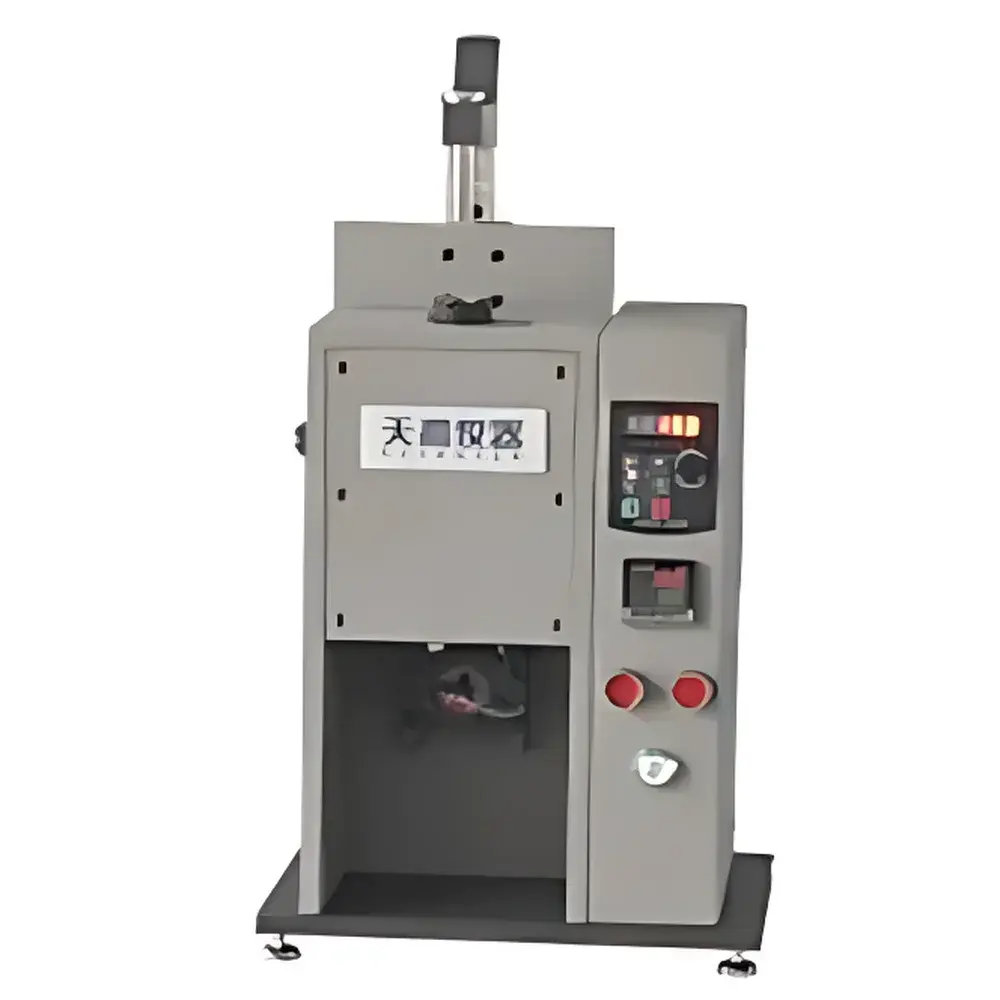
Lishumei TY-7010 Miniature Vertical High-Speed Masticator
| Brand | Lishumei |
|---|---|
| Origin | Jiangsu, China |
| Manufacturer Type | Authorized Distributor |
| Country of Origin | China |
| Model | TY-7010 |
| Price Range | USD 2,800–5,600 (FOB) |
| Dimensions | 350 × 285 × 640 mm |
| Heating + Motor Power | ≤0.5 kW |
| Voltage | 220 V ±10%, 50 Hz |
| Single Batch Capacity | 20–30 g |
| Temperature Range | Ambient to 300 °C (customizable) |
Overview
The Lishumei TY-7010 Miniature Vertical High-Speed Masticator is a precision-engineered laboratory-scale mastication system designed for rapid formulation development and material screening in polymer R&D and quality control laboratories. Unlike conventional internal mixers or twin-screw extruders, the TY-7010 employs a vertically oriented, plunger-driven shear mixing principle—relying on controlled mechanical shearing under programmable thermal conditions to achieve homogeneous melt blending in minimal time. Its compact columnar architecture enables consistent torque transmission and uniform temperature distribution across the mixing chamber, critical for reproducible rheological behavior during small-batch compounding. This instrument is not intended for continuous production but serves as a high-fidelity simulation tool for downstream extrusion and injection molding processes—particularly valuable for evaluating additive dispersion, pigment migration, thermal stability (e.g., OIT), flame retardant efficacy, and melt flow index (MFI) correlation prior to pilot-scale trials.
Key Features
- Ultra-low sample consumption: Optimized for single batches of 20–30 g, reducing raw material costs and waste generation without compromising compositional fidelity.
- High-shear vertical plunger mechanism: Delivers rapid, uniform dispersion even for challenging ratios (e.g., 1:99 masterbatch dilution), minimizing segregation and ensuring statistical representativeness in subsequent analytical testing.
- Programmable thermal control: PID-regulated heating zone with stable setpoint accuracy ±2 °C across 0–300 °C range; optional extended-range calibration available for specialty thermoplastics and thermosets.
- Integrated safety interlocks: Automatic motor cutoff upon lid opening, overtemperature shutdown, and real-time current monitoring to prevent coil overload during high-viscosity mixing.
- Direct post-mixing sample readiness: Extruded strands or cut granules are dimensionally suitable for immediate ASTM D1238 (MFI), ISO 1133, ASTM D1505 (density), ASTM D3878 (OIT), and UL 94 pre-screening—eliminating secondary pelletizing steps.
Sample Compatibility & Compliance
The TY-7010 accommodates a broad spectrum of thermoplastic and thermosetting polymers—including PP, PE, PS, ABS, PC, PA6/66, TPU, and filled composites (e.g., CaCO₃-, talc-, or glass fiber-reinforced systems). It supports both virgin and recycled feedstocks, provided melt viscosity remains within the torque envelope of the 0.5 kW drive system. All wetted components (mixing chamber, plunger, and die) are constructed from hardened stainless steel (AISI 316) with passivated surface finish to resist corrosion from halogenated flame retardants or acidic stabilizers. The device complies with IEC 61000-6-2 (EMC immunity) and IEC 61000-6-4 (EMC emissions); electrical safety conforms to GB 4706.1–2005 (equivalent to IEC 60335-1). While not certified to UL or CE for standalone placement in EU/US production environments, it meets GLP-aligned documentation requirements for lab-scale formulation records when used with validated SOPs.
Software & Data Management
The TY-7010 operates via an embedded microcontroller interface with tactile keypad and LCD display—supporting manual parameter entry (temperature, dwell time, plunger speed) and real-time monitoring of chamber temperature and motor load. No proprietary software is required; however, optional RS-485 Modbus RTU output enables integration into centralized LIMS or MES platforms for audit-trail logging. All process parameters and timestamps are stored internally (non-volatile memory, 1,000-cycle capacity) and exportable via USB-C for traceability in regulated environments. When deployed in GMP-adjacent settings (e.g., medical polymer development), users may configure electronic signatures and change-control logs per FDA 21 CFR Part 11 guidelines using third-party validation packages.
Applications
- Rapid colorant and additive masterbatch optimization—validating dispersion homogeneity before full-scale compounding.
- Melt flow ratio (MFR/MVR) prediction studies across resin lots or supplier grades.
- Oxidative induction time (OIT) screening of antioxidant packages under controlled thermal history.
- UL 94 V-0/V-2 prequalification of flame-retarded formulations using direct strand extrusion and conditioning.
- Recycled polymer compatibility assessment—detecting cross-contamination or degradation-induced gel formation.
- Teaching labs: Demonstrating shear-thinning behavior, filler-matrix interaction, and thermal degradation kinetics in undergraduate polymer engineering courses.
FAQ
What is the maximum allowable melt viscosity for reliable operation?
The TY-7010 is engineered for materials with apparent melt viscosity below 5,000 Pa·s at 200 °C and 10 s⁻¹ shear rate. Higher-viscosity systems (e.g., LCPs or highly filled PEEK) require reduced batch mass or pre-drying to avoid stalling.
Can the temperature profile be ramped during mixing?
No—this model supports only isothermal operation. For dynamic thermal protocols (e.g., stepwise crystallization studies), external hot-stage coupling or post-mixing DSC analysis is recommended.
Is cleaning between formulations automated?
Manual cleaning is required using purging compounds (e.g., LDPE or PP homopolymer) at elevated temperature; no solvent flush or ultrasonic assist is integrated.
Does the unit support nitrogen purge for oxygen-sensitive compounds?
Yes—a standard 6 mm OD inlet port is provided at the top flange for inert gas introduction; users must supply regulated N₂ source and flowmeter.
Are calibration certificates included with shipment?
NIST-traceable temperature calibration certificate (at 100 °C, 200 °C, and 300 °C) is supplied; torque calibration is user-performed via supplied reference weights and procedure manual.






