
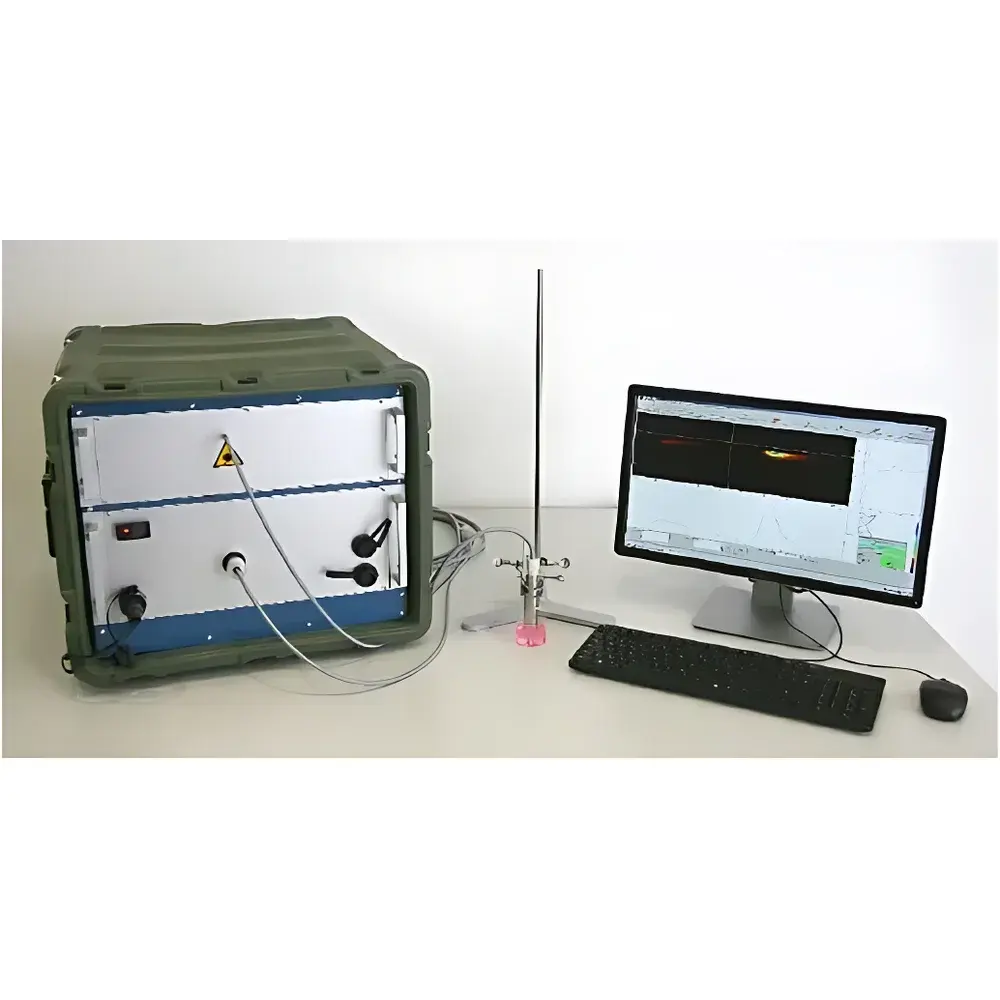
LLG UV-LFM Mobile Fluorescence Lifetime and Spectral Analyzer
| Brand | Laser-Laboratorium Göttingen e.V. |
|---|---|
| Origin | Germany |
| Manufacturer Type | Authorized Distributor |
| Origin Category | Imported |
| Model | UV-LFM |
| Pricing | Upon Request |
Overview
The LLG UV-LFM Mobile Fluorescence Lifetime and Spectral Analyzer is a field-deployable optical measurement instrument engineered for quantitative, real-time detection and characterization of native and induced fluorescence in complex environmental and industrial matrices. Operating on the principle of time-resolved ultraviolet-induced fluorescence (UV-TRF), the system employs a pulsed 266 nm diode-pumped solid-state (DPSS) laser to excite aromatic and heterocyclic compounds—such as polycyclic aromatic hydrocarbons (PAHs), benzene-toluene-ethylbenzene-xylene (BTEX), dissolved organic carbon (DOC), petroleum hydrocarbons, and proteinogenic amino acids (e.g., tyrosine and tryptophan). The emitted fluorescence is captured via a custom-designed fiber-optic sensor head optimized for immersion in aqueous media and direct soil pore-water interrogation. Simultaneous acquisition of both fluorescence lifetime decay profiles (ns–µs range) and full emission spectra (280–750 nm) enables robust discrimination of overlapping fluorophores and mitigation of matrix interference—critical for unambiguous identification in heterogeneous samples.
Key Features
- Integrated 266 nm UV laser source with pulse width < 1 ns and repetition rate up to 10 kHz, ensuring high photon flux and signal-to-noise ratio for low-concentration detection.
- Dual-channel detection architecture: time-correlated single-photon counting (TCSPC) module for lifetime analysis and a cooled CCD-based spectrometer for high-resolution spectral recording (FWHM < 2.5 nm).
- Field-rugged, battery-operated portable chassis (IP54 rated) with integrated GPS, tilt sensor, and environmental logging (temperature, pressure, humidity) for georeferenced in-situ mapping.
- Optimized fiber-optic probe: quartz-clad, chemically inert, with pressure-rated tip (up to 10 bar) and optional hydrophobic/hydrophilic surface functionalization for soil or water interface studies.
- Real-time data streaming via Ethernet or 4G/LTE; onboard storage supports >10,000 lifetime-spectrum pairs with timestamping and metadata tagging.
Sample Compatibility & Compliance
The UV-LFM is validated for direct analysis of liquid-phase samples (groundwater, surface water, leachates, process streams) and semi-solid matrices (soil slurries, sediment pore water, food homogenates) without extraction or derivatization. Its non-destructive, contact-mode operation complies with ASTM D8132-22 (Standard Practice for Field Screening of Organic Contaminants Using UV Fluorescence) and supports method development aligned with ISO 11047:2021 (Soil quality — Determination of polycyclic aromatic hydrocarbons — Fluorescence spectroscopy after solvent extraction). For regulated environments, the system’s audit-trail-enabled software (PAKMAN v5.3+) meets ALCOA+ principles and facilitates compliance with FDA 21 CFR Part 11 requirements when deployed under documented SOPs in GLP/GMP settings.
Software & Data Management
PAKMAN (Portable Analysis Kit for Multivariate Modeling) is the proprietary, Windows-based application suite bundled with the UV-LFM. It provides synchronized control of laser pulsing, detector gating, spectral acquisition, and TCSPC histogramming. Core analytical modules include multivariate curve resolution (MCR-ALS), parallel factor analysis (PARAFAC), and partial least squares (PLS) regression calibrated against reference standards traceable to NIST SRMs. All raw datasets (lifetime decays, spectra, metadata) are stored in HDF5 format with embedded checksums and version-controlled schema. Export options include CSV, MATLAB .mat, and vendor-neutral JCAMP-DX for third-party chemometric platforms.
Applications
- Environmental site assessment: rapid delineation of hydrocarbon plumes and PAH hotspots in groundwater and vadose zone soils.
- Leak detection in buried pipelines and storage tanks via tracer-based fluorescence monitoring with sub-ppb sensitivity.
- Remediation performance tracking: time-series quantification of contaminant degradation intermediates using lifetime fingerprinting.
- Food and beverage process control: real-time monitoring of protein denaturation, Maillard reaction progression, and spoilage indicators (e.g., tryptophan quenching) in dairy, brewing, and juice production lines.
- Research applications: kinetic studies of photochemical reactions, humic substance characterization, and microplastic-associated fluorophore profiling.
FAQ
What sample preparation is required prior to UV-LFM analysis?
None for aqueous samples; turbid or particulate-laden waters may require inline filtration (0.45 µm). Soil analysis requires minimal slurry preparation (1:5 w/v in deionized water) and centrifugation to isolate pore water.
Can the UV-LFM distinguish between naphthalene and phenanthrene in a mixed PAH sample?
Yes—via resolved fluorescence lifetime components (τ₁ ≈ 42 ns for naphthalene vs. τ₂ ≈ 68 ns for phenanthrene) combined with spectral deconvolution using PAKMAN’s PARAFAC engine.
Is the fiber-optic sensor head suitable for long-term in-well deployment?
The standard probe is rated for intermittent immersion; extended deployments (>72 h) require optional stainless-steel armored cabling and anti-fouling coating (available as accessory kit).
Does the system support remote calibration verification?
Yes—PAKMAN includes automated daily self-check routines using internal LED references and optional cuvette-based NIST-traceable fluorescein standards.
What are the data security and export controls applicable to the UV-LFM?
As a German-origin instrument incorporating dual-use laser technology, export outside EU/US/NATO jurisdictions requires prior authorization under EU Dual-Use Regulation (EC No 2021/821) and German BAFA licensing. On-device encryption (AES-256) and role-based access control comply with ISO/IEC 27001:2022 Annex A.9.




