
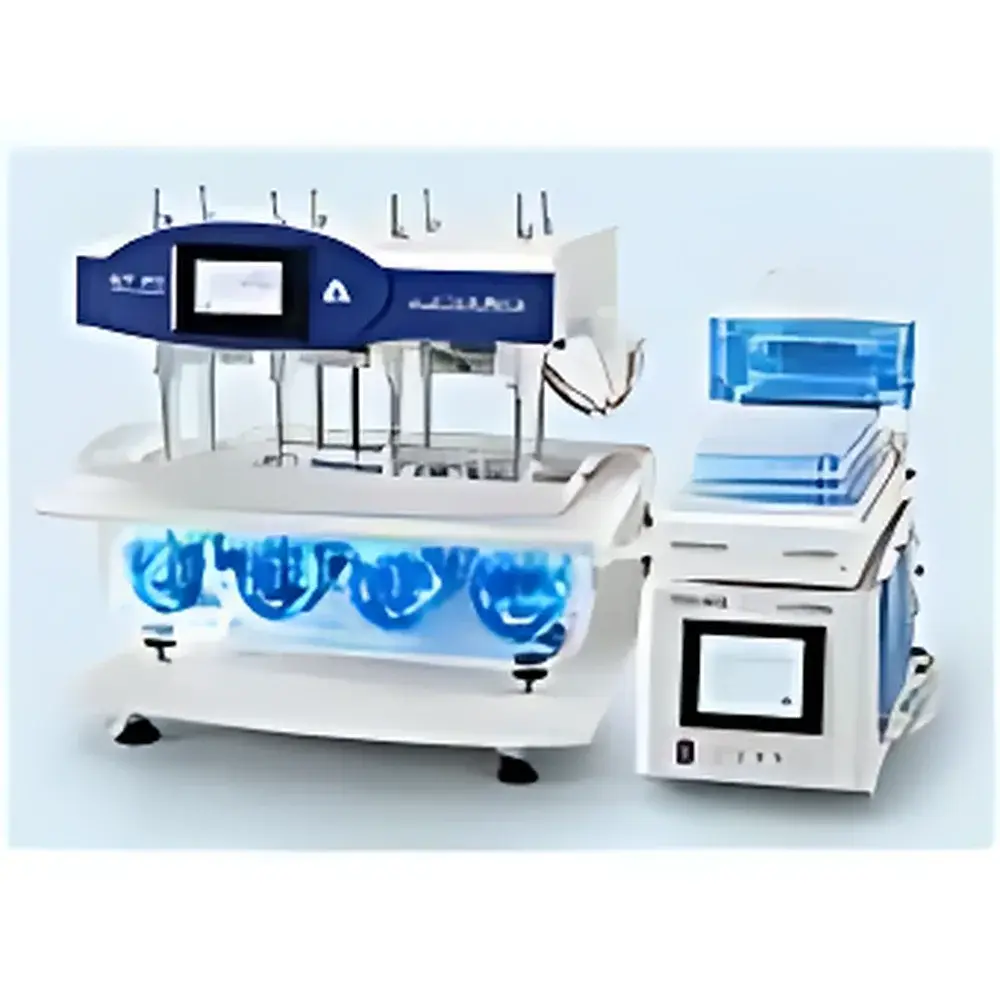
LOGAN SYSTEM 850DL 8-Position Automated Dissolution Sampling System
| Brand | LOGAN |
|---|---|
| Origin | USA |
| Model | SYSTEM 850DL |
| Instrument Type | Online Dissolution Tester |
| Number of Vessels | 8 |
| Temperature Range | 20–60°C |
| Temperature Accuracy | ±0.1°C |
| Rotation Speed Range | 25–250 rpm (±1 rpm) |
| Paddle Wobble | ≤0.5 mm |
| Basket Wobble | ≤1.0 mm |
| Water Bath Temperature Range | Ambient to 45°C |
| Water Bath Temperature Resolution | 0.1°C |
| Water Bath Volume | 18 L |
Overview
The LOGAN SYSTEM 850DL is an online, fully automated 8-position dissolution testing and sampling system engineered for regulatory-compliant pharmaceutical development and quality control. It operates on the principles of USP Apparatus 1 (basket), Apparatus 2 (paddle), and extended configurations including mini-vessel, flow-through cell, paddle-over-disk, and rotating cylinder methods—enabling comprehensive method development and bioequivalence (BE) support. The system integrates precise mechanical actuation, real-time temperature monitoring, and closed-loop fluid handling to ensure thermodynamic stability and hydrodynamic consistency across all eight dissolution vessels. Designed in accordance with ICH Q5A, Q5C, and USP , it supports both immediate-release and modified-release dosage forms—including tablets, capsules, suspensions, transdermal patches, and hydrogels—under controlled, auditable conditions.
Key Features
- Modular architecture comprising UDT-812A dissolution station, SCR-DL sample collector, SYP-8L 10-mL syringe pump, and DSC-800 central controller—ensuring scalability and serviceability
- Dual-stage filtration integrated into each sampling line to remove particulates and prevent HPLC/UV flow-cell clogging
- High-precision syringe pump with ±1% volumetric accuracy and programmable aspiration/dispense cycles for reproducible sample withdrawal (e.g., 1–10 mL per timepoint)
- Independent temperature monitoring via eight embedded Pt100 probes—one per vessel—with real-time display and deviation logging
- Hermetic dual-lid configuration for each dissolution cup, minimizing solvent evaporation and maintaining sink condition integrity over extended runs (up to 24 h)
- Automated media replenishment (re-fill) and sample reconstitution functions to preserve volume constancy and concentration fidelity
- FDA 21 CFR Part 11–compliant audit trail with electronic signatures, time-stamped event logs, and tamper-evident data storage
Sample Compatibility & Compliance
The SYSTEM 850DL accommodates solid oral and transdermal dosage forms per USP , , and . Its mechanical design meets ASTM E2503-22 specifications for rotational stability (paddle wobble ≤0.5 mm; basket wobble ≤1.0 mm) and thermal uniformity (±0.1°C vessel-to-vessel deviation at setpoint). All wetted components are constructed from USP Class VI-certified materials (e.g., PTFE, borosilicate glass, 316L stainless steel) to prevent leachables and adsorption artifacts. The system supports GLP/GMP environments through role-based access control (three-tier permission structure), electronic record retention, and exportable CSV/Excel reports compliant with Annex 11 and ALCOA+ data integrity principles.
Software & Data Management
DSC-800 Control Software provides intuitive protocol authoring, real-time graphical monitoring (temperature, rotation, sampling timeline), and automated report generation. It supports method validation workflows including precision (RSD ≤2% across replicates), accuracy (spike recovery ≥98%), and robustness (parameter sensitivity analysis). Raw data—including timestamps, sensor readings, pump actuation events, and user actions—are stored in encrypted SQLite databases with SHA-256 hashing. Remote supervision is enabled via secure HTTPS API integration, allowing authenticated access through mobile applications without compromising network segmentation requirements. Data exports meet FDA eCTD Module 5 submission standards and are compatible with LIMS and CDS platforms (e.g., Waters Empower, Agilent OpenLab).
Applications
- Comparative dissolution profiling for generic–reference listed drug (RLD) equivalence assessment under FDA’s SUPAC-IR/MD guidance
- Early-stage formulation screening using multi-speed zoning—enabling independent RPM control per vessel group for accelerated DoE studies
- Integrated dissolution–permeation modeling via coupling with Franz diffusion cells or PAMPA systems to predict in vivo absorption kinetics
- Real-time UV/HPLC/FTIR analysis via direct tubing interface to spectrophotometers or autosamplers—eliminating manual transfer errors
- Extended-release characterization using sequential sampling protocols with adaptive timepoint scheduling based on % dissolved thresholds
- Photographic documentation of tablet erosion and disintegration dynamics via optional high-resolution camera module synchronized with sampling triggers
FAQ
Does the SYSTEM 850DL comply with FDA 21 CFR Part 11 requirements?
Yes. It includes electronic signature enforcement, audit trail logging, and role-based authentication—all validated per Part 11 Annex A and aligned with ISPE GAMP 5 Category 3 software classification.
Can the system perform mini-vessel (Apparatus 7) or flow-through cell (Apparatus 4) testing?
Yes. With appropriate accessory kits (sold separately), the platform supports USP Apparatus 4, 6, and 7 configurations without hardware modification.
Is remote monitoring supported out-of-the-box?
Yes. The DSC-800 software includes a RESTful API and mobile-responsive web interface for secure off-site oversight, subject to customer IT security policy approval.
What is the maximum allowable run duration for unattended operation?
The system supports continuous operation up to 96 hours with scheduled maintenance intervals, contingent upon proper bath fluid level management and ambient temperature control (15–30°C recommended).
How is temperature uniformity verified across all eight vessels?
Each vessel is equipped with a calibrated Pt100 probe; system validation includes IQ/OQ protocols demonstrating ≤±0.1°C deviation at 37°C across all positions per USP verification criteria.




