
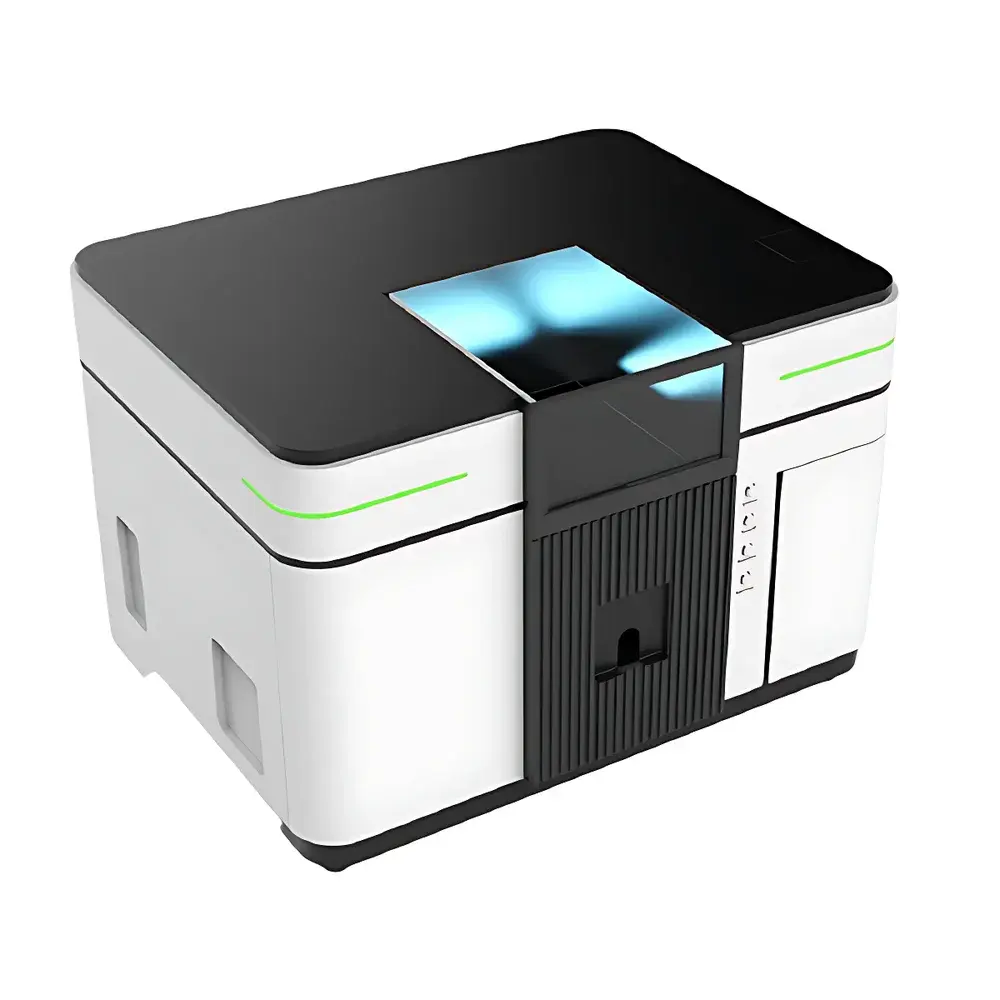
Luban Instruments LAS-220A Flame Atomic Absorption Spectrometer
| Brand | Yoke |
|---|---|
| Origin | Shanghai, China |
| Manufacturer Type | Direct Manufacturer |
| Instrument Type | Flame AAS |
| Monochromator | Plane Grating (1800 lines/mm, blazed at 250 nm) |
| Optical System | Double-Beam |
| Detector | Photomultiplier Tube (PMT) |
| Background Correction | D₂ Lamp + Self-Absorption Method |
| Wavelength Range | 185–900 nm |
| Spectral Bandwidths | 0.1, 0.2, 0.4, 0.7, 1.4, 2.0 nm (6-step automatic switching) |
| Lamp Positions | 8 |
| Optical Platform | 20-mm-thick monolithic aluminum vibration-isolated mount |
| Atomizer | Titanium combustion system with motorized vertical positioning |
Overview
The Luban Instruments LAS-220A Flame Atomic Absorption Spectrometer (FAAS) is a precision analytical instrument engineered for quantitative elemental analysis in the low- to mid-ppb concentration range. It operates on the fundamental principle of atomic absorption spectroscopy: ground-state free atoms in a flame absorb light at element-specific wavelengths emitted by hollow cathode lamps (HCLs). The LAS-220A employs a double-beam optical architecture to compensate for source intensity drift and lamp aging, ensuring high photometric stability and long-term baseline reproducibility. Its Czerny-Turner monochromator—equipped with an 1800-line/mm plane diffraction grating blazed at 250 nm—delivers high spectral resolution and stray-light rejection across the full operational range (185–900 nm). The instrument’s rigid, 20-mm-thick monolithic aluminum optical platform functions as a passive vibration-damping structure, minimizing mechanical drift induced by ambient thermal fluctuations or floorborne vibrations—a critical design feature for laboratories lacking dedicated optical tables.
Key Features
- Intelligent gas control module with real-time pressure monitoring, flow regulation, and interlock safety protocols compliant with EN 61010-1 for laboratory equipment.
- Automated wavelength scanning and peak search algorithm that locates optimal absorption maxima via derivative-based peak detection, eliminating manual wavelength alignment.
- Dual-mode background correction: simultaneous use of deuterium arc lamp (D₂) for broadband correction and self-absorption (SA) method for narrowband interference—enabling accurate quantification in complex matrices containing molecular absorption or scattering species.
- Eight-position lamp turret with auto-recall functionality: stores and applies pre-optimized lamp current, slit width, and detector high-voltage settings per element, reducing method setup time and operator variability.
- Motorized atomizer lift mechanism with position memory: enables precise, repeatable burner head height adjustment to maximize analyte atomization efficiency and signal-to-noise ratio for each element.
- Titanium-based combustion system: corrosion-resistant, thermally stable construction ensures rapid thermal equilibration, consistent flame geometry, and extended service life under continuous operation with aggressive acid matrices.
Sample Compatibility & Compliance
The LAS-220A is optimized for aqueous liquid samples introduced via pneumatic nebulization into an air-acetylene or nitrous oxide-acetylene flame. It supports standard EPA Methods 7000B, ASTM D1688, ISO 11171, and USP for heavy metal testing in environmental, pharmaceutical, food, and industrial raw material applications. All firmware and hardware configurations adhere to IEC 61326-1 (EMC for laboratory equipment) and include audit trail capabilities aligned with GLP and GMP documentation requirements. While not 21 CFR Part 11–certified out-of-the-box, the system’s data logging architecture supports third-party validation for regulated environments when deployed with compliant LIMS integration.
Software & Data Management
The instrument is controlled via Windows-based acquisition software featuring intuitive method wizards, multi-element sequence programming, and real-time spectral display. Raw absorbance data are stored in vendor-neutral CSV and ASCII formats; calibration curves support linear, quadratic, and weighted least-squares regression models. Built-in QC tools include bracketing standards, duplicate sample analysis, and drift correction using internal reference channels. Audit logs record all parameter changes, calibration events, and user logins with timestamps—enabling traceability required under ISO/IEC 17025:2017 Clause 7.7.
Applications
- Environmental monitoring: determination of Pb, Cd, Cu, Zn, Ni, and Cr in wastewater, soil digests, and drinking water per EPA regulatory limits.
- Pharmaceutical quality control: residual catalyst metal analysis (e.g., Pd, Pt, Rh) in active pharmaceutical ingredients (APIs) per ICH Q2(R2) guidelines.
- Food safety testing: quantification of toxic elements (As, Hg, Cd) in infant formula, seafood, and fortified cereals against EU Commission Regulation (EC) No 1881/2006.
- Geological and metallurgical analysis: base metal assays in ore concentrates and leachates using flame AAS as a cost-effective alternative to ICP-OES for single-element workflows.
- Academic research: teaching laboratories utilize the LAS-220A for hands-on instruction in atomic spectroscopy fundamentals, calibration theory, and matrix interference evaluation.
FAQ
What flame gases are supported by the LAS-220A?
The system is configured for air-acetylene combustion by default and can be upgraded to support nitrous oxide-acetylene for refractory elements (e.g., Al, Si, V) upon installation of a high-temperature burner head and appropriate gas manifold.
Is the instrument compatible with hydride generation or graphite furnace accessories?
No—the LAS-220A is a dedicated flame AAS platform. It does not support external atomization modules; those capabilities are available in the LAS-320 series.
How is background correction validated during routine operation?
The software includes a built-in D₂ lamp intensity verification routine and SA correction efficiency test using certified reference materials with known background interference profiles (e.g., NIST SRM 1643e).
Can method parameters be exported for cross-instrument transfer?
Yes—method files (.lsm) contain all instrument settings and are portable between LAS-220A units running identical firmware versions.
What maintenance intervals are recommended for the optical system?
Optical alignment verification is advised every 6 months or after relocation; grating cleaning is performed only if visible contamination is confirmed via spectral baseline inspection—not on a fixed schedule.
Related Products




