
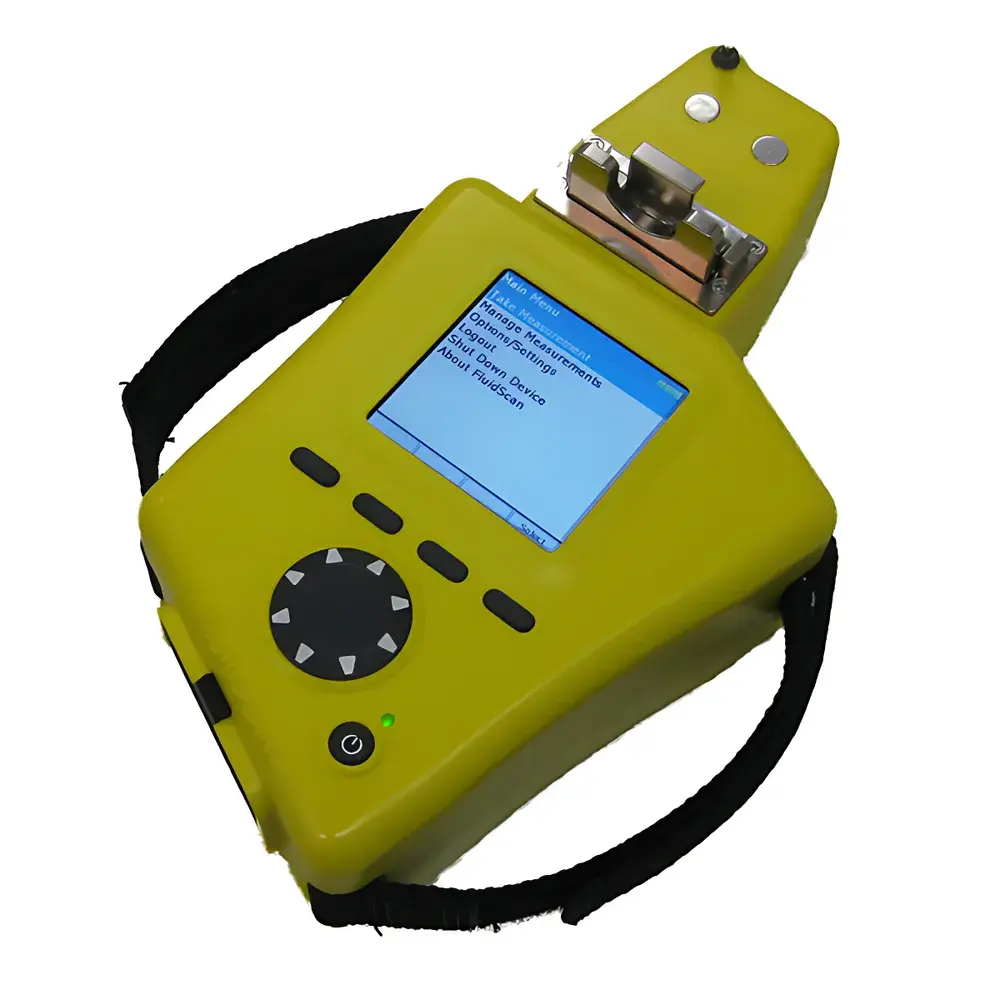
Spectro Scientific FluidScan 1000 Portable Oil Condition Analyzer
| Brand | Spectro Scientific |
|---|---|
| Origin | USA |
| Manufacturer Type | Original Equipment Manufacturer (OEM) |
| Product Origin | Imported |
| Model | FluidScan 1000 |
| Pricing | Available Upon Request |
Overview
The Spectro Scientific FluidScan 1000 Portable Oil Condition Analyzer is a field-deployable, Fourier Transform Infrared (FTIR) spectrometer engineered for quantitative in-situ analysis of lubricating oils and related hydrocarbon-based fluids. Operating on the principle of mid-infrared absorption spectroscopy, the instrument measures molecular vibrational signatures to determine key chemical and physical degradation indicators—including oxidation, nitration, sulfation, water contamination, acid number (TAN), base number (TBN), glycol presence, soot loading, and fuel dilution—without sample dilution or solvent preparation. Designed for integration into predictive maintenance programs, the FluidScan 1000 delivers laboratory-grade analytical performance in a ruggedized handheld platform compliant with ASTM D7889 (“Standard Test Method for Field Determination of Used Lubricant Properties Using Portable Infrared Spectrometers”). Its optical architecture employs a fixed-path, thermally stabilized interferometer with a high-sensitivity DTGS detector, ensuring high reproducibility across variable environmental conditions typical of industrial field use.
Key Features
- Single-drop sample requirement (≤50 µL) with analysis completed in under 60 seconds
- No consumables, solvents, or calibration standards required for routine operation
- Integrated spectral library containing reference data for over 500 commercial lubricants—including mineral, synthetic, aviation, turbine, gear, hydraulic, and engine oils—as well as biofuels and heat transfer fluids
- User-expandable oil database supporting custom fluid profiles and OEM-specific formulations
- On-device color-coded status alerts (green/yellow/red) based on configurable thresholds for each parameter
- Embedded microprocessor with real-time chemometric modeling using partial least squares (PLS) regression validated against reference laboratory methods
- IP65-rated enclosure with shock-absorbing rubber armor and MIL-STD-810G certified durability for plant-floor and remote site deployment
Sample Compatibility & Compliance
The FluidScan 1000 supports quantitative analysis across diverse fluid categories including but not limited to: mineral and synthetic crankcase oils, turbine oils (MIL-PRF-23699, MIL-PRF-2304), phosphate ester fire-resistant hydraulic fluids, aviation hydraulic fluids (MIL-H-5606, MIL-H-83282), compressor oils, gear oils, heat transfer oils, biodiesel feedstocks, and finished biofuels (B100, B20). All reported parameters—including water (ppm), TAN (mg KOH/g), TBN (mg KOH/g), oxidation (Abs/0.1 mm), nitration (Abs/mm²), sulfation (Abs/mm²), soot (%), glycol (%), ethanol (%), FAME (%), and free fatty acids (FFA %)—are traceable to ASTM E1655 (standard practice for infrared multivariate quantitative analysis) and demonstrate repeatability equivalent to ASTM E2412 (standard test method for FTIR analysis of used lubricants). The system meets requirements for NESHAP RICE compliance when deployed alongside MiniVisc 3050 viscosity data for extended drain interval justification.
Software & Data Management
The FluidScan 1000 operates with Spectro’s proprietary OilView™ software suite, enabling full traceability and audit-ready documentation per GLP/GMP and FDA 21 CFR Part 11 requirements. Features include automated report generation (PDF/CSV), time-stamped measurement logs with operator ID tagging, encrypted local storage (16 GB internal flash), wireless synchronization via Bluetooth or Wi-Fi to centralized CMMS/EAM platforms, and hierarchical asset management with customizable equipment hierarchies. Data export supports LIMS integration through ASTM WK57812-compliant XML schema. Firmware updates are delivered via secure HTTPS and digitally signed to ensure integrity.
Applications
- Predictive maintenance of critical rotating equipment: gas turbines, steam turbines, reciprocating engines, compressors, and gearboxes
- Condition-based oil change scheduling for backup generators and mission-critical power systems
- Contamination monitoring in hydraulic systems serving aerospace, marine, and heavy construction machinery
- Quality assurance of incoming lubricants and verification of oil replenishment integrity
- Field validation of oil reclamation and recycling processes
- Supporting ISO 4406 particulate cleanliness reporting when paired with particle counters
- Regulatory compliance documentation for EPA, OSHA, and insurance risk mitigation audits
FAQ
Does the FluidScan 1000 require annual recalibration?
No. The instrument uses a self-referencing optical design with an internal reference beam and temperature-compensated interferometer; calibration is maintained through factory-validated spectral models and does not require user-performed hardware recalibration.
Can it analyze used diesel engine oil contaminated with coolant?
Yes. Glycol detection sensitivity is ≤100 ppm, and the algorithm discriminates between ethylene glycol and propylene glycol while correcting for water interference via multivariate deconvolution.
Is the device compatible with third-party CMMS platforms such as SAP PM or IBM Maximo?
Yes. Through OilView™’s API-enabled data export and configurable CSV/XML templates, integration with enterprise asset management systems is supported without middleware.
What is the measurement uncertainty for TAN in engine oils?
When operated within specified ambient temperature (10–40°C) and humidity (<80% RH non-condensing) ranges, the expanded uncertainty (k=2) for TAN is ±0.15 mg KOH/g relative to ASTM D664 reference values.
How is data security ensured during wireless transmission?
All Bluetooth and Wi-Fi communications use TLS 1.2 encryption; stored measurement data is AES-256 encrypted at rest, and user access is controlled via role-based authentication with password complexity enforcement.






