
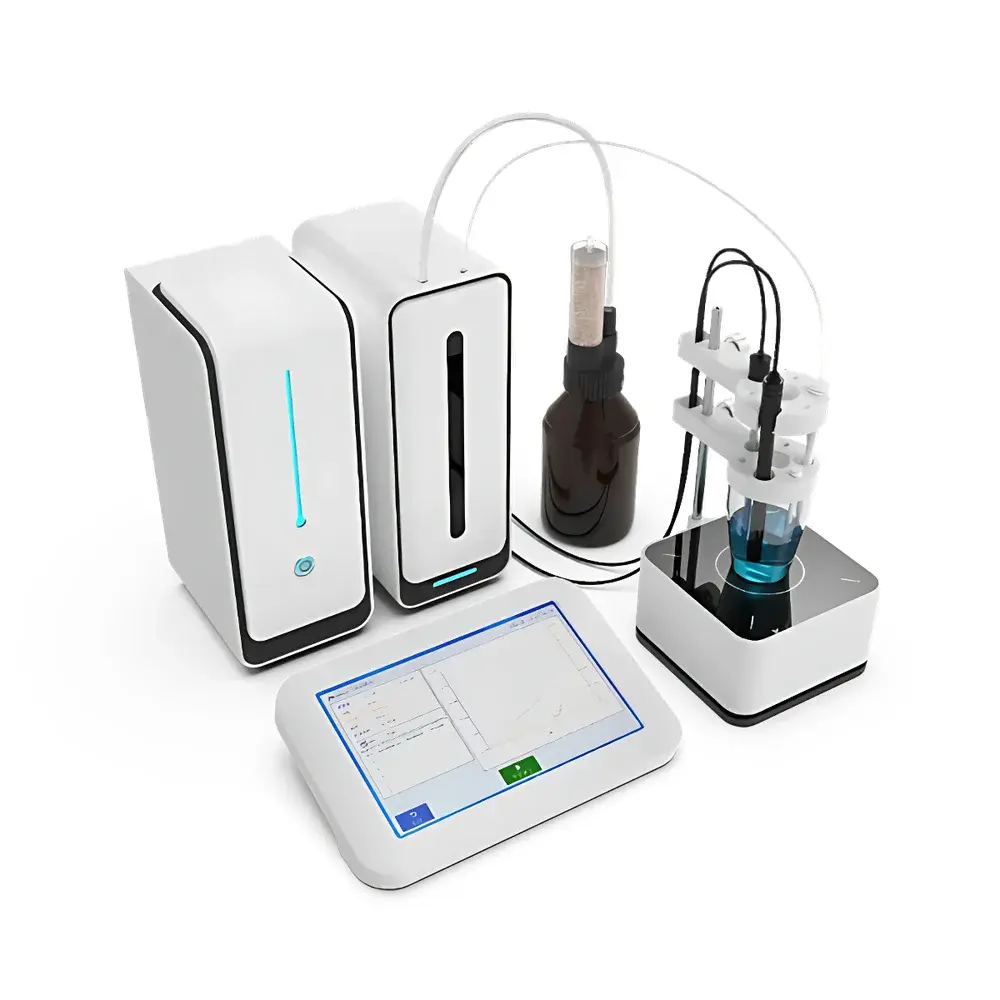
Yoke KM-10 Automatic Potentiometric Titrator
| Brand | Yoke |
|---|---|
| Origin | Shanghai, China |
| Manufacturer Type | Manufacturer |
| Regional Classification | Domestic (China) |
| Model | KM-10 |
| Instrument Type | General-purpose Potentiometric Titrator |
| Application Scope | Universal |
| pH Measurement Range | −2.00 to +16.00 pH |
| pH Meter Accuracy | ±0.01 pH |
| pH Resolution | 0.01 pH |
| Titration Potential Accuracy | ≤0.2 mV |
| Titration Resolution | 1/24000 |
Overview
The Yoke KM-10 Automatic Potentiometric Titrator is an engineered solution for high-reproducibility potentiometric titration in routine QC laboratories, academic research settings, and industrial quality control environments. Based on the fundamental principle of monitoring potential change across a reference–indicator electrode pair during controlled reagent addition, the KM-10 delivers precise endpoint detection via first-derivative (ΔE/ΔV) or second-derivative (Δ²E/ΔV²) algorithms, as well as fixed-endpoint and Gran plot methods. Its modular architecture separates the titration unit, electrode station, and control module—reducing electromagnetic coupling between high-current drive circuits and low-voltage analog signal paths. This physical decoupling enhances long-term stability and measurement fidelity, particularly in electromagnetically noisy production lab environments where multiple instruments operate concurrently.
Key Features
- Modular, decentralized design with independent shielded signal lines for each functional block—minimizing crosstalk and ensuring consistent baseline stability over extended operation cycles.
- 10-inch capacitive touchscreen with intuitive, menu-driven interface; real-time visualization of titration curves (E vs. V), derivative plots, method parameters, and raw/parsed results.
- Integrated precision burette featuring glass syringe pump actuation, linear flow control, and volumetric accuracy validated per ISO 8655-3 (volumetric piston burettes); repeatability <0.1% RSD at 1 mL delivery.
- Comprehensive self-diagnostic suite: automatic pH electrode calibration (1–3 point, NIST-traceable buffers), burette volume verification, and system integrity checks prior to method execution.
- Automated fluid handling: programmable multi-stage rinse (including post-titration line purge), solvent-compatible wetting cycles (≥3×), and auto-refill from auxiliary reservoirs—enabling unattended sequential analysis of up to 24 samples.
- Chemically inert fluid path constructed entirely from PTFE, ETFE, and borosilicate glass; compatible with 1 M HCl, 1 M NaOH, acetonitrile, methanol, and mixed aqueous–organic media without degradation.
Sample Compatibility & Compliance
The KM-10 supports aqueous, non-aqueous, and mixed-solvent titrations—including acid–base, redox, precipitation, and complexometric determinations. Electrode inputs accept standard BNC and DIN connectors, enabling use with pH, Ag/AgCl, Pt, and ion-selective electrodes (e.g., fluoride, chloride). The instrument complies with ISO/IEC 17025 documentation requirements for method validation and meets essential performance criteria outlined in ASTM E2087 (Standard Practice for Potentiometric Titration) and USP (Acid–Base Titrations). Audit trail functionality—including operator ID, timestamped method changes, result modifications, and electronic signature support—facilitates alignment with FDA 21 CFR Part 11 when paired with validated LIMS integration.
Software & Data Management
Embedded firmware enables full method scripting (pre-titration conditioning, dynamic step size adjustment, pause/resume logic) and stores ≥10,000 complete titration records locally. Data export options include CSV (for Excel/Origin), PDF reports (with embedded curve graphics and metadata), and direct USB transfer. All measurements are time-stamped with millisecond resolution and linked to calibration logs and environmental conditions (ambient temperature, humidity if external sensor connected). Raw potential and volume data are retained in native format to permit retrospective reprocessing using alternative endpoint algorithms—critical for GLP/GMP investigations requiring traceable data reanalysis.
Applications
- Pharmaceutical QC: assay of active pharmaceutical ingredients (APIs) via non-aqueous acidimetry (e.g., amine quantification in chloroform/methanol).
- Foods & Beverages: titratable acidity (TA) in fruit juices, free fatty acid (FFA) determination in edible oils per AOAC 943.01.
- Water & Wastewater: alkalinity profiling (HCO₃⁻/CO₃²⁻/OH⁻ speciation), chloride by Mohr or Volhard methods.
- Chemical Manufacturing: concentration verification of standardized titrants (e.g., 0.1 M NaOH, 0.05 M EDTA), catalyst residue analysis in polymer synthesis.
- Academic Research: kinetic studies involving slow-reacting systems where endpoint drift correction is applied post-acquisition.
FAQ
What electrode types are supported?
Standard pH, redox (Pt), silver (Ag), and ion-selective electrodes with BNC or DIN connectors.
Can the KM-10 perform back-titrations?
Yes—method editor supports reverse titration logic, including pre-dosed excess reagent addition and subsequent titration to endpoint.
Is remote monitoring or network connectivity available?
Local Ethernet port enables configuration via web browser; optional OPC UA server module supports integration into plant-wide SCADA or MES systems.
How is data integrity ensured during power interruption?
Non-volatile memory preserves all ongoing titration state data; recovery resumes from last stable volume increment upon reboot.
Does the system support GLP-compliant audit trails?
Yes—full electronic log records operator actions, calibration events, method versions, and result approvals with immutable timestamps.





