
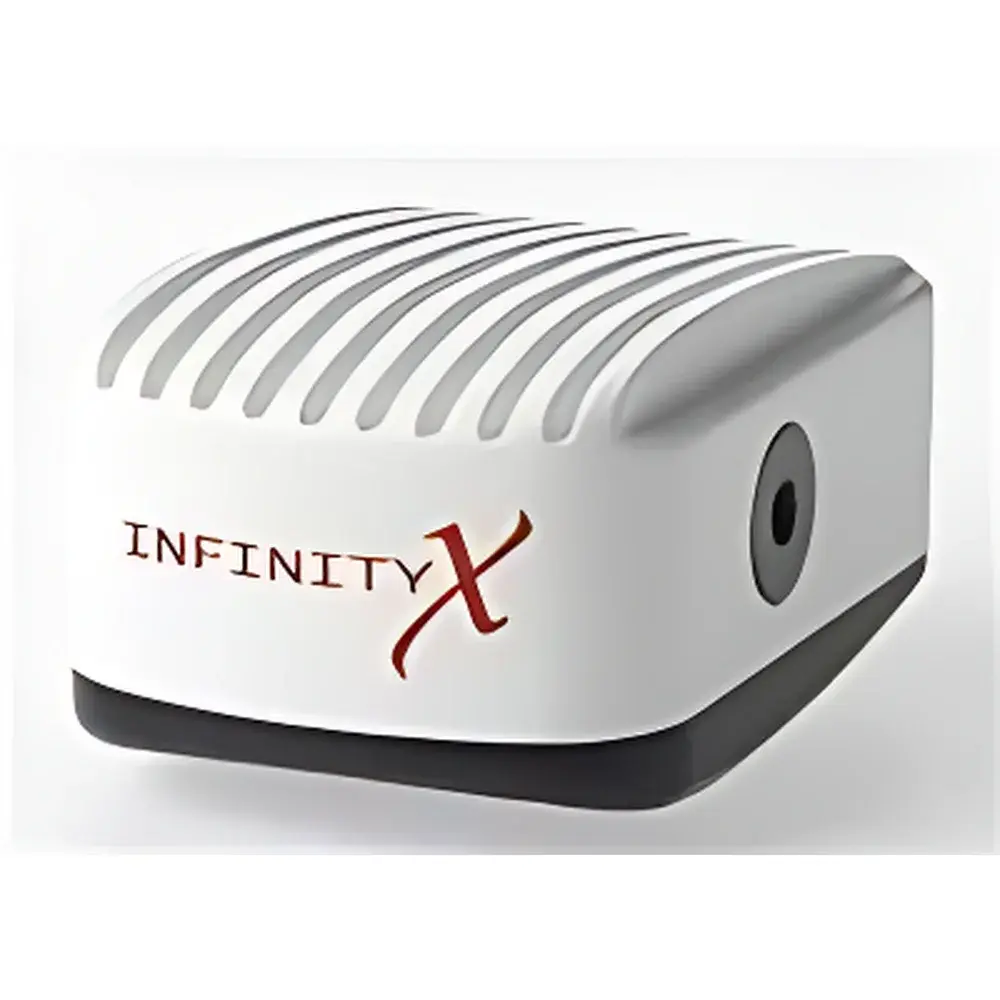
Lumenera INFINITY X Series Pixel-Shift High-Resolution USB 2.0 CCD Camera
| Brand | Lumenera |
|---|---|
| Origin | Canada |
| Model | INFINITY X-21 / INFINITY X-32 |
| Sensor Type | Monochrome or Color CCD |
| Sensor Size | 1/2" (X-21) / 1/8" (X-32) |
| Resolution | 21 MP (1280×1024) / 32 MP (1616×1216) |
| Pixel Size | 5.2 µm (X-21) / 4.4 µm (X-32) |
| Frame Rate | 15 fps @ full resolution (X-21), 12 fps @ full resolution (X-32) |
| Dynamic Range | >60 dB (X-21) / >66 dB (X-32) |
| Bit Depth | 8-bit / 10-bit |
| Interface | USB 2.0 |
| Compliance | RoHS, CE, FCC Class B |
Overview
The Lumenera INFINITY X Series represents a specialized class of high-resolution scientific imaging systems engineered for demanding static and quasi-static applications in life sciences, industrial metrology, and materials inspection. Unlike conventional rolling-shutter CMOS cameras, the INFINITY X leverages pixel-shift architecture—implemented via precise mechanical sub-pixel sensor translation synchronized with image acquisition—to synthetically enhance spatial sampling beyond native sensor limits. This technique effectively increases effective resolution while preserving photon collection efficiency and minimizing aliasing artifacts. The series utilizes progressive-scan interline-transfer CCD sensors, delivering global shutter behavior, low read noise, and high quantum efficiency across visible and near-visible wavelengths (350–1000 nm). Designed for integration into OEM instruments and laboratory-grade microscopes, the INFINITY X operates as a deterministic, low-latency imaging node compliant with USB 2.0 bandwidth constraints—enabling plug-and-play deployment without requiring frame grabbers or proprietary buses.
Key Features
- Precision pixel-shift imaging engine enabling synthetic resolution enhancement up to 2× native pixel count in both horizontal and vertical dimensions, validated under controlled illumination and calibration targets per ISO 12233:2017 Annex E.
- Dual-resolution variants: INFINITY X-21 (1280 × 1024, 21 MP effective output) and INFINITY X-32 (1616 × 1216, 32 MP effective output), each supporting both monochrome and color configurations with Bayer-pattern or monochrome sensor options.
- High dynamic range performance (>60 dB for X-21; >66 dB for X-32) achieved through correlated double sampling (CDS) and programmable gain control, ensuring quantitative linearity across exposure ranges from 100 µs to 10 s.
- USB 2.0 interface with isochronous transfer mode guarantees deterministic timing and zero packet loss under sustained full-frame capture—critical for GLP-compliant documentation workflows and time-series morphological analysis.
- Onboard FPGA-based preprocessing including flat-field correction, dark-frame subtraction, and real-time histogram equalization—configurable via Lumenera’s Software Development Kit (SDK) without host CPU overhead.
- Ruggedized aluminum housing rated IP40, thermally stabilized sensor mount, and locking USB-B connector suitable for integration into automated production inspection stations and regulated laboratory environments.
Sample Compatibility & Compliance
The INFINITY X Series supports standard C-mount and CS-mount optical interfaces, enabling direct coupling to compound microscopes, stereo macrosystems, and telecentric lenses used in PCB inspection, histopathology slide scanning, and semiconductor wafer metrology. Its 1/2″ (X-21) and 1/8″ (X-32) optical formats accommodate both high-magnification objectives and wide-field macro optics. All models comply with IEC 61000-6-2 (immunity) and IEC 61000-6-3 (emissions), carry CE marking for EMC and LVD directives, and conform to RoHS 2011/65/EU material restrictions. Firmware implements non-volatile calibration storage per sensor unit, supporting traceable intensity response curves required under ISO/IEC 17025-accredited imaging labs.
Software & Data Management
Lumenera’s INFINITY ANALYZE software provides full camera control, pixel-shift sequence orchestration, and batch-aligned image reconstruction—including MTF measurement, modulation transfer function mapping, and SNR profiling. The SDK supports Windows (x64), Linux (x86_64), and macOS (10.15+) with native C/C++, Python (v3.7+), and MATLAB bindings. All acquired images are saved in TIFF 6.0 format with embedded EXIF metadata (exposure time, gain, temperature, lens ID, pixel-shift offset vector). Audit trail functionality logs every parameter change with timestamp, user ID, and system hash—meeting FDA 21 CFR Part 11 requirements when deployed with validated electronic signature modules.
Applications
- High-fidelity digital pathology: Acquisition of whole-slide images at sub-micron detail for AI-assisted tumor margin detection and nuclear morphology quantification.
- Automated optical inspection (AOI): Defect detection on printed circuit boards, solar cells, and thin-film coatings using multi-angle pixel-shift composites to resolve sub-pixel edge discontinuities.
- Materials science: Grain boundary mapping in metallurgical samples, phase contrast imaging of polymer blends, and in-situ thermal expansion tracking during environmental chamber testing.
- Forensic document examination: Non-destructive spectral imaging of ink layer stratification and erased handwriting recovery using sequential RGB and monochrome acquisitions.
- OEM integration: Embedded vision subsystem in laser micromachining tools, coordinate measuring machines (CMMs), and automated cell sorters requiring calibrated, reproducible intensity data.
FAQ
Does the INFINITY X support hardware triggering for synchronized multi-camera setups?
Yes—TTL-compatible input and output trigger lines enable external synchronization with lasers, shutters, or motion stages, with jitter <1 µs (measured RMS).
Can pixel-shift sequences be customized for non-square patterns or arbitrary offsets?
Yes—the SDK exposes low-level shift register control, allowing user-defined displacement vectors and acquisition matrices for anisotropic super-resolution or custom moiré suppression protocols.
Is firmware update capability available in the field?
Yes—signed firmware updates are delivered via INFINITY ANALYZE; all updates preserve existing calibration coefficients and require no recalibration unless sensor replacement is performed.
What is the maximum sustained acquisition duration for time-lapse experiments?
Limited only by host storage I/O throughput; tested operation exceeds 72 hours continuous acquisition at 640×480@30 fps with lossless compression enabled and thermal drift <0.05 pixels/hour.
Are calibration certificates provided with each unit?
Each shipped camera includes a factory-generated calibration report documenting dark current uniformity, photoresponse non-uniformity (PRNU), and pixel-shift repeatability (σ < 0.02 pixels over 1000 cycles) traceable to NIST-traceable standards.





