
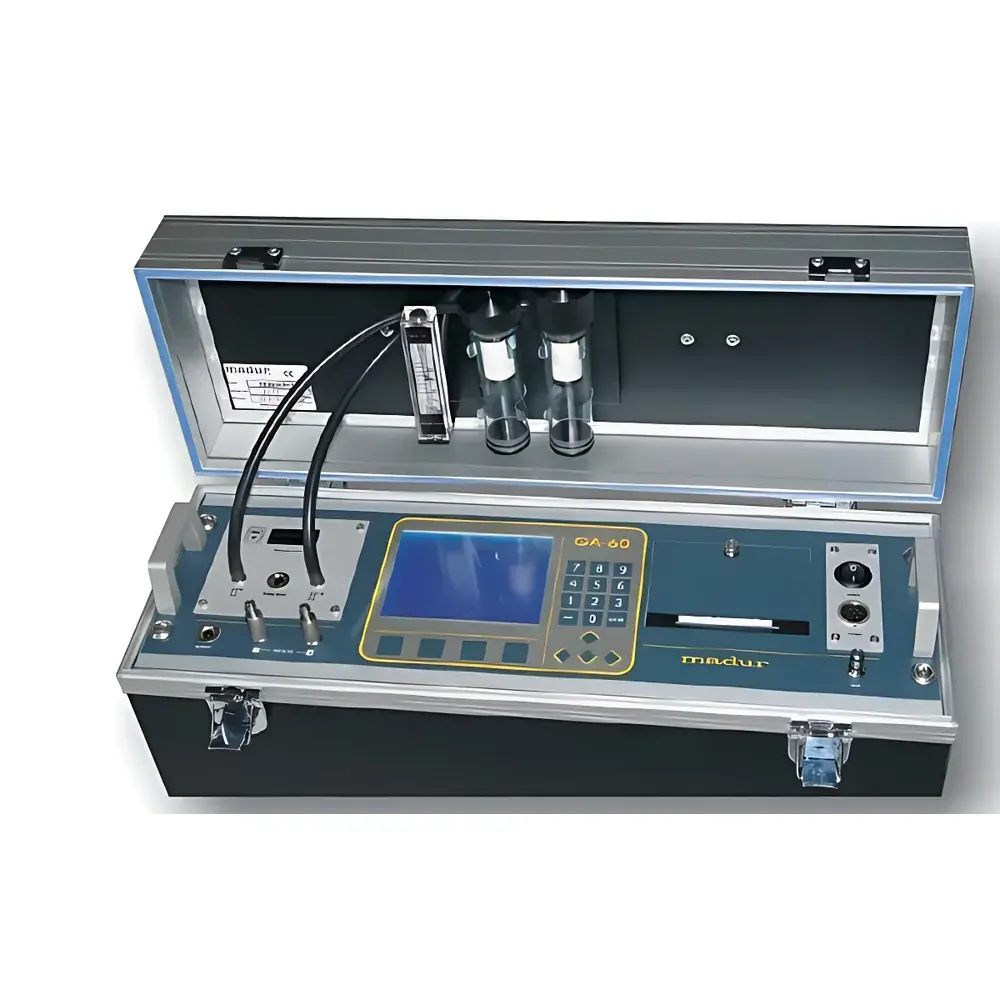
Madur GA-60 Flue Gas Analyzer
| Brand | Madur |
|---|---|
| Origin | Austria |
| Model | GA-60 |
| Instrument Type | Continuous Emission Monitoring System (CEMS) |
| Measurement Principle | Electrochemical & NDIR (Non-Dispersive Infrared) Sensor Technology |
| Accuracy (CO) | ±5 ppm |
| Repeatability | ≤2% |
| Response Time (T90) | 45 s |
| Stability | ≤5% |
| Gas Channels | 5 standard electrochemical sensors + up to 2 additional electrochemical + 3 NDIR sensors |
| Data Storage | 1 million records (256 MB) |
| Display | 320 × 240 pixel backlit LCD |
| Printer | Integrated 57 mm dot-matrix thermal printer |
| Power Supply | 12 V / 2.2 Ah rechargeable lead-acid battery (6 h operation) or 110–220 V AC adapter |
| Dimensions (L×H×W) | 500 × 410 × 180 mm |
| Weight | 9.5 kg |
| Operating Temperature | 10–50 °C |
| Storage Temperature | −20–55 °C |
| Humidity Range | 5–90% RH (non-condensing) |
| Pressure Resolution | 1 Pa (differential), 0.1 hPa (ambient, optional) |
| Temperature Inputs | 8 channels (4 thermocouples + 4 thermistors, optional) |
| Flow Control | Electronically regulated peristaltic pump (90 L/h nominal, 1.63 L/min sampling flow) |
| Sample Conditioning | Peltier-based gas dryer + heated probe (300 mm standard) + 5 µm/20 µm particulate filters |
Overview
The Madur GA-60 Flue Gas Analyzer is a modular, field-deployable continuous emission monitoring system engineered for precision combustion analysis and regulatory-compliant flue gas assessment in industrial boilers, cogeneration units, incinerators, and stationary combustion sources. It employs dual-sensor architecture—electrochemical cells for O₂, CO, NO, NO₂, SO₂ (and optionally H₂S, H₂), and non-dispersive infrared (NDIR) detectors for CO₂, CH₄, and N₂O—to deliver simultaneous, cross-interference-compensated measurements of up to 10 gaseous species. The analyzer operates on standardized combustion stoichiometry principles, calculating derived parameters—including Lambda (excess air ratio), combustion efficiency (η), flue gas toxicity index (CO/CO₂), and mass-normalized emissions (mg/Nm³)—in accordance with DIN 51603, OENORM M 7142, and ISO 12141. Its integrated Peltier dryer, heated sampling probe, and real-time drift compensation algorithms ensure stable performance under variable moisture, temperature, and particulate load conditions typical of stack environments.
Key Features
- Modular sensor architecture: Base configuration includes five electrochemical sensors; expandable to two additional electrochemical and three NDIR modules for customized gas coverage.
- Dual-path CO measurement channel: Isolated from other gas paths; auto-purges with ambient air upon programmable threshold exceedance without interrupting concurrent measurements.
- High-resolution environmental sensing: Differential pressure resolution of 1 Pa; ambient pressure resolution of 0.1 hPa (optional); eight configurable temperature inputs (four Type-K thermocouples + four Pt100 thermistors).
- Intelligent sample conditioning: Thermoelectric (Peltier) gas dryer with condensate separator; heated probe (300 mm standard, custom lengths available); 5 µm and 20 µm particulate filtration.
- Regulatory-grade data handling: Onboard averaging intervals (2–180 s); extended logging modes (10 s to 30 min intervals); full audit trail for all calibration events, parameter changes, and alarm states.
- Robust field interface: Backlit 320 × 240 pixel graphical LCD; integrated 57 mm dot-matrix printer with graphic capability; RS-232C serial interface for PC connectivity and remote configuration.
- Flexible analog I/O: Eight programmable voltage outputs (0–11 V, 12-bit) and eight current outputs (0–25 mA, 12-bit), assignable to any measured or calculated parameter for SCADA integration.
Sample Compatibility & Compliance
The GA-60 is validated for use with dry and wet flue gases containing particulates up to 90 Bacharach scale, with operating temperature ranges spanning −10 °C to 1000 °C (flue gas) and −10 °C to 100 °C (ambient). Its electrochemical and NDIR sensors meet EN 50104 (O₂), EN 45544-1 (toxic gases), and EN 15267-3 (performance certification for CEMS). The analyzer supports traceability per ISO/IEC 17025 when used with certified calibration gases (ISO 6141, ISO 6145), and its firmware implements automatic zero/span verification routines compliant with EPA Method 7E and VDI 3950. All stored data include timestamps, sensor status flags, and environmental metadata required for GLP/GMP documentation and EU IED (Industrial Emissions Directive) reporting.
Software & Data Management
Data acquisition and instrument configuration are managed via Madur’s proprietary Windows-based software, compatible with Windows 10/11 (64-bit). The application enables full remote control—including sensor calibration, alarm threshold definition, fuel database editing (10 preloaded DIN/OENORM fuel profiles + user-defined entries), and report generation in PDF/CSV/XLSX formats. All measurements support time-stamped, cryptographically signed storage with built-in audit trail functionality—meeting FDA 21 CFR Part 11 requirements for electronic records and signatures when configured with user authentication and session logging. The 256 MB internal memory retains up to one million complete measurement sets (all raw + calculated values), with automatic overwrite protection and USB export capability.
Applications
- Combustion optimization and efficiency auditing in biomass, natural gas, oil, and coal-fired systems.
- Periodic compliance testing for NOₓ, SO₂, CO, and CH₄ emissions per EU BREF documents and U.S. NSPS Subpart D/Da.
- Commissioning and troubleshooting of heat recovery steam generators (HRSGs) and thermal oxidizers.
- Research-grade flue gas characterization in academic and industrial R&D laboratories studying alternative fuels and low-carbon combustion.
- Continuous stack monitoring in waste-to-energy plants where multi-gas interference (e.g., NO₂/SO₂ cross-sensitivity) demands active compensation algorithms.
- Field validation of extractive CEMS installations using the GA-60 as a reference method per EN 14181 QAL2/QAL3 protocols.
FAQ
What gas species can the GA-60 measure natively, and which require optional modules?
The base unit measures O₂, CO, NO, NO₂, and SO₂ via electrochemical sensors. Optional NDIR modules enable CO₂ (0–25% or 0–100%), CH₄ (0–5% or 0–100%), and N₂O (0–2000 ppm). Additional electrochemical options include H₂S and H₂.
Does the GA-60 comply with EPA or EU regulatory standards for stack testing?
Yes—it satisfies EN 15267-3 for CEMS performance certification and is routinely deployed for QAL2/QAL3 validation under EN 14181. For U.S. applications, it aligns with EPA Method 7E (CO, NOₓ, SO₂), Method 3A (O₂), and Method 10 (CO) when operated per manufacturer-specified protocols.
How does the analyzer handle moisture and condensation during sampling?
It integrates a Peltier thermoelectric cooler capable of dew point suppression to 120 °C) and mechanical condensate trap—minimizing water vapor interference without chemical drying agents.
Can measurement data be exported to third-party SCADA or LIMS platforms?
Yes—via RS-232C ASCII protocol or programmable 0–11 V / 0–25 mA analog outputs. The software also supports OPC UA and Modbus RTU conversion through optional middleware drivers.
Is firmware update and calibration traceability supported?
Firmware updates are distributed via Madur’s secure customer portal with version-controlled release notes. Calibration certificates include NIST-traceable gas standards, uncertainty budgets, and operator identification—archived automatically in the audit log.
Related Products







