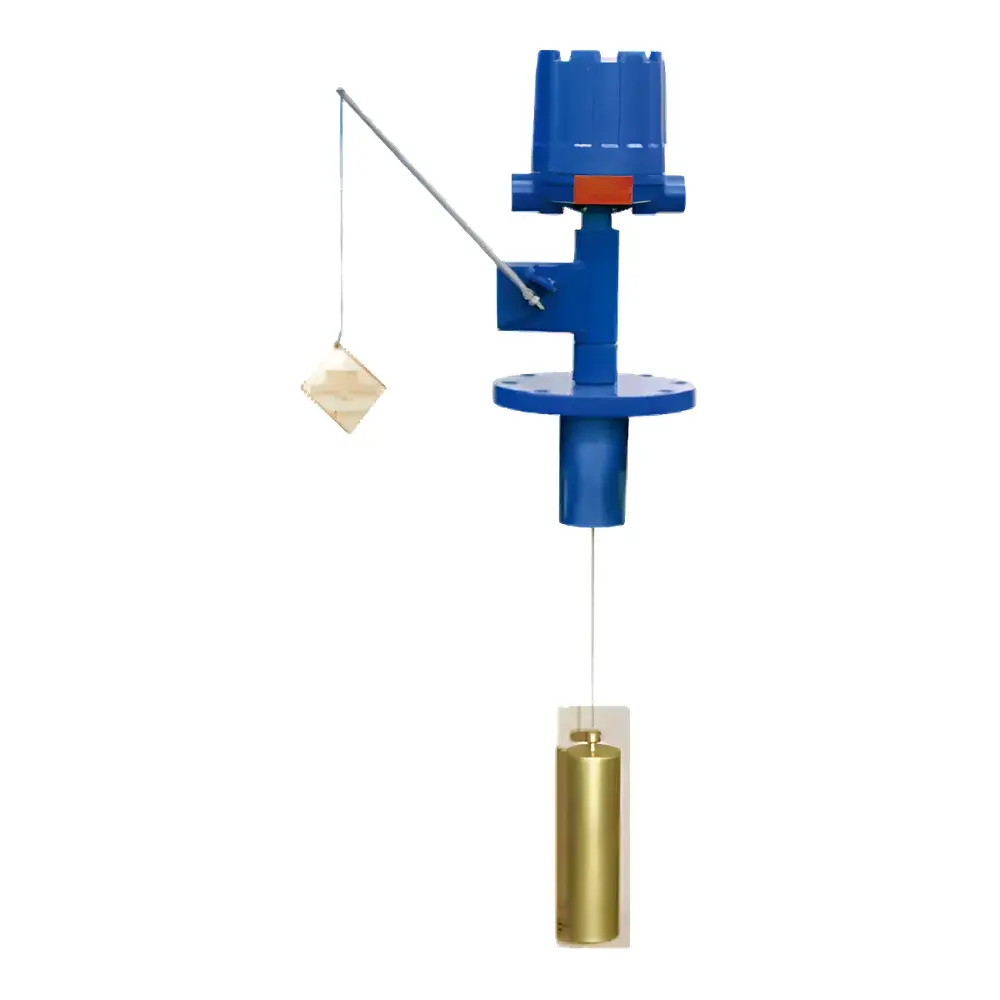
MAGNETROL Top Mount Buoyant Level Switch
| Brand | MAGNETROL |
|---|---|
| Model | Top Mount Buoyant Level Switch |
| Type | Mechanical Float-Level Switch |
| Operating Principle | Buoyancy-Based Displacement Sensing |
| Switch Levels | Single-, Dual-, or Triple-Point Alarm Output |
| Adjustable Deadband | Narrow or Wide (Field-Adjustable) |
| Specific Gravity Range | 0.40–2.40 |
| Construction Options | Stainless Steel 316, Hastelloy C-276, PVDF, PTFE-Lined Wetted Parts |
| Cable & Float Materials | Customizable per process compatibility |
| Mounting | Top-Mount Flanged or Threaded Entry |
| Output Options | SPDT, DPDT, or 3PDT Electromechanical Switches |
| Certifications | ATEX II 1/2 G Ex ia IIC T6 Ga, IECEx ia IIC T6 Ga, FM Class I, Div 1, Groups B, C, D, T6, SIL 2 per IEC 61508 |
Overview
The MAGNETROL Top Mount Buoyant Level Switch is a field-proven, mechanically actuated level detection device engineered for high-reliability point-level monitoring in demanding industrial process environments. It operates on the fundamental principle of buoyancy displacement: a precisely calibrated buoyant float—suspended vertically via a corrosion-resistant cable or rigid stem—rises or falls with liquid level changes. This motion actuates a hermetically sealed, explosion-proof microswitch housed within the top-mounted enclosure, delivering discrete ON/OFF signals for high-level, low-level, or intermediate alarm conditions. Designed for continuous duty in tanks, sumps, separators, and floating roof vessels, the switch delivers stable performance across turbulent, foaming, viscous, or suspended-solid-laden media—including wastewater, heavy crude oil, sludge, emulsions, and chemically aggressive process liquids. Its top-mount configuration eliminates side-wall penetration, reducing leakage risk and simplifying maintenance access without requiring tank shutdown.
Key Features
- Field-adjustable setpoint and deadband: Operators can fine-tune trip level and hysteresis directly at the instrument using calibrated thumbwheels or screwdrivers—no disassembly required.
- Multi-point capability: Configurable as single-, dual-, or triple-level switches to support cascade alarms, pump control logic, or safety interlocks.
- Material flexibility: Wetted components—including floats, cables, stems, and process connections—are available in 316 stainless steel, Hastelloy C-276, titanium, PVDF, and PTFE-lined variants to ensure chemical compatibility across pH 0–14, oxidizing, sulfidic, or halogen-rich services.
- Robust mechanical architecture: Sealed switch housing rated IP66/IP67/NEMA 4X; explosion-proof enclosures certified for Zone 0/1 (ATEX/IECEx/FM) and SIL 2 functional safety applications per IEC 61508.
- Customizable float geometry: Standard and extended-length floats accommodate liquid columns from 300 mm to over 6 m; optional tapered or weighted floats enhance stability in low-density or high-turbulence applications.
- Integrated verification option: Compatible with MAGNETROL’s Proof-er® test kit for in-situ functional validation of both float buoyancy and switch actuation—critical for regulatory audits under ISO 9001, API RP 554, or ISA-84 compliance frameworks.
Sample Compatibility & Compliance
This switch is validated for use with clean, abrasive, viscous, or aerated liquids exhibiting specific gravities between 0.40 and 2.40. It maintains repeatability ±1.5 mm under steady-state conditions and withstands sustained turbulence, wave action, and foam layers up to 150 mm thick without false triggering. It complies with international standards including IEC 60529 (IP rating), IEC 60079-0/-11 (intrinsic safety), and IEC 61508 (SIL 2 hardware fault tolerance). Documentation packages support FDA 21 CFR Part 11 traceability when paired with MAGNETROL’s certified calibration logs and MRO records—making it suitable for pharmaceutical, food & beverage, and regulated chemical manufacturing environments governed by GMP/GLP protocols.
Software & Data Management
As a purely electromechanical device, the Top Mount Buoyant Level Switch requires no embedded firmware, network interface, or configuration software. All operational parameters are set manually and remain stable without power or communication dependency—ensuring fail-safe operation during blackouts or control system failures. For integration into digital asset management systems (DAMS) or predictive maintenance platforms, optional analog transducer kits (e.g., 4–20 mA position feedback modules) are available as field-upgrade accessories. Calibration certificates, material test reports (MTRs), and hazardous area certification dossiers are provided in English and comply with ASME BPE, PED 2014/68/EU, and EN 10204 3.1 requirements.
Applications
- Wastewater treatment: High-level alarm in equalization basins, sludge thickeners, and grit chambers handling solids-laden effluent.
- Oil & gas production: Interface detection in three-phase separators; overflow protection in floating roof storage tanks containing crude, condensate, or produced water.
- Chemical processing: Solvent recovery sumps, caustic dosing tanks, and polymerization reactors where foam suppression or vapor space integrity is critical.
- Power generation: Condensate polishing skids, demineralizer sumps, and closed-loop cooling tower make-up reservoirs.
- Food & beverage: Syrup, molasses, or edible oil storage tanks where sanitary design and non-intrusive mounting are mandatory.
FAQ
Can this switch be used in pressurized vessels?
Yes—when equipped with ANSI/EN flanged top-mount housings rated up to Class 600 (PN100), it supports operating pressures up to 10 MPa (1450 psi) depending on material selection and temperature class.
Is calibration required after installation?
No routine recalibration is needed; however, initial setpoint verification using Proof-er® or equivalent traceable reference standard is recommended prior to commissioning per ISO/IEC 17025 guidelines.
What is the maximum allowable temperature range?
Standard models operate from –40 °C to +120 °C; high-temp variants with ceramic-insulated switches and Inconel components extend range to +200 °C.
Does it support HART or Foundation Fieldbus communication?
No—this is a discrete-level switch only. For smart analog output, consider MAGNETROL ECHOTRAC® ultrasonic or ECLIPSE® guided wave radar alternatives.
How often should mechanical inspection occur?
Per API RP 554 Section 5.4.3, visual and functional checks are recommended every 12 months—or per process severity assessment—in accordance with site-specific RBI (Risk-Based Inspection) programs.
Related Products