
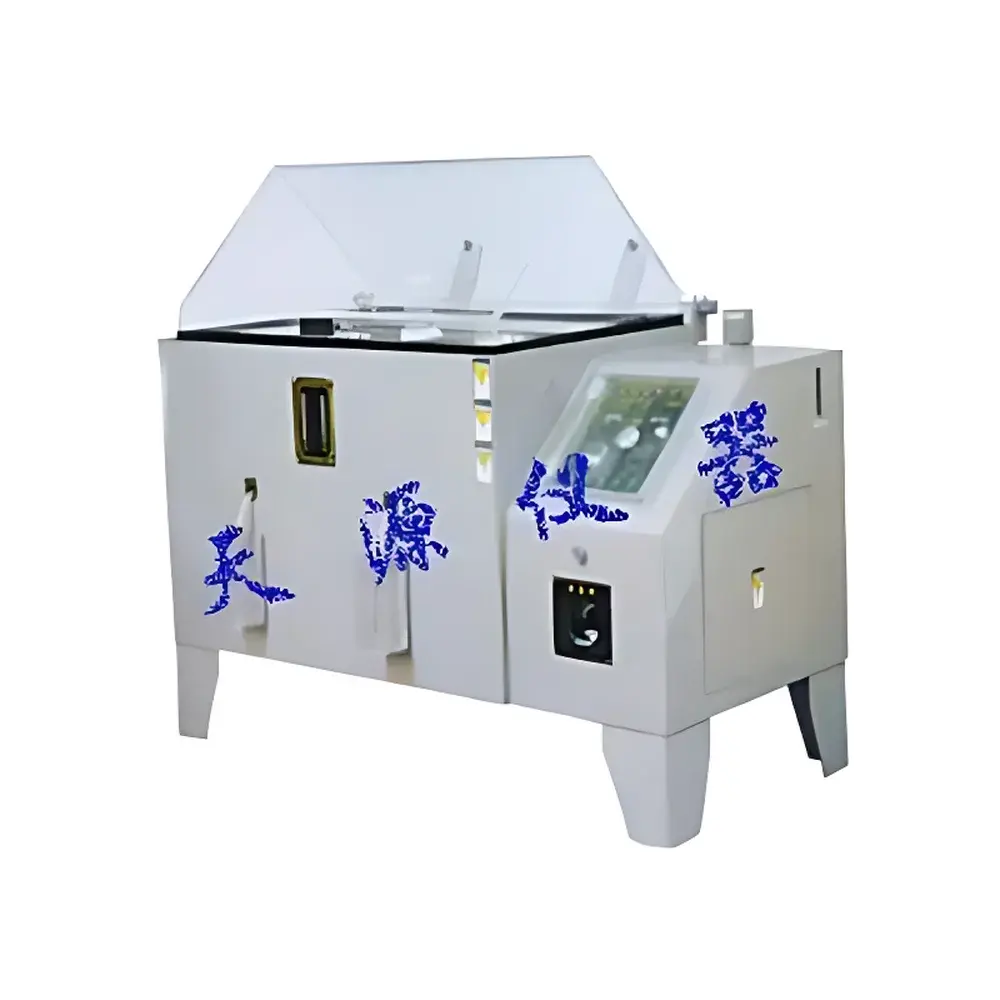
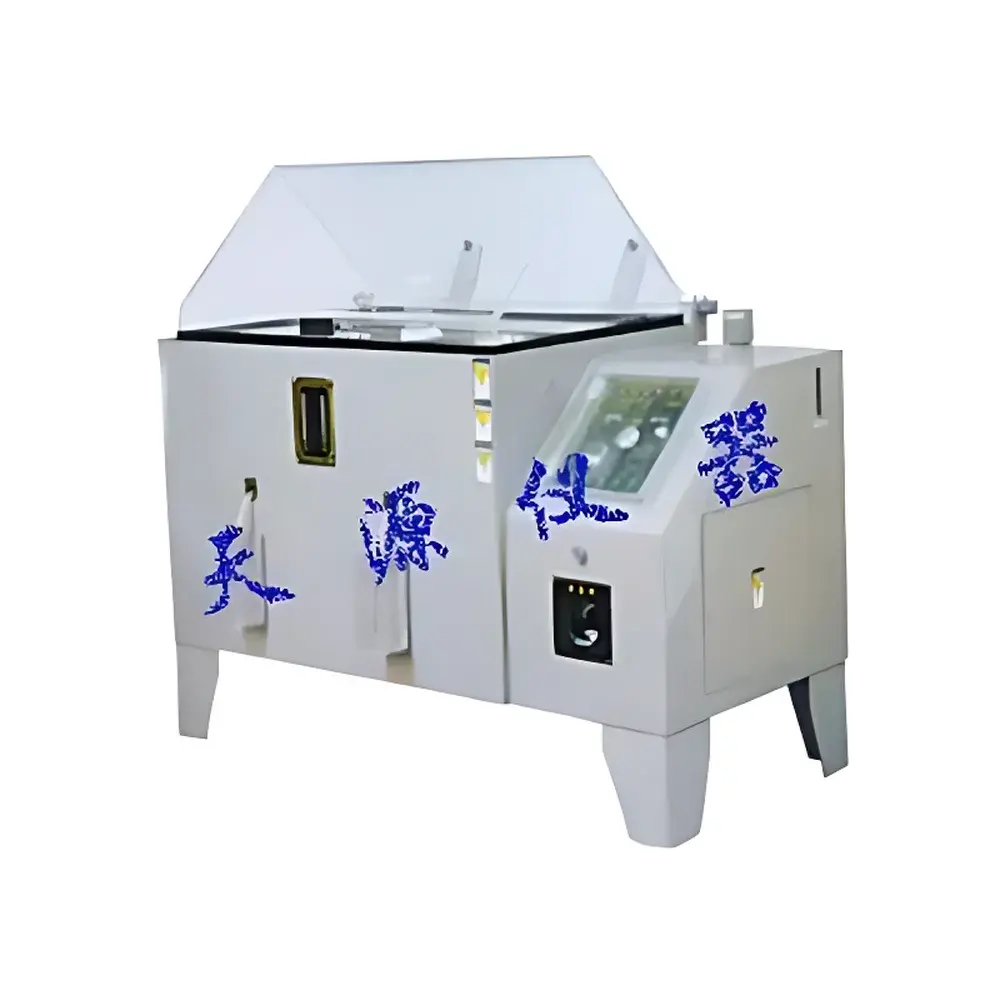
TianYuan SF-90(270L) Salt Spray Test Chamber
| Brand | TianYuan |
|---|---|
| Origin | Jiangsu, China |
| Manufacturer Type | Direct Manufacturer |
| Model | SF-90(270L) |
| Internal Chamber Dimensions (W×D×H) | 900×600×500 mm |
| External Dimensions (W×D×H) | 1415×885×1285 mm |
| Test Chamber Temperature | NSS/ACSS: 35±1°C |
| CASS | 50±1°C |
| Saturated Air Chamber Temperature | NSS/ACSS: 47±1°C |
| CASS | 63±1°C |
| Salt Solution Capacity | 25 L |
| Weight | 80 kg |
| Power Supply | 1-phase, AC 220 V, 20 A |
| Temperature Control Accuracy | ±0.1°C (PID digital control) |
| Spray Nozzle | Precision borosilicate glass nozzle (rated >6000 h crystallization-free operation) |
| Spray Distribution | Conical disperser with adjustable fog density and directional uniformity |
| Humidification Method | Henry’s Law-based saturated air chamber with electric heating |
| Safety Protection | Dual overtemperature cutoff with visual/audible alarm |
| Fog Containment | Water-sealed chamber door and integrated anti-fog viewing window |
| Timer Function | Digital programmable timer (hh:mm:ss resolution) |
| Heating Element | Corrosion-resistant titanium heating tubes (steam-direct heating) |
Overview
The TianYuan SF-90(270L) Salt Spray Test Chamber is a rigorously engineered environmental test system designed for accelerated corrosion evaluation of metallic coatings, electroplated surfaces, anodized aluminum, and protective organic finishes. It operates on the principle of controlled saline aerosol generation—using compressed air to atomize a precisely formulated sodium chloride (NaCl), acetic acid (for ASS/ACSS), or copper chloride (for CASS) solution into a stable, reproducible fog within a thermally regulated test chamber. The chamber conforms to internationally recognized corrosion testing standards including ASTM B117, ISO 9227, JIS Z2371, and GB/T 2423.17. Its 270-liter internal volume (900 × 600 × 500 mm) accommodates medium-to-large test specimens while maintaining strict spatial uniformity in temperature, humidity, and salt deposition rate—critical parameters for inter-laboratory comparability and regulatory acceptance.
Key Features
- Structural integrity ensured by high-gloss, UV-stabilized PVC panels reinforced with three-dimensional banding technology—providing long-term resistance to HCl, H₂SO₄, and NaCl vapor exposure without warping or delamination.
- Integrated front-panel control interface with intuitive digital PID temperature controller (±0.1°C accuracy), real-time chamber/saturation chamber temperature monitoring, and programmable spray cycling (continuous or intermittent modes per ISO 9227 Annex B).
- Dual independent overtemperature protection circuitry: primary thermal cutoff at 60°C and secondary mechanical fuse at 75°C—automatically de-energizing all heaters and triggering audible/visual alerts.
- High-reliability borosilicate glass spray nozzle, precision-machined to maintain consistent droplet size distribution (median diameter ~1–2 µm) and eliminate crystallization-induced clogging for ≥6000 operational hours.
- Saturated air chamber utilizes Henry’s Law-compliant humidification: compressed air is preheated and humidified to precise dew point conditions before entering the test chamber—ensuring stable relative humidity (≥95% RH) and eliminating condensation variability.
- Titanium-sheathed immersion heaters deliver rapid thermal response and exceptional resistance to chloride-induced pitting corrosion—reducing standby time and improving test cycle repeatability.
- Water-sealed chamber door gasket and integrated demisted observation window enable continuous visual inspection without compromising fog containment or operator safety.
Sample Compatibility & Compliance
The SF-90(270L) supports standardized specimen mounting per ASTM B117 and ISO 9227 requirements—including non-overlapping placement at 15°–30° angles from vertical, minimum 600 mm clearance from chamber walls, and unobstructed exposure to falling mist. It accommodates flat panels up to 500 mm × 600 mm, threaded fasteners, automotive trim components, and PCB-level metallizations. All internal wetted surfaces are inert to pH 3.0–3.2 (ACSS) and pH 3.1–3.3 (CASS) solutions. The system meets CE marking requirements for low-voltage equipment (2014/35/EU) and electromagnetic compatibility (2014/30/EU). Documentation includes factory calibration certificates traceable to NIM (China National Institute of Metrology) for temperature and timer functions.
Software & Data Management
While the SF-90(270L) features a standalone microprocessor-based controller with no embedded PC or network interface, it provides full audit-ready manual logging capability. All operational parameters—including start/stop timestamps, chamber and saturation temperatures, spray duration, and fault events—are recorded via front-panel LED display and retained in non-volatile memory for ≥100 test cycles. Optional RS-232 serial output enables connection to external data loggers or SCADA systems for automated recordkeeping compliant with GLP and GMP documentation practices. Calibration logs, maintenance history, and operator sign-offs can be maintained separately in accordance with ISO/IEC 17025 Clause 7.7.
Applications
This chamber is routinely deployed in quality assurance laboratories for evaluating coating adhesion (e.g., ASTM D3359), galvanic corrosion resistance of zinc-nickel alloys (ISO 2081), passivation efficacy of stainless steels (ASTM A967), and durability of automotive under-hood components per GMW14872. It supports R&D validation of conversion coatings (e.g., trivalent chromium vs. hexavalent alternatives), qualification of marine-grade fasteners (ISO 4042), and supplier conformance screening for aerospace hardware (AMS 2700). Its robust construction and repeatable fog delivery make it suitable for both routine QC testing and long-duration (≥1000 h) accelerated life studies.
FAQ
What standards does the SF-90(270L) comply with?
It is configured and validated for ASTM B117, ISO 9227 (NSS, ASS, CASS variants), JIS Z2371, and GB/T 2423.17. Calibration reports include temperature uniformity mapping per ISO 9227 Annex A.
Can the chamber operate in cyclic corrosion test (CCT) mode?
Yes—the programmable timer and independent control of spray, heating, and saturation functions allow user-defined sequences (e.g., 4 h salt spray / 4 h drying / 4 h humidity), though full CCT protocols require external sequencing logic.
How is salt solution concentration monitored and maintained?
Users manually prepare and verify solution conductivity or density prior to filling; the chamber includes a calibrated 25 L reservoir with level indicator and overflow drain. No in-line concentration sensor is integrated.
Is remote monitoring or Ethernet connectivity available?
No native Ethernet or Wi-Fi interface is provided. RS-232 output supports basic parameter readout and event logging when connected to third-party acquisition hardware.
What maintenance intervals are recommended for the glass nozzle and titanium heaters?
Nozzle inspection is advised every 500 h of cumulative spray time; titanium heaters require annual visual inspection for surface oxidation but have no scheduled replacement interval under normal operating conditions.
Related Products



